There is growing interest in China regarding President Yoon Suk-yeol's declaration of martial law and the impeachment political situation.
State-run media such as Xinhua News Agency and China Central Television (CCTV), as well as various Chinese-language media outlets, have been providing real-time coverage of related events since the 3rd, including President Yoon's declaration of martial law, the deployment of martial law troops to the National Assembly, the National Assembly's resolution to lift martial law, and the proposal of President Yoon's impeachment, offering various analyses.
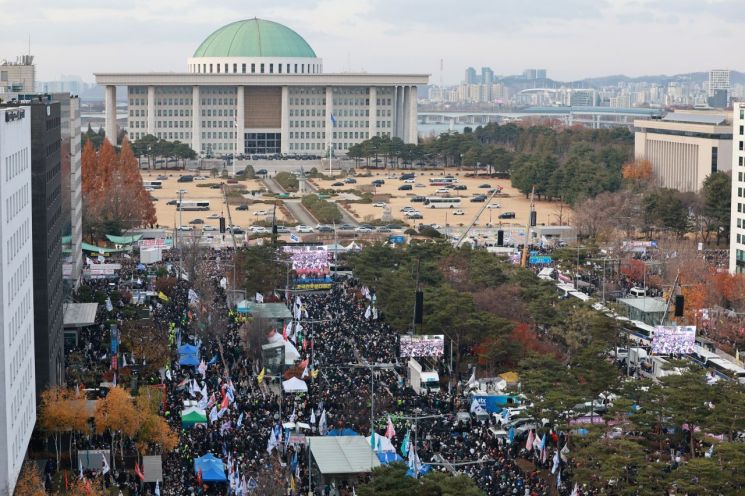 On the afternoon of the 7th, numerous citizens gathered in front of the National Assembly in Yeouido, Seoul, filling the surrounding roads during the "Treason Yoon Seok-yeol Resignation! Realization of People's Sovereignty! Great Social Reform! Nationwide Candlelight March." Photo by Yonhap News.
On the 7th, local media quickly reported on President Yoon's national address and the impeachment vote, covering the content of his remarks and the reactions of party leaders from both ruling and opposition parties.
They are particularly watching whether this will lead to a change in South Korea's political leadership and the potential impact on China-South Korea relations.
Chinese portals such as Baidu (百度) and Sina (新浪網, Sina.com), as well as social networking services (SNS) like Weibo (微博, the Chinese version of X) and WeChat (微信, the Chinese version of KakaoTalk), saw related search terms rise to the top, reflecting strong interest among Chinese people.
The Hong Kong South China Morning Post (SCMP) published an article titled "The Potential Impact of Leadership Change in South Korea on China," citing several experts who mentioned the possibility that if President Yoon is impeached, the ruling power could shift to the main opposition party, the Democratic Party, which might adopt a more conciliatory approach toward China.
SCMP reported that the Democratic Party and its leader Lee Jae-myung have been critical of President Yoon's foreign policy, which emphasized cooperation with the United States and Japan, and have called for a more restrained approach toward China.
Several experts predict that if the government changes, it is highly likely to pursue a more China-friendly policy and may take a different stance from the upcoming U.S. administration under Donald Trump, which has signaled a tough approach toward China.
Andrew Yeo, Korea Chair at the East Asia Policy Center of the Brookings Institution, a U.S. think tank, said, "There will be more efforts to engage with China," adding, "If the Trump administration is very tough on export, investment, security, and technology controls, South Korea may not follow suit."
On the other hand, there are also several opinions that there will be no significant change in South Korea's China policy going forward.
Ramon Pacheco Pardo, a professor of international relations at King's College London, said, "The heyday of China-South Korea relations is in the past. Future (South Korean) presidents may try to engage more with China, but the fundamentals will not change."
Stan Gerson, director at the Wilson Center, also predicted, "President Yoon was already trying to rebalance his foreign policy to place more emphasis on China," adding, "It is highly likely that any future administration (regardless of party) will continue to do so."
© The Asia Business Daily(www.asiae.co.kr). All rights reserved.












