The Final 'Plastic Reduction Negotiations' Held in Busan
Oil-Producing Countries Including Saudi Arabia Oppose "Regulation of Production Substances"
Proposal Revised and Mediation Offered, but Ultimately Failed
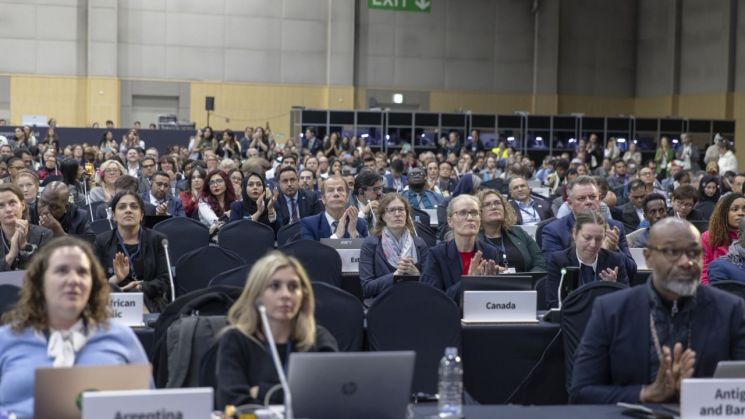 On the 1st, representatives from various countries attending the 5th Intergovernmental Negotiating Committee (INC-5) meeting for the international agreement on plastic pollution response. Photo by UNEP
International negotiations to reduce plastic finally collapsed. This was because oil-producing countries strongly opposed regulations on plastic production materials. Although it was decided to continue additional discussions, the consensus is that the possibility of agreement is slim. Strong criticism has been raised, especially from countries supporting regulation and environmental organizations, for failing to prevent plastic pollution.
On the 2nd, the 5th Intergovernmental Negotiating Committee (INC-5) for the international treaty to address plastic pollution concluded in Busan without reaching an agreement. The international community promised to create a treaty to tackle plastic pollution at the United Nations Environment Assembly (UNEA) in May 2022. Four rounds of negotiations have taken place over the past two years, and the Busan meeting, which began on the 25th of last month, was the final one. Originally scheduled to end on the 1st, discussions were extended until 3 a.m. due to the lack of a conclusion.
The decisive cause of failure was the difference in positions regarding the regulation of the plastic production material ‘polymer.’ Polymers are substances made using petroleum and serve as raw materials for plastics. Among the approximately 170 countries attending the meeting, about 100 countries supported directly reducing plastic production. In contrast, oil-producing countries such as Saudi Arabia, Iran, and Russia opposed this, arguing that plastic pollution arises from waste and that focus should be on management rather than production. Saudi Arabia, in particular, defined polymer regulation clauses as a ‘red line’ and maintained an absolute refusal to accept them.
As positions failed to narrow, Chair Luis Bayas Balvidieso proposed five drafts. The pre-negotiation report was 77 pages long with over 3,000 points of disagreement, and Chair Balvidieso proposed a so-called ‘informal document (non-paper)’ that significantly condensed these. However, the refusal of oil-producing countries to discuss production reduction delayed the meeting by nearly a day. As the possibility of the meeting’s collapse on the final day, the 1st, increased, the chair presented Option 1, which did not discuss plastic production reduction, and Option 2, which proposed various regulatory methods.
Five Proposals and South Korea’s Mediation Were Also Ineffective
However, the final proposal also met opposition. Countries supporting production reduction criticized the last draft for being excessively regressive. In particular, the inclusion of ‘primary plastics’ and ‘polymers’ in parentheses rather than as main discussion points drew strong criticism. Juan Carlos Monterrey Gomez, Panama’s chief representative, said, “We did not accept a weak treaty here and will never accept one in the future,” condemning the talks as a “moral failure.”
South Korea’s mediation also failed to have significant effect. On the 26th of last month, Environment Minister Kim Wan-seop held a dinner with chief representatives from Uruguay, France, Kenya, Canada, and other host country coalition members to present a mediation proposal. The proposal aimed to establish general standards and guidelines for regulations such as production reduction, maintaining legal binding force while allowing member countries to autonomously implement policies. Although it was a measure to break the deadlock in negotiations, it did not attract much attention.
The international community decided to continue negotiations by holding an additional negotiation meeting (INC-5.2) next year. The government stated, “We will actively participate in the upcoming additional negotiation meetings to take a leading role in advancing efforts to end plastic pollution.”
However, skeptical voices remain about whether negotiations will succeed next year. A representative from Green Korea United analyzed, “The issue of securing funding to implement the treaty’s contents was not resolved,” adding, “All 15 detailed clauses in the 5th proposal remain in parentheses.” They pointed out, “At this rate, it is difficult to expect a successful treaty formulation in the next meeting.”
Plastic production amounts to 460 million tons annually, 99% of which is made from fossil fuels. Plastic waste totals 350 million tons, half of which is buried in landfills. Since the 1950s, a total of 9 billion tons of plastic have been produced, but the recycling rate is only about 9%. If plastic reduction does not begin, related products are expected to triple by 2050.
© The Asia Business Daily(www.asiae.co.kr). All rights reserved.












