Airline Evaluation Results Announced
Among 10 Domestic Airlines, 5 Received A Grade for Domestic Routes, 2 for International Routes
Among 10 domestic airlines in the first half of this year, Air Seoul was found to have the lowest operational reliability. It received a C+ for domestic flights and a D++ for international flights. The other airlines had the next lowest grade of C+.
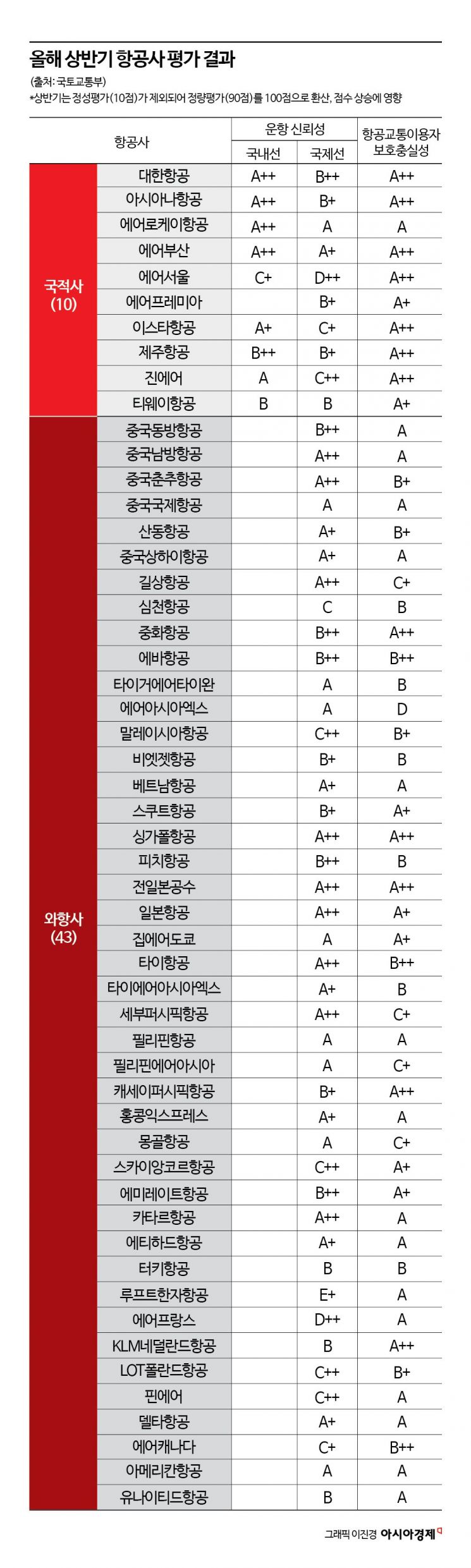
On the 26th, the Ministry of Land, Infrastructure and Transport announced the evaluation results of operational reliability and user protection diligence for 53 domestic and international airlines in the first half of this year. Among the 10 domestic airlines, five received an A grade or higher for domestic flights, and two for international flights. While the 10 domestic airlines showed good performance, some foreign airlines were found to need improvements in user protection and service.
This year, the Ministry disclosed the results semiannually for the first time to provide useful information for airline selection to air traffic users. The evaluation results are classified as A Excellent (90 points or above), B Very Good (80 points or above), C Average (70 points or above), D Poor (60 points or above), E Bad (50 points or above), and F Very Bad (below 50 points). The results are announced once annually based on data from January to December of the relevant year.
Domestic flights are evaluated based on operational reliability such as on-time performance, with additional points given for compliance with business plans and maintaining domestic routes at regional airports. Korean Air, Asiana Airlines, and three other airlines received an A grade or higher. Air Seoul received the lowest grade of C+.
For international flights, despite the impact of the Russia-Ukraine war, routes departing from regional airports such as Aero K and Air Busan were rated A. Air Seoul received the lowest grade of D++.
Additionally, domestic airlines experienced a decline in on-time performance due to congestion at Incheon Airport and an increase in Southeast Asia and China routes compared to the previous year. Notably, Korean Air, Asiana Airlines, and Air Premia received a B grade, while T'way Air received a C grade, and Eastar Jet and Jin Air received a D grade.
Domestic on-time performance was rated A++ for Korean Air, Asiana Airlines, Air Busan, and Aero K, while Air Seoul (C+) and T'way Air (B) declined compared to last year (Air Seoul C++, T'way Air B+). Foreign airlines were evaluated favorably due to more flexible schedules despite the impact of congestion at Incheon Airport compared to domestic airlines.
Operational reliability for international and domestic flights is influenced by the routes operated. For detailed on-time performance by specific routes, the Ministry’s 'Monthly Air Consumer Report,' published since July, can be consulted.
Regarding user protection diligence, which evaluates airlines’ damage relief plans, dispute resolution results, and administrative sanctions history, all 10 domestic airlines received an A grade. This is better than foreign airlines, which are more vulnerable in user protection.
Among foreign airlines, some improved their grades, such as Sky Angkor Airlines (from F+ last year to A+ in the first half of this year) and Air France (from C++ last year to A this year). On the other hand, some airlines like AirAsia X still require more efforts in user protection, receiving a D grade, and Jeil Air received a C grade.
Kim Young-hye, Director of the Aviation Industry Division at the Ministry, said, "As the service expectations of air traffic users rise, we are working to enhance public access to airline service information by disclosing evaluation results semiannually and publishing the Monthly Air Consumer Report. Going forward, we will advance the evaluation by diversifying assessment items to encourage continuous service improvement by airlines."
© The Asia Business Daily(www.asiae.co.kr). All rights reserved.











