First Application of Electrical Room in 4-Row Rolling Mill... Enhancing Worker Safety
Systematic Management of Diagnostic Data and Smart Factory Technology Innovation
POSCO Gwangyang Steelworks (Head Lee Dong-ryeol) is accelerating efforts to establish a safe working environment by introducing a remote equipment inspection system using wheeled mobile robots.
The mobile robot remote inspection system, developed by POSCO Holdings Future Technology Research Institute AI Robot Convergence Lab and first introduced at the 4th Hot Rolling Mill Plant of POSCO Gwangyang Steelworks, replaces the manual electrical room equipment inspection work that had been carried out until now with robots.
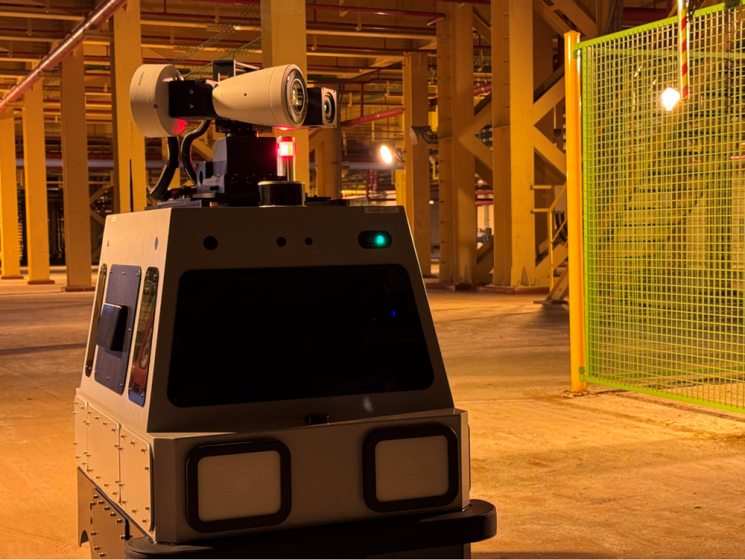 POSCO Gwangyang Steelworks has introduced a mobile robot remote inspection system developed by POSCO Holdings Future Technology Research Institute AI Robot Convergence Research Center to its 4-rolling mill plant. The photo shows a wheeled mobile robot inspecting factory equipment. Photo by Gwangyang Steelworks
The electrical rooms within the steelworks require constant monitoring to prevent fire accidents. However, due to the large area?equivalent to more than two soccer fields?conducting precise inspections directly took a long time. There were also safety concerns for workers due to high-voltage cables and high-temperature environments. The existing CCTV-based monitoring had blind spots, making accurate equipment diagnosis difficult.
The newly introduced mobile robot remote diagnosis system at Gwangyang Steelworks is a measure to overcome such high-risk factors and CCTV blind spots. Based on the 4-wheel drive wheeled robot ‘Dogugonggan Patrover,’ an equipment inspection mission module was developed and installed so that the robot inspects the equipment directly instead of workers.
Using the robot enables continuous diagnosis of equipment, and through POSCO Holdings’ self-developed remote control system (PosRX Platform), diagnostic data transmitted in real time by the robot can be managed, allowing for more accurate and systematic equipment diagnosis and statistical data management. This is expected to enhance worker safety, enable timely equipment repairs through analysis of diagnostic data, and facilitate preventive equipment inspection activities.
To ensure smooth communication between the robot and the remote control system, a Wi-Fi environment was also established, and CCTV for fire detection was installed to prevent fire accidents during robot charging by detecting battery fires in advance.
Choi Ja-young, Senior Researcher at POSCO Holdings Future Technology Research Institute AI Robot Convergence Lab, said, “The introduction of robots has greatly improved worker safety and laid the foundation for expanding application to other processes. We will continue to lead the creation of safer working environments through ongoing technological innovation.”
Gwangyang Steelworks plans to expand the newly developed robot remote inspection system to similar processes. It will also continuously promote robot automation to create a safe working environment and introduce it to outdoor equipment inspections, embarking on the development of innovative smart factory technologies.
© The Asia Business Daily(www.asiae.co.kr). All rights reserved.












