5 Months of Practice-Oriented Training
AI Talent Ready for Immediate Deployment
AI specialized talents leading industrial innovation in Ulsan have been nurtured.
On the 22nd, UNIST (President Jongrae Park) and Ulsan City graduated 35 students at the ‘AI Novatus Academia Ulsan Course 7th Graduation Ceremony’ held at the AI Innovation Park.
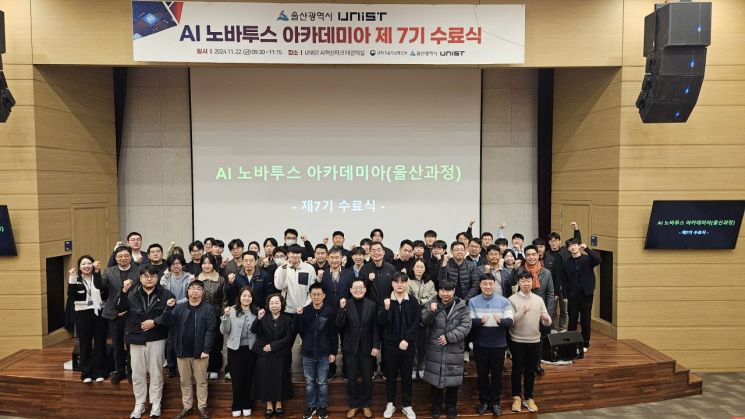 Participants of the 'AI Novatus Academia Ulsan Course 7th Class' graduation ceremony are taking a commemorative photo. Photo by UNIST
This program was conducted with the goal of introducing AI technology for innovation in the manufacturing industry in the Ulsan region and nurturing talents suitable for practical work in the industrial field.
The graduation ceremony was attended by 55 people, including graduates from major local companies such as Hyundai Heavy Industries and Samyangsa, Ulsan city officials, and UNIST professors. The education took place over five months starting from July and was a course researching how to practically apply AI technology in the work environment.
In particular, the trainees learned how to practically apply AI technology through preliminary research solving problems occurring on site.
Hyundai Mipo Dockyard achieved a 9% cost reduction by optimizing cable routes within ships. While slightly increasing cable length, they reduced the size and cost of supports. They also analyzed workload data to develop a process simulation model, demonstrating the possibility of AI-based smart process management.
Neonant analyzed injection molding process data to reduce defect rates to 6% and shortened setup time from 30 minutes to 10 minutes. This is expected to save over 400 million KRW annually. They also introduced an AI-based automatic control system, suggesting the potential use of AI in the precision casting industry.
BNK Gyeongnam Bank improved loan prediction accuracy using machine learning and was able to more effectively identify fraudulent loan applications. Through AI models, they reduced risks and demonstrated the potential of AI utilization in the financial industry.
Taehwa Environment developed a system using AI to predict and reduce nitrogen oxides in petroleum refining processes. This enabled a reduction of about 1.4 billion KRW in facility investment costs, and AI-based environmental pollution prevention technology is expected to spread throughout the industry.
Korea National Oil Corporation analyzed safety accident data to predict risk factors and established a risk response system linked with chatbots. It is expected to prevent safety accidents at work sites.
Yang Seungjun, head of the UNIST AI Innovation Park project group, said, “Through this education, AI technology has led to tangible results such as productivity improvement, cost reduction, and quality enhancement in corporate sites,” adding, “UNIST will continue to strive to accelerate the digital transformation of Ulsan’s industries and strengthen competitiveness.”
Since 2021, UNIST AI Innovation Park has been providing AI education to companies in the Ulsan region. So far, 210 graduates from 90 companies have been produced, and they are effectively applying AI technology in practical work.
© The Asia Business Daily(www.asiae.co.kr). All rights reserved.












