Briefing on the Results of the Integrated Regulatory Review Service
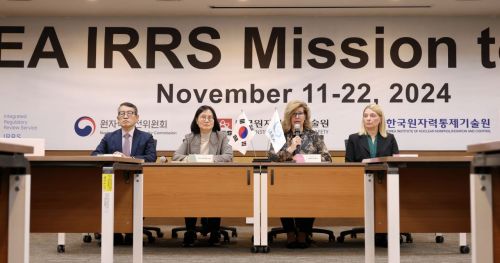 The Integrated Regulatory Review Service (IRRS) team of the International Atomic Energy Agency (IAEA) is briefing the results of the IRRS review on the 22nd at the Korea Institute of Nuclear Safety in Yuseong-gu, Daejeon. Provided by the Nuclear Safety and Security Commission
The International Atomic Energy Agency (IAEA) has evaluated South Korea's nuclear safety as being at a "high level." However, it recommended that the responsibility for safety be explicitly stated in law and that the dispersed safety standards be integrated.
The IAEA Integrated Regulatory Review Service (IRRS) review team held a press conference on the 22nd at the Korea Institute of Nuclear Safety (KINS) in Yuseong-gu, Daejeon, announcing the results of the IRRS conducted on South Korea's nuclear safety regulatory system from the 11th to that day.
The IRRS is a service that comprehensively reviews the nuclear safety regulatory systems, institutions, and activities of IAEA member states according to IAEA safety standards, providing recommendations and suggestions. This is the second time South Korea has undergone an IRRS, the first being in 2011.
The IAEA review team gave an overall high evaluation of South Korea's nuclear regulatory system. Laura Deuze, head of the IRRS inspection team, stated, "Through this inspection, we concluded that South Korea demonstrates a high level of nuclear safety with an independent regulatory body and a mature regulatory system," adding, "We judged that such infrastructure promotes a sound and robust safety culture."
The review team particularly praised the close cooperation and strong relationships among the Nuclear Safety and Security Commission (NSSC), KINS, and the Korea Institute of Nuclear Nonproliferation and Control (KINAC), noting that these enhance nuclear safety and security at regional offices and improve the effectiveness of regulatory programs. They also highly valued the regulatory agencies' collaboration with universities to educate over 7,000 students on nuclear safety and the operation of the Radiation Source Location Tracking System (RADLOT).
However, the IRRS inspection team conveyed that the government should revise the national safety policy and strategy to include all elements required by IAEA safety standards. Laura Deuze said, "South Korea's policy was first established in 1994, and as other policies were announced, safety standards became divided across multiple policy documents," adding, "Rather than missing content, we recommended consolidating these standards into a single document."
Additionally, the inspection team recommended clarifying in nuclear and radiation-related laws that the institutions or individuals managing facilities or activities bear ultimate responsibility for safety. Regarding the NSSC, the team pointed out the need to maintain management systems and develop additional procedures and processes to support effective regulatory oversight.
Deuze explained, "Since the NSSC is a relatively young independent agency compared to regulatory bodies in other countries, its management system is also in an early stage," adding, "They need to formalize and specify administrative systems and procedures."
The IRRS also discussed current policy issues, including the status and future of the NSSC and Korean regulatory agencies, as well as preparations for regulating Small Modular Reactors (SMRs). Deuze stated, "SMRs are at a stage worldwide where regulatory agencies are establishing safety standards and conducting design reviews," adding, "Globally, there is an effort to create common safety standards and design review criteria so that regulatory approaches continue to align with existing fundamental regulatory frameworks and systems, establishing an international direction."
Amid ongoing domestic discussions about extending the operating license renewal period from 10 to 20 years, Deuze clarified that the IRRS did not cover discussions related to continued operation regulation. She said, "Any regulatory agency always decides on approval based on whether continued operation meets safety standards," adding, "The decision on the renewal period depends on the judgment of the relevant regulatory body and government."
The IRRS review involved 21 nuclear safety experts from 14 countries worldwide. They conducted document reviews and interviews with responsible personnel regarding South Korea's nuclear safety regulatory system and visited sites including nuclear power plants, research reactors, radioactive waste disposal facilities, and radiation utilization facilities.
The IRRS review team will deliver the final report to the South Korean government in three months. Son Myung-sun, planning coordinator at the NSSC, said, "We will carefully examine and review the contents of the final report and prepare measures to further strengthen South Korea's regulatory system."
© The Asia Business Daily(www.asiae.co.kr). All rights reserved.