Report on Optimal Power Supply Strategies for Meeting Industrial Power Demand
As electricity demand surges and the construction of transmission networks is delayed, there are calls for the rapid expansion of the national power grid.
The Korea Chamber of Commerce and Industry's Sustainable Growth Initiative (SGI) stated in its report titled "Optimizing Power Supply to Meet Industrial Electricity Demand," released on the 20th, that "while electricity demand has increased by 98% over the past 20 years, transmission networks have only increased by 26%, raising concerns about meeting demand."
South Korea's peak electricity demand rose from 47GW in 2003 to 94GW in 2023, a 98% increase. Correspondingly, power generation capacity increased by 154%, from 56GW to 143GW during the same period. However, transmission facilities only grew by 26%.
The report emphasized, "Since South Korea currently relies on a centralized power supply system, constructing transmission networks that connect power generation facilities to demand areas is crucial," and added, "It is urgent to establish a national support system for the timely expansion of transmission networks."
In a centralized power supply system, as power generation capacity and electricity demand increase, transmission facilities (line length) should also increase proportionally.
However, recent transmission network construction projects have been delayed by an average of 5 to 6 years or more. The East Coast?Singapyeong High Voltage Direct Current (HVDC) line was delayed by 66 months, and the Bukdangjin?Sintangjeong transmission line was delayed by 150 months. Major causes of delays include local resident opposition, delayed responses from related agencies, and lack of cooperation from local governments.
These delays have caused various problems such as supply constraints in power demand areas, hindrance to power generation projects, and increased power production costs. There is also a high possibility that large-scale power demands from advanced industries like artificial intelligence (AI) and semiconductors will not be met. For example, the Seoul metropolitan area semiconductor cluster requires 10GW of power by 2050, but significant setbacks are expected due to delays in constructing transmission networks connecting to the metropolitan area.
The report pointed out that due to the shortage of transmission networks, the operation of existing power generation facilities is restricted, and the progress of new power generation projects is also hindered. Recently, due to transmission network shortages, new power generation permits in the Honam region have been effectively suspended from September this year until 2031.
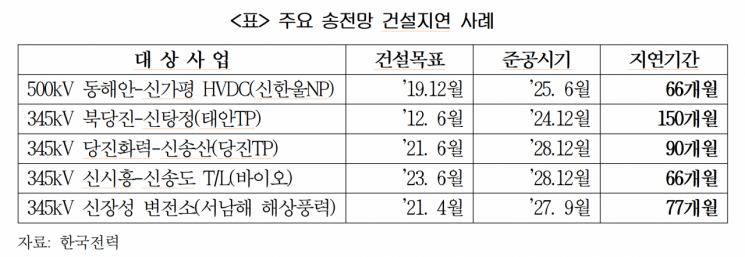 Major Power Transmission Network Construction Delay Cases. Provided by Korea Electric Power Corporation and Korea Chamber of Commerce and Industry
Park Kyung-won, a research fellow at the KCCI SGI, said, "In South Korea, building transmission networks that can immediately transport electricity generated across the country to where it is needed is more important than expanding power generation facilities," adding, "Current legal and institutional support systems have limitations in swiftly processing permits and providing realistic compensation amounts." Professor Park Jong-bae of Konkuk University also stated, "Transmission network shortages can lead to increased electricity rates for industries," and "Globally, timely expansion of power grids is the most urgent national task for maintaining national competitiveness and power security."
Germany and the United States have treated power grid expansion as a national priority and improved laws and regulations accordingly. Germany strengthened its compensation system, while the United States relaxed approval standards to accelerate transmission network expansion.
In South Korea, if the "Special Act on National Power Grid" proposed in the National Assembly is passed, the speed of transmission network expansion is expected to improve significantly. The special act includes shortening site selection periods, coordinating disagreements among government ministries, and establishing a flexible land compensation system. It also limits the site selection committee's deadline for deciding on project-specific sites to two years, significantly reducing the current average site selection period of 4 to 5 years.
Park Yang-soo, head of SGI, emphasized, "Stable power supply is an essential condition for industrial competitiveness," and stressed, "Enacting a special law for power grid expansion is urgent."
© The Asia Business Daily(www.asiae.co.kr). All rights reserved.













