Gyeonggi Province held a session to build consensus and pledge cooperation between labor and management to promote a work-life balance culture and improve productivity through reduced working hours. Gyeonggi Province is preparing to introduce a 4.5-day workweek next year.
On the 15th, Gyeonggi Governor Kim Dong-yeon held the ‘2024 1st Gyeonggi Province Labor-Management-Government Council’ at Seohui Hall in the Gyeonggi Provincial Government Office, signing a ‘Joint Declaration’ with 14 council members including Kim Yeon-pung, Chairman of the Korean Confederation of Trade Unions Gyeonggi Regional Headquarters, Kim Chun-ho, Chairman of the Gyeonggi Employers Federation, and Noh Gil-jun, Chairman of the Gyeonggi Regional Labor Relations Commission.
Governor Kim Dong-yeon stated, "The direction of Gyeonggi Province’s administration can be summed up as ‘Humarnomics’ (a people-centered economy). We focus our policies on investing heavily in people, providing more opportunities, and ensuring relatively equal opportunities," adding, "Until now, the economic focus of the development era seemed to be money and quantitative growth in some respects. Now, the center of the economy must be people to ensure sustainability and long-term increases in efficiency and productivity."
He continued, "Next year, about 50 public institutions and private companies will pilot the 4.5-day workweek. This is not only about work-life balance but also about improving productivity," and explained, "Additionally, the issue of career interruption is very serious, so we are implementing the 0.5 & 0.75 job projects that provide jobs without career breaks. These two projects are the first of their kind in South Korea."
He particularly noted, "The global political and economic frameworks and orders are undergoing significant changes. Especially since Trump’s election, uncertainties have increased in all areas including investment, education, human exchange, and immigration. North Korea has deployed troops to Russia, and industrial restructuring driven by AI technological advances is happening at a frightening speed. There will likely be major changes in the nature of labor, the future of work, and industrial restructuring."
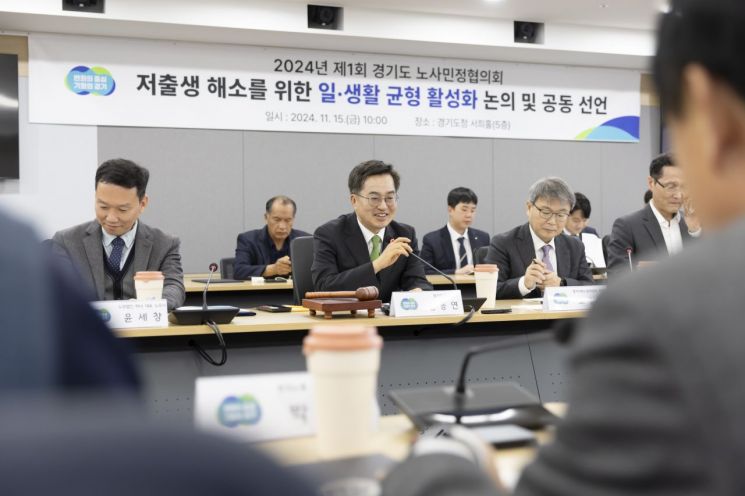 Gyeonggi Province Governor Kim Dong-yeon is speaking at the '2024 1st Gyeonggi Province Labor-Management-Government Council' held on the 15th at Gwanggyo Gyeonggi Provincial Office in Suwon. Photo by Gyeonggi Provincial Office
Furthermore, he expressed concern, saying, "I am deeply worried about how much the government is contemplating and preparing to respond to these changes," and added, "At least in Gyeonggi Province, I hope we can prepare together for the rapidly changing international situation, the new global economic order, and the future of labor and work genres in response to industrial restructuring driven by technological progress. In this regard, Humarnomics initiatives like the 4.5-day workweek and the 0.5 & 0.75 job projects will be good starting points for solutions. I hope we can discuss, cooperate, and unite our efforts."
In response, Kim Yeon-pung, Chairman of the Korean Confederation of Trade Unions Gyeonggi Regional Headquarters, said, "Discussions to address the low birthrate are not merely preparations for the future but essential tasks for both current and future generations," and added, "I hope the opinions shared here today will become a new driving force for Gyeonggi Province."
Kim Chun-ho, Chairman of the Gyeonggi Employers Federation, expressed strong cooperation, stating, "The Gyeonggi Province Labor-Management-Government Council is leading efforts to create a work environment where work and family can coexist. We will strive to resolve the low birthrate issue through close cooperation and social consultation."
The joint declaration includes commitments to actively cooperate in addressing the era’s challenges of intensified competition due to advancements in future technologies such as AI and the low birthrate crisis, improving workers’ quality of life, sustaining corporate growth, enhancing labor conditions, and expanding opportunities to realize Humarnomics.
Meanwhile, Gyeonggi Province will implement a pilot project for the ‘4.5-day workweek’ without wage cuts next year, targeting 50 private companies in the province and some public institutions under the provincial government.
Participating institutions can choose one of the following through labor-management agreement to reduce working hours: ▲biweekly 4-day workweek ▲35-hour workweek ▲half-day work on Fridays. The public sector will support wages needed for the reduced working hours.
The ‘0.5 & 0.75 job’ project without career interruption is a policy that complements the shortcomings of existing low birthrate measures such as parental leave and childbirth support allowances. The ‘0.5 job’ refers to jobs with 4 hours of work per day (20 hours per week, 2-3 days per week), and the ‘0.75 job’ refers to jobs with 6 hours of work per day (30 hours per week, 3-4 days per week). The province plans to pilot this project targeting family-friendly companies among public institutions and private companies.
© The Asia Business Daily(www.asiae.co.kr). All rights reserved.











