Demand Slump Hits Steel Industry
Boosting Exports to Benefit from Strong Dollar
Refining and Petrochemical Sectors Face Rising Currency Losses
Automotive Industry Expects Exchange Rate Gains from Exports
As the won-dollar exchange rate continues its high-altitude march day after day, companies' management outlook for next year has fallen into uncertainty. Following the economic and trade policy changes expected after the U.S. presidential election, uncertainty has further increased. Companies are strengthening exchange rate monitoring and preparing scenario-based responses for various situations according to short- and long-term fluctuations. They are implementing various hedge strategies to reduce financial burdens.
According to the industry on the 15th, the refining, petrochemical, and steel industries, which rely mostly on imports for raw materials, are closely watching whether the 'strong dollar (weak won)' phenomenon will prolong. For now, they are reducing losses through a natural hedge strategy that uses dollars earned from exports for imports.
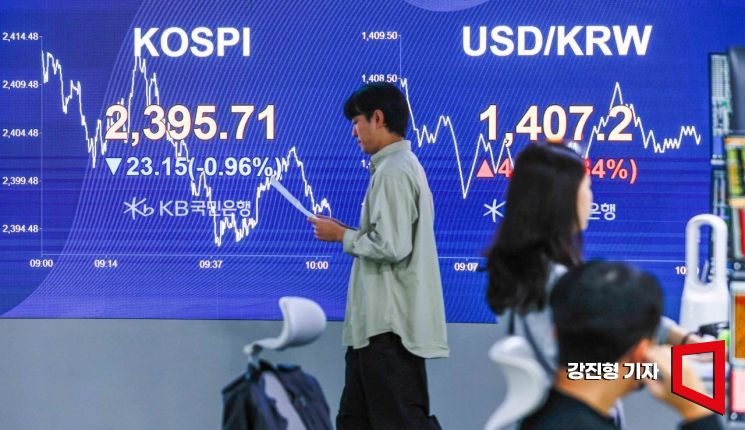 On the 15th, dealers are working in the KB Kookmin Bank dealing room in Yeouido, Seoul, as the KOSPI index fell below the 2400 mark for the first time in three months since the 'Black Monday' in August. On the same day, the won-dollar exchange rate opened at 1,408 won, up 2.9 won from the previous day. Photo by Kang Jin-hyung
A refining industry official explained, "Since crude oil imports and exports are both conducted in dollars, the impact of exchange rates is partially offset," but added, "Typically, refineries export only about 50-60% of their products, and since import volumes are larger, there is a burden of exchange losses." If the strong dollar continues, oil prices will rise, increasing the burden on ordinary citizens and the national economy, which could negatively affect demand for refined products, so the situation is being closely monitored.
The petrochemical industry, which continues to face sluggish market conditions, also does not welcome exchange rate fluctuations. However, companies with a high export ratio expect that if the exchange rate rises, even if they sell products somewhat cheaper, the sales price will increase. LG Chem, for example, has an export ratio of 50-60%.
The steel industry is also facing a double burden as rising raw material prices increase import costs, and recent weak demand for steel products makes it difficult to pass on costs to sales prices. POSCO is currently establishing its management plan for next year, but the exchange rate variable has increased. They are responding by reducing domestic sales volume and increasing export ratios to take advantage of the high exchange rate.
The battery industry, which incurs significant costs for raw material purchases and overseas facility investments, is also facing heavy financial burdens due to the rising won-dollar exchange rate. Especially this year, which marks the peak of overseas facility investments, foreign currency debt has increased significantly. LG Energy Solution's foreign currency debt reached 6.8 trillion won in the third quarter, a sharp increase from 4.2 trillion won at the end of last year. If the exchange rate rises by 10%, a net loss of approximately 238.8 billion won is expected.
The airline industry also bears fuel costs, the largest portion of operating expenses, in dollars. If the strong dollar trend continues, the won-denominated costs will increase. Among Korean Air's third-quarter operating expenses of 3.6222 trillion won, fuel costs accounted for 1.1662 trillion won, about one-third. The base exchange rate was set at 1,319.6 won per dollar, but if 1,400 won per dollar is applied, fuel costs could arithmetically increase by 6% compared to the third quarter, meaning an increase of more than 70 billion won.
On the other hand, the automobile industry, a representative foreign currency earning sector, is considered a beneficiary of the high exchange rate. Last year, South Korea's automobile and parts exports amounted to 93.9 billion dollars, imports were 22.8 billion dollars, resulting in a trade surplus of about 71.1 billion dollars. Even a 1 won decrease in the won's value means an accounting profit increase of more than 70 billion won. According to the management performance announcements of Hyundai Motor and Kia, the biggest contributor to the increase in operating profit this year has been the 'exchange rate effect.'
Hyundai Motor's increase in operating profit from the first to third quarter this year due to exchange rate effects is about 1.438 trillion won. During the same period, Kia's figure was 1.077 trillion won. This means that operating profit increased by more than 2.5 trillion won solely due to exchange rates. The combined operating profit of the two companies for the first to third quarters this year was about 21 trillion won, about 500 billion won more than the same period last year. Despite factors that worsened performance, such as one-time provisions, the high exchange rate level helped produce positive results.
The electronics industry is also closely watching changes in the situation as exchange rate fluctuations act as both favorable and unfavorable factors. On the positive side, a lower won value enhances product price competitiveness, which helps increase export performance. However, since currency market risks have increased, there are concerns that raw material price risks may also rise.
Both semiconductor and home appliance companies face slightly increased production costs due to rising prices of equipment and raw materials purchased in dollars. The electronics industry is focusing on diversifying currencies used in payment processes beyond the U.S. dollar and minimizing logistics costs to reduce business volatility. A semiconductor industry official said, "Costs related to importing equipment from the Netherlands, Japan, and the U.S., as well as special gases for semiconductors, may increase," but added, "Since the weak won also has advantages for exports, it is difficult to judge the net effect now, and we are carefully monitoring the situation."
© The Asia Business Daily(www.asiae.co.kr). All rights reserved.













