National Institute of Health Research, Increased Risk of Metabolic Diseases Such as Insulin Resistance
A study conducted in Korea has, for the first time, identified that the consumption of ultra-processed foods such as carbonated drinks, snacks, fast food, and instant foods increases the risk of metabolic abnormalities in obese children and adolescents.
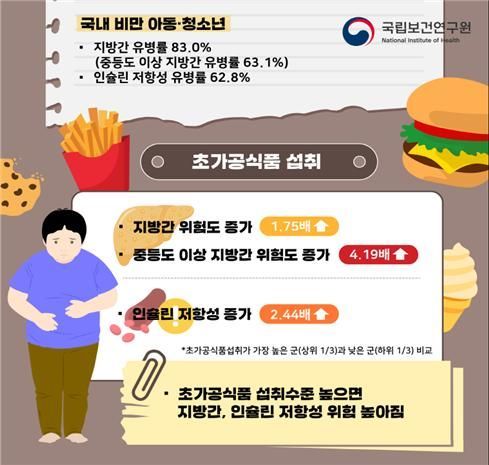
The Endocrine and Kidney Disease Research Division of the Korea Disease Control and Prevention Agency's National Institute of Health disclosed on the 12th the results of an analysis on the association between ultra-processed food consumption and metabolic abnormalities in 149 overweight and obese children and adolescents aged 8 to 17 years with a body mass index (BMI) at or above the 85th percentile.
Ultra-processed foods refer to foods that have undergone industrial processing and contain substances extracted or synthesized from foods to enhance preservation, taste, and convenience. These foods typically contain high amounts of sugar, processed fats, and salt, while being deficient in nutrients such as vitamins and fiber. In Korea, the consumption of ultra-processed foods has steadily increased, rising by 23.1% between 2010 and 2012 and by 26.1% between 2016 and 2018.
The research team classified ultra-processed food intake levels into three groups based on the NOVA classification system: low intake group (lowest third), medium intake group (middle third), and high intake group (highest third). Using the lowest intake group as a reference, they compared the risk of metabolic diseases among the other groups. Obese children and adolescents consumed ultra-processed foods accounting for 20.4% of their daily food intake and 25.6% of their daily energy intake (median values). Those in the highest intake group consumed ultra-processed foods making up 38.0% of their daily food intake and 44.8% of their daily energy intake.
As a result, the group with the highest ultra-processed food consumption had a 1.75 times higher risk of fatty liver and a 2.44 times higher risk of insulin resistance?a condition where blood insulin levels increase excessively due to poor blood sugar regulation?compared to the lowest intake group. Notably, the risk of moderate to severe fatty liver, defined as liver fat exceeding 10%, was 4.19 times higher.
The study also found that for every 10% increase in the proportion of ultra-processed foods consumed, the risk of developing moderate or more severe fatty liver disease increased by 1.37 times, and the prevalence risk of insulin resistance increased by 1.3 times. Among the obese children and adolescents who participated in the study, 83% had fatty liver as confirmed by magnetic resonance imaging (MRI), and 62.8% exhibited insulin resistance, indicating a serious risk of fatty liver disease or type 2 diabetes.
Park Hyun-young, director of the National Institute of Health, advised, "To reduce the risk of metabolic diseases in obese children and adolescents, attention must be paid to the consumption of ultra-processed foods." She added, "Efforts to reduce ultra-processed food intake are necessary at home, childcare, and educational facilities."
The study results were published online on the 17th in the international journal on nutrition and health, Nutrients.
© The Asia Business Daily(www.asiae.co.kr). All rights reserved.












