November IPO Stocks Also Face Price Slump
"Valuations of Unlisted Companies Need Further Adjustment"
The stock prices of newly listed companies on the domestic stock market have been consecutively sluggish, deepening the concerns of the venture capital (VC) industry that had hoped for exits through initial public offerings (IPOs). There are calls for new exit strategies for VCs and policy support to secure new investment momentum.
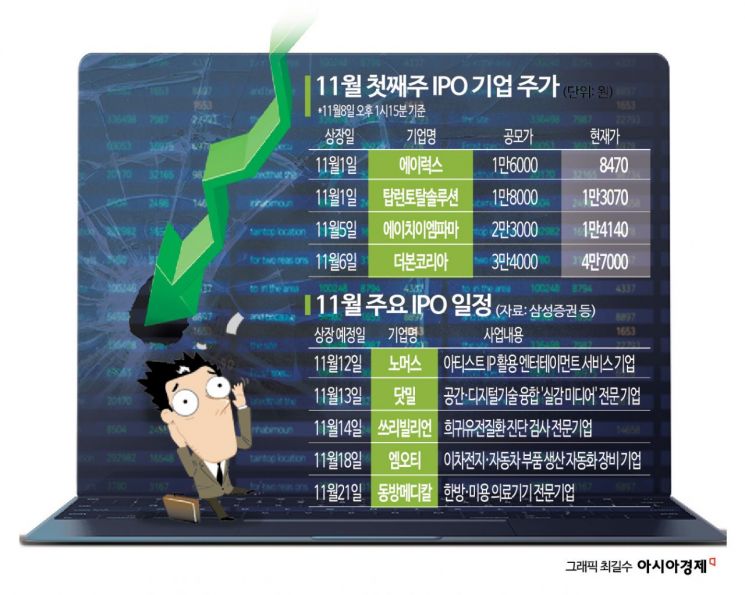
According to the investment banking (IB) industry on the 11th, among the six newly listed stocks this month, five are currently trading below their offering prices. Airlane, a gas separation membrane company that was listed on the KOSDAQ on the previous trading day, the 8th, traded at prices about 20-30% lower than its offering price of 23,000 KRW on the same day. There was not a single moment during the day when the price exceeded the 20,000 KRW mark.
Aerux, which was listed on the 1st, recorded the largest drop on the first day of listing in the history of Korean IPOs. This company, which brands itself as a 'robot edutech' firm, had attracted market attention by securing investments from IMM Investment, Lotte Ventures, Wooshin Investment & Venture, among others. However, Aerux traded at a price 22% lower than its offering price of 16,000 KRW right after the market opened on the listing day, and closed at 9,880 KRW, down 38.3%. Except for the 4th, Aerux closed lower for four consecutive trading days, with its stock price falling to the 8,400 KRW range.
Healthcare specialist company HEM Pharma, which attracted VC investments from Woori Venture Partners, Winvest Venture Investment, and Friend Investment Partners, entered the KOSDAQ market on the 5th with an offering price of 23,000 KRW. Since then, its stock price has dropped nearly half compared to the offering price, fluctuating around the 14,000 KRW level during trading on the 8th. Other newly listed companies such as Tomocube and Toprun Total Solution are also trading below their offering prices. The only newly listed stock currently trading above its offering price is Theborn Korea, led by CEO Baek Jong-won.
Recently, the 'unbeatable IPO' formula, where stock prices soar well above the offering price immediately after listing, no longer holds in the Korean stock market. Since September, companies that have achieved a triple increase (300% rise compared to the offering price) have disappeared from the stock market, while cases where the opening price on the first day is significantly below the offering price are easily found. Park Jong-sun, a researcher at Eugene Investment & Securities, analyzed, "Among the 12 companies listed last month, the average initial return compared to the offering price was a favorable 26.3%, but as of the end of the same month, the loss rate reached 22.9%, indicating intensified 'sorting of the wheat from the chaff' among stocks."
A mid-sized VC representative explained the background of the new stocks' sluggishness, saying, "The primary reason is the high valuation (stock price level relative to corporate value) of unlisted companies. The offering price seems excessively inflated compared to the actual corporate competitiveness." He added, "The stock prices of companies already listed mainly on the KOSDAQ have fallen, and compared to these, the valuations of unlisted companies are high, so further adjustments are necessary. There was a lack of positive signals across the stock market, and the absence of government policy direction to support this was also a cause."
The sluggish stock prices of newly listed companies inevitably become a burden for VCs, who must continue making new investments. According to the Korea Venture Capital Association, as of September, IPOs accounted for 35.1% of domestic VC exits this year, ranking second after sales at 48.8%. IPOs are a representative means for VCs to recover invested funds, but their share has somewhat shrunk amid the ongoing investment market downturn since 2021.
Concerns about the timing of share sales after the lock-up period has been lifted have also increased. Even after the lock-up is lifted, if the stock price is lower than expected, delaying the sale timing may lead to pressure from limited partners (LPs) demanding monetization. Recently, in the VC industry, it is common to set about one-third of held shares to be tradable immediately after listing, and to allocate the remaining two-thirds to lock-up periods of one month and three months. For example, most VCs that invested in HEM Pharma have set a one-month lock-up on most of their held shares, and it is known that stock trading of VC holdings will be possible starting next month.
Considering the IPO market slump and delayed interest rate cuts, the importance of the secondary (pre-owned stock acquisition) fund market is expected to increase further for the time being. A VC industry insider said, "With the exit market depressed and the overall listing review process becoming more stringent since the Pado incident, including technology special listings, it takes longer to exit using the existing methods, so as fund maturities approach, the demand from VCs to trade shares over-the-counter will increase."
© The Asia Business Daily(www.asiae.co.kr). All rights reserved.












