A new therapeutic efficacy principle to enhance the treatment of intractable brain tumors has been identified.
KAIST announced on the 6th that a research team led by Professor Heungkyu Lee from the Department of Biological Sciences at KAIST, in collaboration with the Infectious Disease Prevention and Diagnostic Technology Research Center at the Korea Research Institute of Chemical Technology, confirmed that the deficiency of inhibitory Fc gamma receptor (hereafter FcγRIIB) in a glioblastoma mouse model restored cytotoxic T cell unresponsiveness to immune checkpoint inhibitors, enhancing anticancer effects and improving patient survival rates.
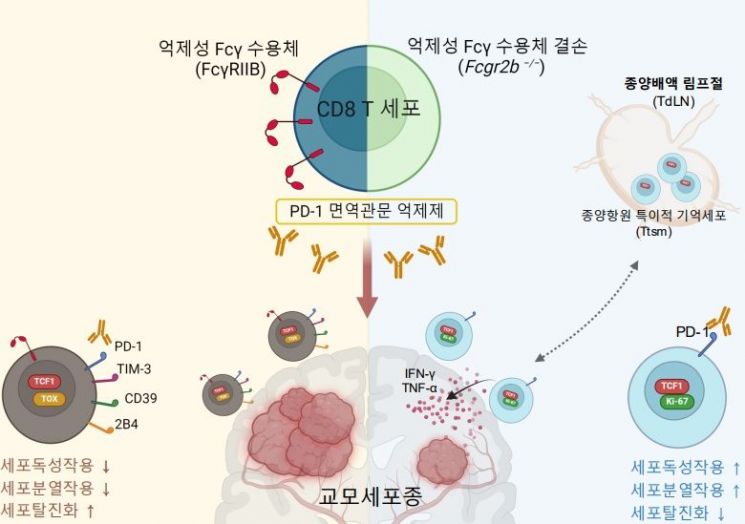 Summary of research results showing that the absence of inhibitory Fc gamma receptor (FcγRIIB) enhances the immune response of glioblastoma brain tumors to anti-PD-1 therapy. Provided by KAIST
Immune checkpoint inhibitors are gaining attention as anticancer therapies that strengthen the anticancer immune response of T cells that eliminate cancer cells. However, glioblastoma, an intractable brain tumor, has not shown efficacy in clinical trials using immune checkpoint inhibitors.
Accordingly, the research team analyzed the causes of T cell dysfunction or weakening due to chronic antigen exposure in intractable cancers, identifying T cell activation regulatory factors and elucidating the principles of enhancing therapeutic efficacy.
The approach involved confirming the impact of FcγRIIB, found in cytotoxic T cells, on the characteristics of tumor-infiltrating cytotoxic T cells and the therapeutic efficacy of immune checkpoint inhibitors (anti-PD-1).
As a result, the team confirmed that antigen-specific memory T cells increase relatively more when FcγRIIB is deficient, while continuously promoting T cell infiltration within tumor tissues.
This study suggests a new therapeutic target for tumors showing unresponsiveness to immune checkpoint inhibitors. It is also significant in demonstrating that combining FcγRIIB inhibition with anti-PD-1 therapy can produce a synergistic effect in tumors such as glioblastoma that do not respond to anti-PD-1 treatment.
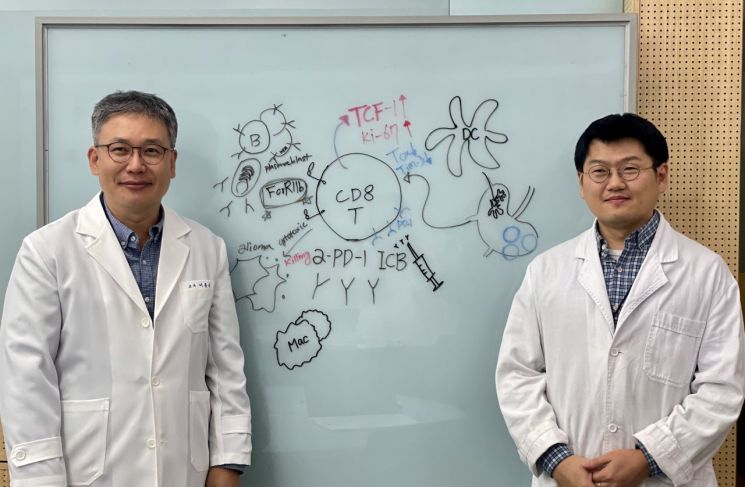 (From left) Professor Lee Heung-kyu and Dr. Gu Geun-bon, Department of Life Sciences. Provided by KAIST
The research team expects that this strategy of enhancing anticancer immune responses through FcγRIIB inhibition will contribute to improving the efficacy of immune checkpoint inhibitors.
Professor Lee stated, “Through this research, we confirmed the potential to overcome clinical failures in brain tumor treatment using immune checkpoint inhibitors and the possibility of broad application to other intractable tumors. Based on this, we can also propose the future utilization and accessibility of cytotoxic T cells for tumor cell therapy.”
Meanwhile, this research was conducted with support from the National Research Foundation of Korea’s Individual Basic Research Program, the Bio-Medical Technology Development Program, and the Samsung Future Growth Foundation.
© The Asia Business Daily(www.asiae.co.kr). All rights reserved.













