Duty-Free Industry Q3 Total Sales Decline
Hotel Shilla Duty-Free Division Q3 Loss Widens
Increased Marketing Costs but Less Effective Than Expected
Hotel Shilla recorded a loss in the third quarter due to deteriorating duty-free store performance, raising concerns that the downturn in the duty-free industry is prolonged. Despite strengthening marketing efforts to attract both domestic and foreign customers and even engaging in commission competition with 'Daigou' (Chinese personal shoppers), sales failed to increase and profitability worsened.
According to the Korea Duty Free Association on the 6th, total duty-free store sales in September this year amounted to 1.194 trillion won, down 10% from 1.3274 trillion won in September last year. Total sales from July to September affect the third-quarter performance of duty-free stores, and sales during this period were all lower than last year.
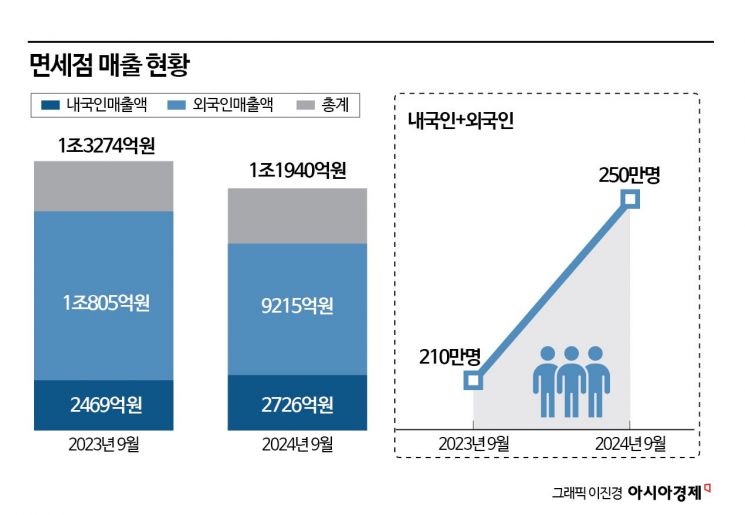
In September, sales to foreigners at duty-free stores dropped significantly. Foreign sales amounted to 931.5 billion won, shrinking about 15% from 1.0805 trillion won last year. As a result, downtown duty-free stores, which generate substantial foreign sales, saw total sales of 945 billion won, about 200 billion won less than last year's 1.114 trillion won. Domestic sales increased by about 30 billion won, from 246.9 billion won to 272.6 billion won, influenced by the Chuseok holiday in September, which led to many domestic travelers going abroad.
Notably, the number of foreign and domestic visitors increased compared to last year. Although more foreigners and Koreans traveled abroad, the incentive to purchase duty-free products declined, resulting in user numbers not correlating with sales.
The continuous decline in duty-free sales can be summarized as reduced consumption due to economic recession, high exchange rates, and decreased competitiveness of duty-free products. With many channels offering cheaper products, domestic customers refrain from purchasing duty-free goods, while foreigners, due to changing tourism trends, prefer buying from convenience stores and retail channels rather than duty-free shops.
Active marketing efforts by duty-free stores to attract customers have also failed to yield significant results. To defend sales, duty-free stores slightly increased the commission fees paid to Chinese personal shoppers (Daigou) in the third quarter and focused all marketing efforts on attracting Chinese individual tourists (Sanke). However, these strategies did not positively impact performance and only eroded profits.
Among duty-free stores, Hotel Shilla, which was the first to announce its results, turned to a loss as its duty-free business segment recorded a large-scale deficit. The duty-free segment posted sales of 844.8 billion won and an operating loss of 38.7 billion won, expanding the operating loss by about 20 billion won compared to last year's 16.3 billion won loss. The burden of airport rental fees and increased discount rates at downtown duty-free stores negatively affected profits.
Other duty-free stores showed similar trends. In particular, Lotte Duty Free is estimated to have experienced a larger profit decline due to one-time costs such as severance pay from voluntary retirements conducted in the third quarter. Hyundai Duty Free recently replaced its CEO and brand identity (BI) to revitalize its atmosphere. An industry insider said, "It will be difficult for the duty-free industry to turn around until the economic situation improves. We tried to attract foreign customers and secure domestic customers through membership launches, but results were poor, and now there are even talks that there is nothing more the duty-free industry can do."
Some suggest the need to revise the basis for calculating license fees and introduce arrival hall delivery services, considering the sluggish duty-free market. License fees are a system that collects a certain percentage of sales to return profits from duty-free stores to society. The duty-free industry argues that fees should be calculated based on operating profit rather than sales. They claim it is unreasonable to impose license fees amid ongoing losses. Although the government has reduced license fees by 50% since 2020 sales, the growing deficit continues to burden performance.
Arrival hall delivery services allow customers to receive goods upon arrival. Since travelers do not have to carry bulky or heavy items, the duty-free industry strongly supports installing arrival hall delivery services. In fact, since April last year, a pilot operation of delivery services at the arrival hall of Busan Port International Passenger Terminal has drawn positive consumer responses.
However, these measures are unlikely to be implemented quickly due to conflicting interests. A duty-free industry official explained, "Arrival hall delivery services were promoted to enhance customer convenience, but conflicts with arrival hall duty-free stores have delayed progress. Regarding license fees, the issue is directly linked to government tax revenue, so there has been no advancement."
© The Asia Business Daily(www.asiae.co.kr). All rights reserved.













