Embassy in Seoul "Received Sudden Notice"
Interpreted as Diplomatic Message Related to US Presidential Election
The Chinese government has suddenly announced a short-term visa exemption for Koreans, drawing attention to the background of this decision.
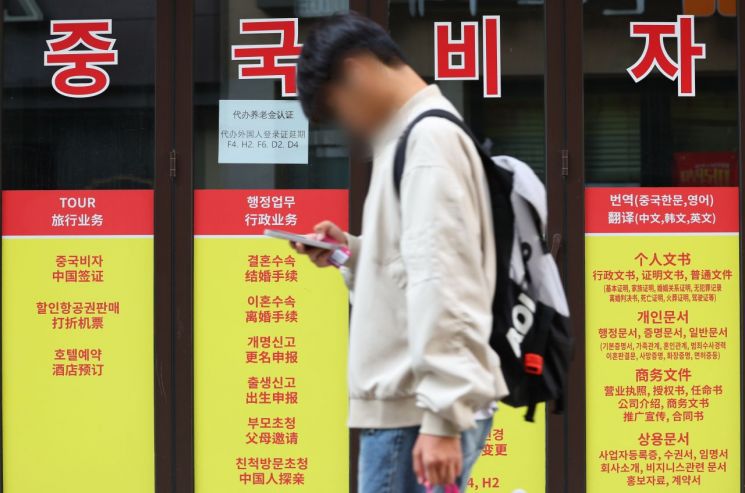 China will add nine countries, including South Korea, to its visa-free pilot program starting from the 8th. Accordingly, holders of ordinary passports from these nine countries, including South Korea, will not need to obtain a visa for visits to China within 15 days for business, travel and tourism, visiting relatives or friends, or transit purposes. The photo shows a travel agency in downtown Seoul on the afternoon of the 3rd. Photo by Yonhap News.
Lin Zhen, spokesperson for the Chinese Ministry of Foreign Affairs, stated during a Q&A session with reporters after a regular briefing on the 1st, “To facilitate travel between Chinese citizens and foreigners, we have decided to expand the scope of the visa-free policy,” adding that a '15-day visa exemption' will be implemented for holders of ordinary passports from nine countries, including South Korea.
Accordingly, nationals of these nine countries will be able to enter China without a visa for 15 days for purposes such as business, tourism, and visiting relatives from the 8th of this month until December 31, 2025.
Typically, China’s visa exemption measures are often extended at the end of the year, so there is a possibility that the visa exemption for Koreans could become a permanent measure depending on the Chinese government’s decision.
Currently, the countries that have mutual visa exemption agreements with China include 24 nations such as Thailand, Singapore, Kazakhstan, Belarus, Ecuador, and Georgia, while China unilaterally grants visa exemptions to 20 countries including France, Germany, Italy, Switzerland, Poland, and Australia.
With the addition of eight European countries and South Korea in this announcement, the number of countries receiving unilateral visa-free treatment has increased to 29.
What draws attention is that the other countries benefiting from the visa-free policy, aside from South Korea, are eight European countries that have no geographical or economic ties with Korea. Lin Zhen mentioned Slovakia, Norway, Finland, Denmark, Iceland, the Principality of Andorra, Monaco, and Liechtenstein during the announcement, then stated, “We have decided to implement visa exemption for South Korea.”
This suggests that the convenience offered was focused on Korea from the outset. Moreover, the Korean government neither requested this measure first nor was there any prior indication of it. A representative from the Korean Embassy in China said, “We were suddenly notified by the Chinese side,” adding, “There had been discussions before, but this decision was sudden.”
Until now, Chinese visas have been notorious for excessively requiring personal information such as workplace, educational background, as well as the occupations and ages of parents and spouses, and the issuance fees have been expensive.
This is the first time since the establishment of diplomatic relations between South Korea and China in 1992 that Koreans have been included in China’s visa-free countries. China has previously granted benefits such as a '30-day visa exemption' for the southeastern resort island of Hainan and a 'mainland maximum 144-hour visa exemption' for transit to third countries. However, this time the visa exemption applies to all Korean passport holders visiting the mainland.
This decision is interpreted as a diplomatic message from China aiming to build a friendly relationship with South Korea before the U.S. presidential election.
The geopolitical situation in Northeast Asia is likely to change rapidly around the U.S. presidential election. Former President Donald Trump had conflicts with China during his tenure. The Biden administration is also wary of China’s technological advancements and is controlling advanced technologies such as semiconductors together with allied countries.
Former President Trump has repeatedly stated during this election cycle that he would impose a 60% tariff on Chinese products. Vice President Kamala Harris is also likely to continue the Biden administration’s stance of checking China.
Therefore, it is analyzed that China needs to make the Northeast Asian situation more flexible than it is now and strengthen its ties with South Korea.
© The Asia Business Daily(www.asiae.co.kr). All rights reserved.













