Poetry, Conditions Including Public Contribution and Traffic Improvement Measures Presented
Gwangju Shinsegae "Accepts"... Main Negotiations to be Completed Within 6 Months
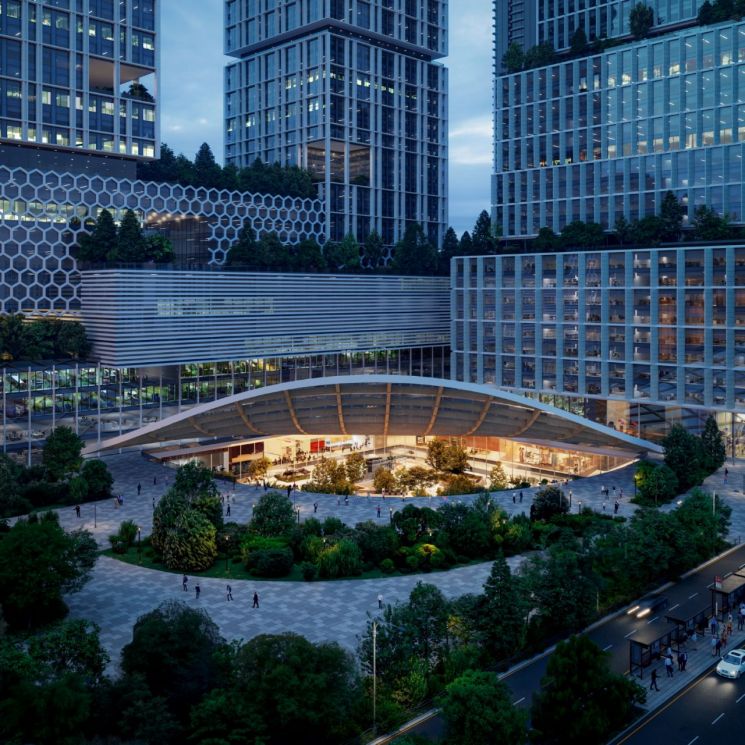 A bird's-eye view of the plaza for the 'Gwangcheon Terminal Complex Project' promoted by Gwangju Shinsegae. [Photo provided by Gwangju City]
On the 30th, Gwangju City announced that it has selected the Gwangcheon Terminal site as a preliminary negotiation target for urban planning changes after consultation with the Urban Planning and Architecture Joint Committee.
The joint committee reviewed the "Development Plan Review Application for the Gwangcheon Terminal Complex Project" (hereinafter referred to as the project plan) submitted by Gwangju Shinsegae to the city in August and advised on the key negotiation conditions for selecting the negotiation target site.
The Gwangju Shinsegae project plan includes Phase 1: expansion of Shinsegae Department Store (2026?2028), Phase 2: creation of a terminal complex facility with cultural, commercial, business, educational, medical facilities, and a luxury hotel (2028?2033), and Phase 3: construction of a residential complex facility (2033?2037).
The city reviewed the necessity of urban management plan changes and the appropriateness of development directions through consultations with related agencies (departments), operation of a joint expert task force (TF), and advice from the Urban Planning and Architecture Joint Committee, finalized the key negotiation conditions, and notified Gwangju Shinsegae.
The negotiation conditions proposed by the city include ▲ simultaneous promotion of department store expansion and terminal project to secure project feasibility ▲ presentation of a reasonable public contribution plan ▲ maximization of convenience for terminal users ▲ introduction of a complex use unique to Gwangju ▲ preparation of traffic improvement measures centered on public transportation, bicycles, and pedestrians.
In response, Gwangju Shinsegae received an official letter on the same day stating that they "accept the negotiation conditions of Gwangju City" and expressed their commitment to contributing to regional development through revitalizing the local economy and creating jobs, and to making it the best "terminal complex development landmark" in South Korea beyond Gwangju.
Going forward, when Gwangju Shinsegae submits a project plan reflecting the negotiation conditions, the city plans to form a "Negotiation Coordination Council" to start formal negotiations and aims to complete negotiations within six months. The Negotiation Coordination Council will consist of about 10 members, including negotiation teams from Gwangju City and the private sector, as well as external experts, and will perform functions such as exchanging understanding of the proposed project plan and public contribution plan, conducting substantive negotiations, and making decisions.
Kim Jun-young, Director of the Urban Space Bureau of Gwangju City, said, "Since the Gwangcheon Terminal site has been selected as a negotiation target for urban planning changes, we will maximize public interest based on the principles of publicness, transparency, and promptness, while enhancing the urban brand value by incorporating Gwangju’s unique characteristics. We will also do our best in negotiations to contribute to solving traffic problems in the Gwangcheon area."
© The Asia Business Daily(www.asiae.co.kr). All rights reserved.












