KAIST Board of Trustees Announces New President Recruitment on 29th Last Month
Tight Schedule to Complete Appointment Before Current President Lee Kwang-hyung's Term Ends in Late February Next Year
Reappointment of Current President Expected Amid Professor Kim Jung-ho, 'Father of HBM,' Running Again
The full-scale process to elect the 18th president of the Korea Advanced Institute of Science and Technology (KAIST) has begun. Attention is focused on whether the rematch between the current president Lee Kwang-hyung, known as the 'eccentric president,' and Professor Kim Jung-ho, called the 'father of HBM (High Bandwidth Memory),' will materialize.
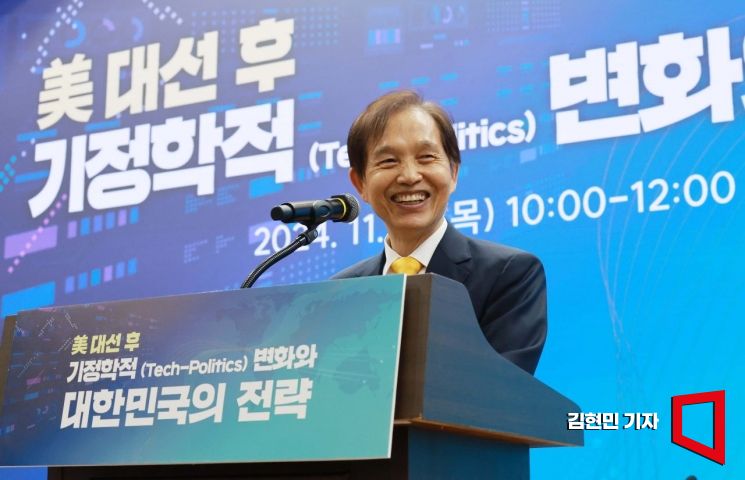 KAIST President Kwang-Hyung Lee is delivering a congratulatory speech at a discussion on Tech-Politics changes after the US presidential election and South Korea's strategy, held at the National Assembly Members' Office Building on the 7th. Photo by Hyun-Min Kim
According to KAIST, on the 29th of last month, the KAIST Board of Directors announced a call for applications to recruit a new president. The application deadline is the 27th of this month. Only those who apply can participate in the KAIST presidential election race.
The current president Lee Kwang-hyung's term ends on February 23 next year. After the application deadline on December 27, the Presidential Candidate Selection Committee will review the candidates and select the final three nominees, followed by personnel screening by the Presidential Office. Then, the KAIST Board of Directors will finalize the candidate through a vote, and with the recommendation of the Minister of Science and ICT and the consent of the Minister of Education, the presidential election will be completed.
To select a successor before President Lee's term expires, all these procedures must be completed within about two months. Considering that personnel screening and other processes took considerable time during the recent appointment of new directors at government-funded research institutes in the science and technology field, the schedule is tight. A science community official also said, "It is true that the schedule has been delayed." Typically, it takes about three months to appoint presidents at the four major science and technology institutes, including KAIST. Of course, compared to Ulsan National Institute of Science and Technology (UNIST), where the recruitment announcement was made only two months after the end of former President Lee Yong-hoon's term, this process can be seen as moving relatively quickly.
The focus is on whether President Lee will seek reappointment and whether Professor Kim Jung-ho will make a rematch. President Lee has not yet expressed his intention to run for reappointment, but the prevailing view within the Ministry of Science and ICT and inside the school is that he will seek reappointment. Observers speculate that President Lee's active external activities since October may have been with reappointment in mind.
Lee Woo-il, former vice chairman of the National Science and Technology Advisory Council and chair of the Presidential Candidate Discovery Committee, said, "We plan to search for candidates domestically and internationally. I believe the current president Lee Kwang-hyung will also be among the candidates." It seems likely that President Lee will challenge the reappointment through communication with the Presidential Candidate Discovery Committee.
Reappointment as KAIST president is not an easy path. Even if the current president is among the candidates, fierce competition is expected. Among past KAIST presidents, only former President Seo Nam-pyo has succeeded in reappointment.
During his tenure, President Lee secured donations exceeding 200 billion won and achieved results such as strengthening cooperation with New York University. He has also greatly expanded his activities outside the school, including serving as chairman of the National Intellectual Property Committee. However, it is reported that there are negative opinions about his reappointment within the school.
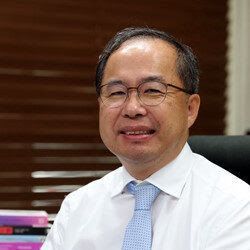 Professor Kim Jeong-ho, KAIST
Professor Kim Jung-ho was selected as a candidate by faculty members along with Professor Ryu Seok-young from the Department of Computer Science. Four years ago, Professor Kim also made it to the final triple shortlist through the same process but did not succeed. At KAIST, there has never been a case where a president was appointed from candidates recommended by internal faculty members.
This aligns with the atmosphere that the KAIST presidential election is not unrelated to the government's position, specifically the Ministry of Science and ICT. KAIST is a science and technology specialized university managed by the Ministry of Science and ICT, not the Ministry of Education. The director of the Future Talent Policy Bureau at the Ministry of Science and ICT is also a KAIST board member.
Lee Chang-yoon, the first vice minister of the Ministry of Science and ICT, also expressed during the National Assembly audit on KAIST in October that since the KAIST president is under government management, the president cannot be selected solely based on internal opinions.
However, Professor Kim has an advantage compared to four years ago. The HBM memory he led the development of has become the hottest product in the AI era. HBM is an essential core component for NVIDIA's GPUs, which are mainly used for AI training. Recently, HBM has also been leading South Korea's semiconductor exports.
Another variable is that former UNIST President Lee Yong-hoon, who was mentioned as a major external candidate, said in a phone interview with Asia Economy, "I will not challenge the KAIST presidency." Lee's absence, who was also considered a candidate for Minister of Science and ICT and senior science and technology advisor to the Presidential Office, increases the likelihood of a rematch between Lee Kwang-hyung and Kim Jung-ho.
© The Asia Business Daily(www.asiae.co.kr). All rights reserved.












