McDonald's Korea "Not Related to Domestic Situation"
Earlier Claims of Kidney Damage from Hamburger Disease Raised
Prosecutors Found No Causal Link, but Consumer Distrust Remains
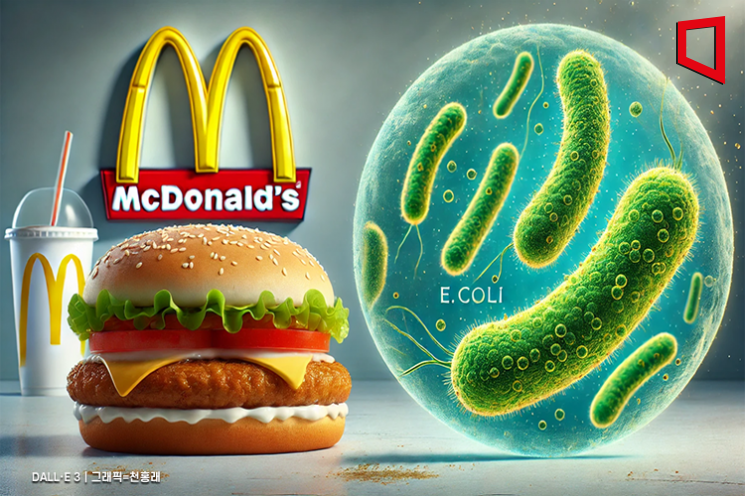
In the United States, a fatal incident occurred after a person consumed a hamburger contaminated with E. coli at McDonald's. Previously, McDonald's had faced significant controversy in South Korea over so-called 'hamburger disease,' and this incident appears to be reigniting concerns about product safety. McDonald's Korea stated that "this issue occurred in the United States and is unrelated to McDonald's Korea."
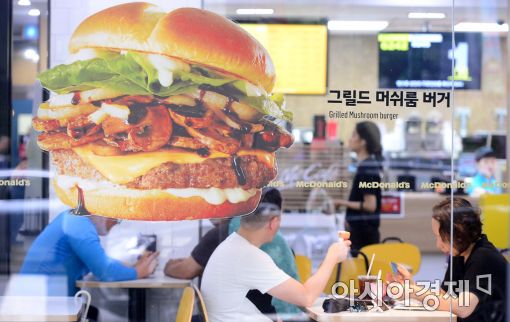 A McDonald's store in downtown Seoul. Photo by Asia Economy DB
According to foreign media including The Wall Street Journal (WSJ) on the 23rd, the U.S. Centers for Disease Control and Prevention (CDC) announced on the 22nd (local time) that E. coli was detected in McDonald's 'Quarter Pounder' burgers. As a result, casualties have been reported in 10 states including Colorado and Nebraska. There has been one death, and 49 people are currently hospitalized. The CDC explained, "The deceased was an elderly person with pre-existing conditions, and the average age of hospitalized victims was 26."
McDonald's suggested that the E. coli may have been detected in thinly sliced onions. It is known that these onions were supplied by one company through three distribution centers. McDonald's instructed to stop using onions in the affected regions and halted the sale of Quarter Pounder burgers in Colorado, Kansas, Utah, and Wyoming. Some locations in Idaho, Iowa, Missouri, Montana, Nebraska, Nevada, New Mexico, and Oklahoma also removed the Quarter Pounder from their menus.
McDonald's emphasized that "products other than the Quarter Pounder were not affected by E. coli" and are still available for purchase in stores. However, the news of the fatal incident caused the stock price to plummet, dealing a significant blow. McDonald's stock closed at $314.69 per share on the 22nd but fell about 10% in after-hours trading following the E. coli announcement. The stock later reduced the loss, closing nearly 5.8% lower than the previous closing price.
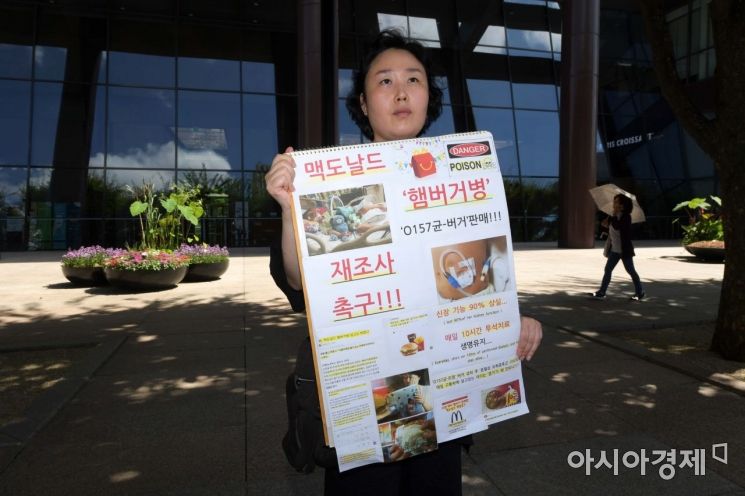 Choi Eun-joo, the mother of a child affected by hamburger disease, is holding a one-person protest urging a reinvestigation in front of the Korea McDonald's headquarters in Jongno-gu, Seoul, on September 12, 2018. About two years ago, Choi's five-year-old daughter developed hemolytic uremic syndrome, losing kidney function after being infected with E. coli from eating a hamburger. Photo by Moon Ho-nam munonam@
The news of the fatal incident at McDonald's in the U.S. has once again brought the safety of McDonald's hamburger products into question in South Korea. In 2017, a consumer sued McDonald's Korea for violations of the Food Sanitation Act after their child was diagnosed with grade 2 kidney failure due to hemolytic uremic syndrome, commonly known as hamburger disease, after eating a hamburger with an undercooked patty. Subsequently, as more people claimed similar symptoms, the hamburger disease controversy escalated significantly.
At that time, prosecutors concluded that it was difficult to establish a causal relationship between McDonald's hamburgers and the disease. However, distrust toward McDonald's hamburgers remains as the supplier of contaminated patties was later caught, and civic groups filed complaints and appeals.
McDonald's Korea maintains that the fatal incident in the U.S. is unrelated to the domestic situation. A representative of McDonald's Korea stated, "This issue occurred in the United States and is unrelated to McDonald's Korea," adding, "We currently use 100% domestically grown onions, and they are strictly managed under the domestic HACCP (Hazard Analysis Critical Control Point) system."
© The Asia Business Daily(www.asiae.co.kr). All rights reserved.













