Developed at government-funded KIST... Clinical trial underway for 'CV-01' by tech investment company Cureverse
Contract worth $370 million with Italy's Angelini Pharma
Ministry of Science and ICT: "Largest export achievement among government-funded research institutes"
A company founded using technology developed by a domestic government-funded research institute has signed a technology export contract worth 500 billion KRW with an overseas buyer company. This is expected to be the largest technology export deal ever made by a research institute under the Korean government.
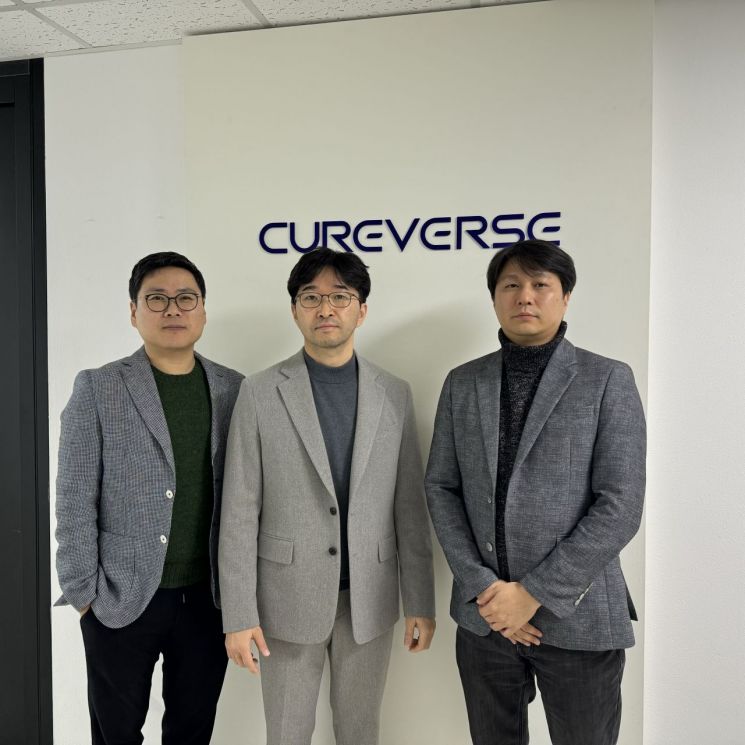 From the left, KIST Center Director Park Ki-duk, Cureverse CEO Cho Sung-jin, Dr. Jin Jung-wook (CSO). Photo by KIST
On the 21st, the Ministry of Science and ICT announced that Cureverse, a bio company founded with technology invested by the Korea Institute of Science and Technology (KIST), signed a technology export contract worth a total of 370 million USD (5.037 trillion KRW, including milestone payments by development stage) with the Italian pharmaceutical company Angelini Pharma.
Cureverse is a brain disease treatment specialist company that has secured differentiated candidate substances for brain inflammatory disease treatments and is developing treatments for Alzheimer's dementia.
The technology subject to transfer is 'CV-01 (CV-ongil)', which began Phase 1 clinical trials last September. The Ministry of Science and ICT expects this contract to be the largest achievement among technology exports from government-funded research institutes, depending on the success of the new drug commercialization. The ministry explained that its intensive support throughout the entire new drug development cycle?from research and development, technology investment and startup, technology commercialization, to clinical trials?led to this global achievement.
Since 2014, Dr. Park Ki-deok and his research team at KIST have developed CV-01, which has a mechanism to treat brain diseases by appropriately regulating the interaction between the 'Keap1·Nrf2' proteins, providing cell protection and inflammation control. CV-01 received clinical approval from the Ministry of Food and Drug Safety in June.
Keap1·Nrf2, a representative in vivo defense mechanism against oxidative stress and inflammation, is known to malfunction due to aging, causing diseases such as dementia and Parkinson's disease.
If CV-01 succeeds in new drug commercialization, it will be the world's first dementia treatment drug based on this mechanism. It is also expected to be applicable to various neurodegenerative diseases caused by brain nerve damage, such as Parkinson's disease and epilepsy.
CV-01 was born through active government support. KIST developed the new drug candidate substance with 4.3 billion KRW funding from the 'National Science and Technology Research Council Future Leading Convergence Research Group' and, with support from the BioStar project, founded the technology investment company Cureverse in 2021, subsequently signing the technology transfer contract for CV-01.
Cureverse received commercialization support such as research institute company registration and tax benefits from the Ministry of Science and ICT, completed non-clinical trials within two years, attracted 8.1 billion KRW in Series A investment, and is currently conducting Phase 1 clinical trials.
Cureverse CEO Cho Sung-jin predicted, "CV-01 has revolutionary potential for dementia, epilepsy, Parkinson's disease, and other neurodegenerative diseases, bringing good news to patients suffering from brain diseases and their families."
KIST President Oh Sang-rok said, "The technology developed by KIST researchers has led to the founding of an advanced bio startup and has become an excellent case of entering the global pharmaceutical market. We will continue to strive to secure world-class core technologies that will be game changers and to achieve technology transfer results with significant impact that the public can feel."
Hwang Pan-sik, Director of the Research and Development Policy Office at the Ministry of Science and ICT, stated, “Thanks to the government's steady support for bio research and development, large-scale bio technology transfer achievements from government-funded research institutes have recently emerged one after another.” He added, “We will continue to promote technology commercialization policies and projects aimed at developing domestic blockbuster new drugs, focusing on an open innovation strategy that links excellent research outcomes from government-funded institutes and universities to clinical trials and commercialization by bio companies.”
© The Asia Business Daily(www.asiae.co.kr). All rights reserved.












