Medical Students Returning from Leave Must Attend Classes Simultaneously with 7,500 Others
Only 4,567 New Students of Class of '25 Subject to KHPLEI Evaluation Criteria
Concerns have arisen that medical schools with increased enrollment this year may fail accreditation by the Korea Institute of Medical Education and Evaluation (KIMEE), and even if they pass accreditation, normal medical education may be impossible. This is because KIMEE's evaluation criteria are based on next year's incoming student numbers, and do not take into account whether medical students who left school this year will return.
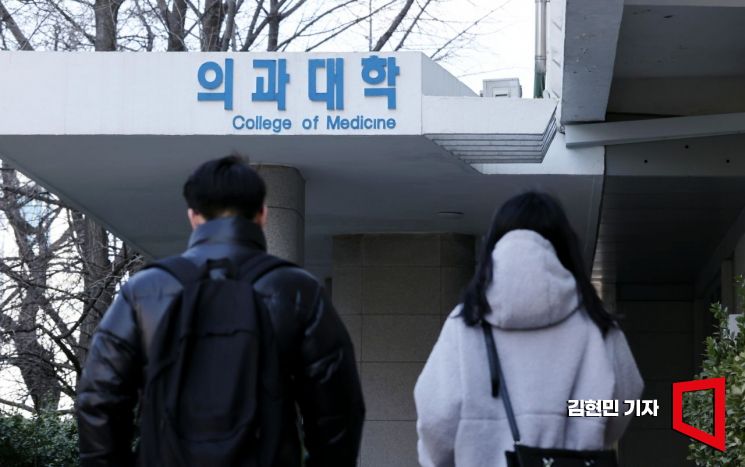
According to Asia Economy's investigation on the 18th, the student number criterion for KIMEE's 'Major Change Evaluation' of medical schools with increased enrollment, starting next month, has been confirmed as 4,567 students, which is the size of next year's medical school freshmen.
Anduk Seon, president of KIMEE, stated, "First, 1,509 freshmen have been added across 30 medical schools. We have explained to the universities how we will evaluate the increased number of students." He added, "We have not yet provided guidance regarding the return of medical students on leave."
Earlier, medical students submitted leave of absence requests in February in protest against the government's plan to increase medical school enrollment by 2,000 students. If these students return in the first semester of next year, there will be a situation where about 7,500 students must attend classes simultaneously.
Professor Euncheol Park of the Department of Preventive Medicine at Yonsei University College of Medicine said, "When these freshmen become clinical students, education and practical training will not be easy." He added, "There will be problems in all aspects related to practical training, including the number of cadavers, microscopes, and beakers." Professor Park also mentioned, "There could be a measure to conduct classes in two shifts by dividing students into Group A and Group B," but he added, "It is already difficult to recruit basic science professors. If that happens, professors will be exhausted from focusing solely on teaching."
KIMEE was established in 2004 by the medical education community with the aim of improving the quality of medical education. It is responsible for evaluating and accrediting medical school curricula. Under the 'Regulations on Evaluation and Accreditation of Higher Education Institutions,' it is designated as an accreditation body by the Ministry of Education and is supervised and guided by the Ministry.
Previously, KIMEE decided to conduct annual major change evaluations for six years starting from the 2025 academic year for 30 medical schools whose enrollment increased by more than 10%. Medical schools that fail accreditation in the evaluation will have students who graduate from the six-year program disqualified from taking the national medical licensing examination.
In response, the Ministry of Education, concerned about the possibility of non-accreditation of medical schools with increased enrollment, has partially amended the 'Regulations on Evaluation and Accreditation of Higher Education Institutions' and is soliciting opinions until the 4th of next month. The amendment mainly aims to require accreditation bodies conducting university evaluations to provide at least a one-year remediation period before declaring a specific university as non-accredited.
© The Asia Business Daily(www.asiae.co.kr). All rights reserved.

![Clutching a Stolen Dior Bag, Saying "I Hate Being Poor but Real"... The Grotesque Con of a "Human Knockoff" [Slate]](https://cwcontent.asiae.co.kr/asiaresize/183/2026021902243444107_1771435474.jpg)














