Four Major Mid-to-Long-Term Strategies to Maximize Radio Wave Expansion and Utilization
Review of Reallocation for 3G, LTE, and 5G Approaching End of Use
Securing Broadband Frequencies and Promoting Radio Wave Industry Development
As digital innovation accelerates, the government has unveiled a blueprint to enhance the utilization of radio waves, a key resource. The plan includes measures to discover and secure 6G, supply additional 5G frequencies, foster the radio wave industry, and support entry into overseas markets to improve the efficiency of radio wave usage.

On the 16th, the Ministry of Science and ICT announced the '4th Basic Radio Wave Promotion Plan' through the Economic Ministers' Meeting. This fourth plan presents four mid- to long-term strategies based on the vision of 'Digital Prosperity Korea Expanding through Radio Waves' by maximizing the expansion and utilization of radio waves. The Basic Radio Wave Promotion Plan is a statutory plan based on the Radio Waves Act.
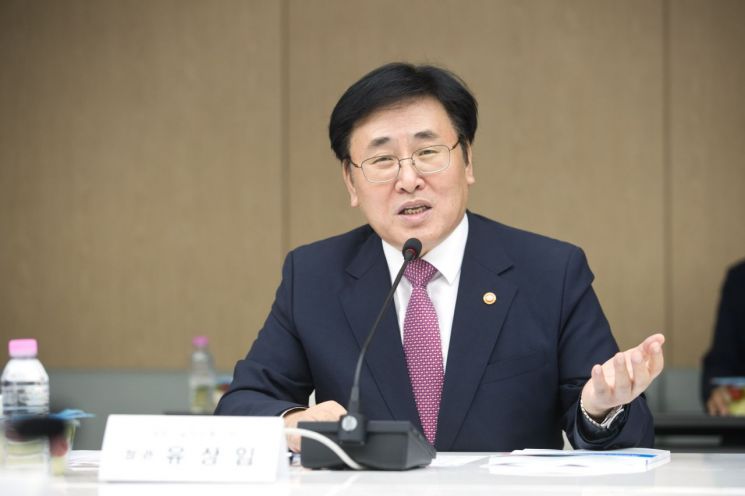
Minister Yoo Sang-im of the Ministry of Science and ICT stated, "As most digital services become wireless amid the global digital innovation trend, the importance of radio waves supporting smooth data flow is increasing. We will actively support the development of radio wave technology, a core resource of digital innovation, and the growth of the radio wave industry, while creating an environment where citizens can use radio waves with confidence."
① Discovering 6G Suitable for Korea... Reviewing Reallocation of 3G, 4G, and 5G
Based on candidate bands adopted at the World Radiocommunication Conference (WRC-23), 6G frequencies will be discovered and secured. Currently, the 6G candidate bands are three: 4.4?4.8 GHz, 7.125?8.4 GHz, and 14.8?15.35 GHz. Decisions on securing and promoting these bands will be made according to domestic usage conditions and trends, and frequency securing plans will be prepared.
Additional supply of 5G frequencies will be considered. The targets include not only the adjacent 3.5 GHz band but also low-band frequencies (700 MHz, 800 MHz, 1.8 GHz bands). The 3.7 GHz band will be supplied to maintain its value for broadband use while allowing multiple operators to participate. The utilization plan for the 28 GHz band, which was not supplied due to the failure of the 4th mobile carrier, is under discussion by a research group, and supply will be reviewed according to the policy direction for the 4th mobile carrier once decided. The introduction of procedures such as financial capability verification for applicants during frequency auctions is also being considered.
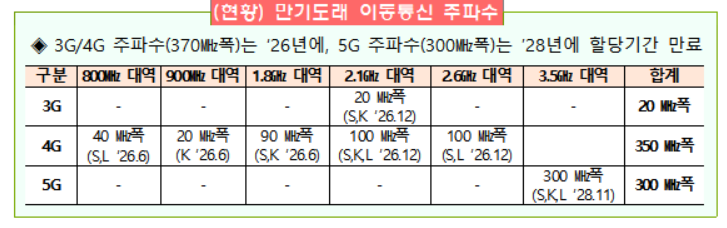
Reallocation of 3G, LTE, and 5G frequencies nearing expiration and securing broadband frequencies will be promoted. For 3G and LTE, as the usage period for frequencies below 3 GHz ends in 2026, the decision on reallocation will be made by June 2025, followed by the establishment of reallocation policies in December of the same year. The reallocation decision for 3G frequencies will consider subscriber protection and the trend of decreasing frequency use. Currently, the number of 3G subscribers, including those for the Internet of Things, is 1.94 million (2.2% as of June last year).
For 5G, the 3.4?3.7 GHz band frequencies will expire in November 2028, with the reallocation decision scheduled for November 2027 and reallocation policies to be established in May the following year.
Broadband frequencies will be secured in low bands (below 1 GHz) and lower mid-bands (1?2 GHz) that enable coverage and cost-effective network construction. Expiring frequencies will be integrated with adjacent bands or secured through new discoveries. The secured frequencies will be supplied as new 6G frequencies or additional 5G frequencies as needed.
In preparation for increased satellite radio wave demand, satellite frequencies will be secured, low-earth orbit satellite communication frequencies allocated, and usage and management systems improved, including the application of foreign satellite terminal permit presumptions.
For Urban Air Mobility (UAM), experimental frequencies (5G frequencies with 20?30 MHz bandwidth) will be supplied first to support research and development, followed by securing and supplying commercial frequencies reflecting international standard trends. Frequency supply for autonomous driving will be reviewed, and the radio wave output standard for wireless charging of electric vehicles will be relaxed from 11KW to 22KW. In the public sector, frequencies for natural disasters and emergencies will be supplied to eliminate blind spots in disaster safety.
② Fostering Key Technologies and Strengthening Market Capabilities for a Radio Wave Industry Powerhouse
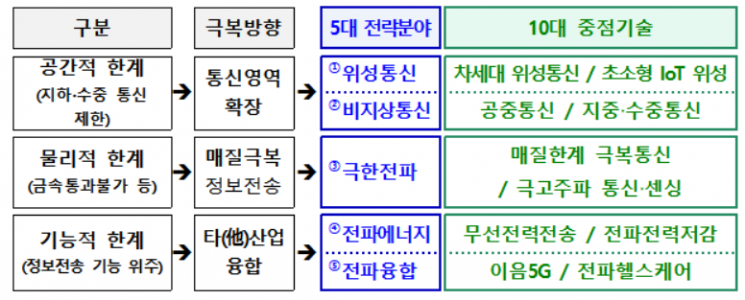
As the application space of radio waves expands from land and sea to space, air, and underwater, usage methods are diversifying. Accordingly, five strategic areas to overcome radio wave limitations (▲ Satellite Communication ▲ Non-Terrestrial Communication ▲ Extreme Radio Waves ▲ Radio Wave Energy ▲ Radio Wave Convergence) and ten key related technologies will be selected and fostered.
To dominate the global wireless market, core radio wave capabilities will also be strengthened. This includes research and development (R&D) of radio wave-based enhancement technologies, discovering and nurturing experts, promoting international standardization activities, and strengthening international cooperation. Additionally, the establishment of a K-Spectrum Fund (tentative name) as a resource for fostering global radio wave companies is being considered, and mutual recognition agreements (MRAs) for testing and certification will be expanded, focusing on target countries for overseas expansion. Regional radio wave industry activation strategies will also be established in connection with the ten key technologies. R&D for low-earth orbit satellite communication will be promoted, and support will be provided to enable business entry in the low-earth orbit satellite communication sector.
The enactment of the Radio Wave Industry Promotion Act will also be pursued. Currently, the Radio Waves Act stipulates the establishment and implementation of the Basic Radio Wave Promotion Plan but lacks specific legal grounds for industrial promotion and does not define the radio wave industry. Therefore, the Radio Waves Act will be divided into the Basic Radio Wave Utilization Act and the Radio Wave Industry Promotion Act, with the latter strengthening the system for promoting the radio wave industry.
③ Expanding Radio Wave Usage Contributing to the Public Interest
Digital wave projects in five major areas?▲ Social Safety ▲ Protection of the Vulnerable ▲ Social Integration ▲ Population Change ▲ Climate Response?will be promoted as digital public and public interest projects. To expand public interest utilization, support, cooperation, and linkage systems such as productization support and demonstration and pilot projects will be established.
An efficiency evaluation system considering frequency demand and band maintenance possibilities will be established, and band maintenance such as efficiency improvement, recovery and reallocation, and shared use will be promoted accordingly. Additionally, a simplified usage system for wireless stations will be introduced, allowing multiple operators to register and use a single channel by dividing usage by time slots, rather than exclusive operation by a single operator.
A pilot project for frequency transfer and lease will be conducted targeting the Eum5G operator, and procedures for transfer and lease will be improved to activate the frequency transfer and lease system. Changes in frequency usage and technical methods, which are currently not permitted by law, will be allowed to induce new technology and service development and investment promotion.
④ Strengthening Radio Wave Security and Creating a Reliable Radio Wave Environment
Radio wave security will be established through the expansion and advancement of GPS monitoring systems and the introduction of an EMP response system based on post-restoration. To respond to illegal drones, the national anti-drone training ground will be expanded, and a damage compensation system for radio wave jamming devices will be introduced, whereby the operator of the jamming device compensates victims first and then exercises subrogation rights against illegal drone users. For space radio wave disaster response, old observation equipment will be replaced, and satellite observation data receiving stations will be expanded. Additionally, a solar activity prediction model will be developed to enable advance warnings during space radio wave disasters.
Furthermore, a comfortable radio wave environment will be created through strict management of electromagnetic wave exposure protection standards, expansion of eco-friendly maintenance of wireless equipment, introduction of low-power base stations using AI semiconductors for carbon reduction, implementation of energy efficiency rating systems, and development of interference identification technology applying big data and AI for advanced radio wave monitoring systems.
© The Asia Business Daily(www.asiae.co.kr). All rights reserved.














