The Supreme Court has ruled that the special exemption from punishment under the Act on Special Cases Concerning the Settlement of Traffic Accidents cannot be applied if an accident occurred while working with a tractor in a rice field, rather than during the movement of the tractor, and the victim does not wish to punish the driver, except in special cases such as traffic accidents involving the 12 major negligent acts.
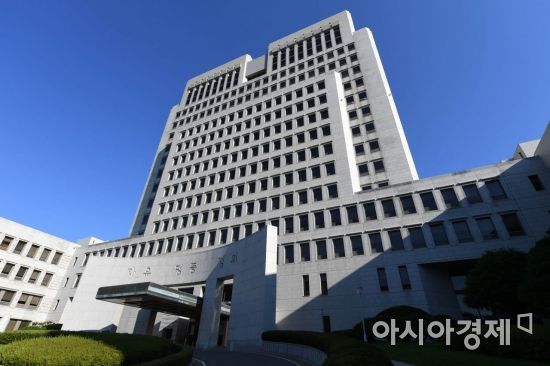
According to the legal community on the 16th, the Supreme Court's First Division (Presiding Justice Shin Sook-hee) upheld the appellate court's decision to overturn the first trial court's dismissal of the indictment in the appeal trial of Jang, who was charged with professional negligence causing injury.
The court stated, "The appellate court, considering the location and circumstances of the accident, concluded that the accident did not simply occur during the movement of the tractor but happened while performing rotary work in the rice field using the tractor (rotary work refers to tilling the bottom of the rice field by overturning the soil with a rotary attached to the tractor). Therefore, it overturned the first trial court's dismissal of the indictment and remanded the case to the first trial court."
It further explained, "There is no error in the appellate court's judgment that it did not violate the rules of logic and experience by failing to conduct necessary hearings, nor did it exceed the limits of free evaluation of evidence, and it correctly applied the law regarding 'traffic accident' under Article 3(1) and Article 2(2) of the Act on Special Cases Concerning the Settlement of Traffic Accidents," thus dismissing Jang's appeal.
The Act on Special Cases Concerning the Settlement of Traffic Accidents (hereinafter referred to as the Special Act) provides a special exemption from punishment considering that criminally punishing all traffic accidents involving professional negligence causing injury under the Criminal Act could lead to an increase in criminal records. It stipulates that if the accident vehicle is insured under comprehensive insurance or the victim does not wish to punish the defendant, and the victim has not suffered serious injury, and the defendant has not committed any of the 12 major negligent acts, the defendant cannot be punished.
Article 1 (Purpose) of the Special Act states, "This Act aims to promote the prompt recovery of damages caused by traffic accidents and enhance the convenience of citizens by stipulating special cases concerning criminal punishment of drivers who cause traffic accidents due to professional negligence or gross negligence."
Article 2 (Definitions) of the same Act defines in Clause 1 the concept of "vehicle" as "vehicles under the Road Traffic Act and construction machinery under the Construction Machinery Management Act." Clause 2 defines "traffic accident" as "an incident causing injury or death to a person or damage to property due to the movement of a vehicle."
Accordingly, a tractor, which is construction machinery under the Construction Machinery Management Act, qualifies as a "vehicle" under the Special Act. Therefore, accidents occurring during the movement of a tractor are considered traffic accidents, and the Special Act applies.
The Supreme Court has previously stated regarding "traffic accident" that "the term 'movement of a vehicle' includes not only the act of driving the vehicle but also acts closely related to it to an extent that can be evaluated equivalently."
Meanwhile, Article 3(2) (Special Exemption from Punishment) of the Special Act stipulates, "For drivers who commit professional negligence causing injury, gross negligence causing injury, or offenses under Article 151 of the Road Traffic Act due to the movement of a vehicle, prosecution cannot be initiated against the explicit will of the victim."
Furthermore, the proviso of the same article excludes the application of this exemption if the driver flees without providing aid after causing injury, abandons the victim by moving them and fleeing, refuses to comply with a breathalyzer test, or commits one of the 12 major negligent acts such as crossing the center line or causing an accident at a crosswalk.
Jang was indicted on charges of professional negligence causing injury for operating a tractor in his rice field in Gwangsan-gu, Gwangju, in March 2022, which resulted in the right leg of his acquaintance A (70 years old at the time of the accident), who was standing behind, being caught in the rotary blades and amputated.
A had sold his used tractor to Jang for 3 million won about four months before the accident. On the day of the incident, Jang was practicing operating and driving the tractor in his rice field to perform rotary work to finely crush the soil. A happened to pass by, saw this, and offered to teach Jang how to operate and drive the tractor, to which Jang agreed.
After A explained the tractor operation method and demonstrated rotary work on one side of the rice field, Jang said he would try the rest and got into the tractor driver's seat. However, Jang failed to notice A standing behind the tractor, pressed the clutch to move the tractor forward, lowered the rotary blades, and operated the forward gear. At that moment, A's right leg was caught in the rotating rotary blades.
As a result of the accident, A's right leg was amputated up to the thigh, causing permanent disability.
In Jang's trial for professional negligence causing injury, the key issue was whether the injury caused by the tractor to A could be considered a "traffic accident." There was no dispute that the tractor qualifies as a "vehicle" and that Jang's negligence caused injury to A, but whether the special exemption under the Special Act could be applied was contested.
The first trial court ruled that it was a "traffic accident" occurring during the movement of a vehicle (the tractor) and dismissed the indictment.
The court reasoned that since A had explicitly expressed that he did not wish to punish Jang before the trial, prosecution was not permissible, yet the indictment was filed.
The court stated, "According to the records, it is recognized that the victim explicitly expressed his intention not to punish the defendant before the indictment was filed. Therefore, the indictment is invalid as it violates legal procedures, and the indictment is dismissed."
The court added, "Although the victim expressed a desire to punish the defendant again around December 30, 2022, after the indictment, under the principle of offenses requiring the victim's complaint, the person who expressed a desire not to punish cannot arbitrarily withdraw that intention, so the expression has no effect."
However, the second trial court's judgment differed.
The court accepted the prosecutor's appeal reason that the accident could not be regarded as causing injury due to the movement of a vehicle, and thus the Special Act did not apply.
As grounds for this judgment, the court cited: ▲ Jang had kept the tractor in his rice field continuously after purchasing it from A (indicating the tractor was not being moved) ▲ The tractor was in Jang's rice field immediately before the accident, and Jang was preparing for rotary work ▲ The tractor was used for rotary work just before the accident ▲ At the time of the accident, Jang lowered and rotated the rotary blades to perform rotary work (if it had been merely moving the tractor, the blades would not have been lowered or rotated).
The second trial court concluded that since Jang had never moved the rotary externally and both A and Jang had performed rotary work just before the accident, the accident occurred during the "rotary work" process, not during the "movement" of the tractor.
The Supreme Court also found no problem with the second trial court's judgment.
According to the Criminal Procedure Act, if the second trial court overturns a dismissal of indictment, the first trial court will retry the case. Since the Supreme Court found the first trial court's dismissal of indictment to be erroneous, it is expected that Jang will be found guilty in the retrial.
© The Asia Business Daily(www.asiae.co.kr). All rights reserved.












