"Price Expected to Be Set Below $30,000"
Market Reaction Is Uncertain
The robo-taxi, Tesla's secret weapon that has attracted market attention, has finally made its debut.
On the 10th (local time), Tesla held the 'We, Robot' event at Warner Bros. Studios in Burbank, California, unveiling the robo-taxi prototype 'Cybercap.'
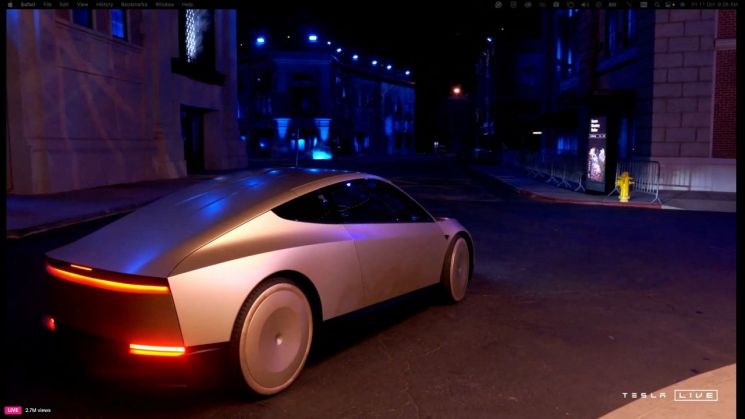
Elon Musk, Tesla CEO, appeared driving the two-seater Cybercap around the studio and said, "The future of autonomous driving has arrived," adding, "Tonight, there are 50 fully autonomous vehicles (FSD) here, and both these Y models and the Cybercap are driverless cars."
The two-door Cybercap is designed without a steering wheel or pedals and uses wireless charging. CEO Musk explained that the Cybercap is planned for mass production in 2026, with a price set below $30,000 (about 40 million KRW). He also added that operating costs will be 20 cents per mile.
Musk stated, "We will enable robo-taxi experiences through all Tesla vehicles, including Model 3, Model Y, and Model S, in regions approved by regulators," and expressed confidence that "full autonomous driving could be possible as early as next year in Texas and California."
At the event, a large autonomous driving concept car called 'Robovan,' capable of carrying up to 20 people, and the humanoid robot 'Optimus' also made appearances. Musk emphasized, "In the long term, the price of the Optimus robot will be set at $20,000 to $30,000," adding, "They will also be responsible for serving drinks at today's event." The event, broadcast live on X (formerly Twitter) and YouTube, captured scenes of Optimus robots taking photos with the audience and handing out drinks.
However, the market reaction was somewhat lukewarm. Tesla's stock, which had risen about 3.5% in after-hours trading following the announcement of the Cybercap's reasonable price, gave back its gains and even dropped as much as 5% during the session toward the end of the event.
Dennis Dick, a stock trader at Triple D Trading, said, "As a shareholder, I am quite disappointed," adding, "Everything seems great, but the market wanted a more definite timeline, and Musk did not provide much information." Contrary to Musk's bold claims, it is assessed that it will take considerable time for full autonomous driving to operate entirely without driver intervention and to clear regulatory hurdles.
The robo-taxi sector is not only Tesla's Cybercap but also includes Alphabet (Google's parent company) with 'Waymo' and General Motors (GM) with 'Cruise,' all competing in the field. Earlier, Alphabet announced plans in July to invest an additional $5 billion (about 7 trillion KRW) in Waymo over several years. As for Cruise, it received permission last year to operate the autonomous shuttle 'Origin' in San Francisco, but production has been indefinitely delayed following a series of accidents.
© The Asia Business Daily(www.asiae.co.kr). All rights reserved.












