Following the U.S. Federal Reserve (Fed), expectations are growing that the Bank of Korea will soon cut its benchmark interest rate, leading to a surge of idle funds flowing into banks. While there is a continued rush for deposits and savings accounts to take advantage of the last high-interest rates before the rate cut, standby funds are also increasing simultaneously in preparation for new investment opportunities such as real estate.
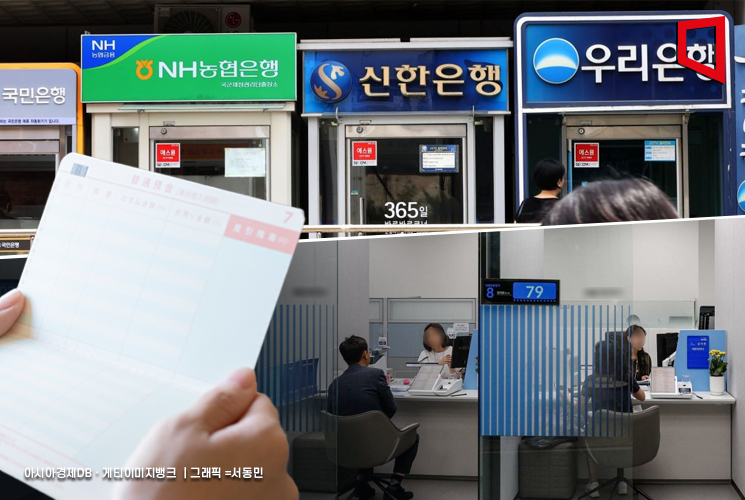
According to the financial sector on the 4th, the combined demand deposit balance of the five major domestic banks (KB Kookmin, Shinhan, Hana, Woori, and NH Nonghyup) stood at 623.3173 trillion won as of the end of September, up 6.085 trillion won (0.99%) from the previous month. This marks nearly a 1% increase for two consecutive months, following the 1.01% rise in the previous month.
Demand deposits, which include ordinary deposits and on-demand withdrawal deposits (commonly known as parking accounts), typically offer significantly lower interest rates compared to regular savings but allow depositors to withdraw or deposit funds at any time. As such, they are considered 'investment standby funds' due to the ease of moving money into investment assets such as securities and real estate.
The increase in demand deposits is attributed to the sluggish domestic stock market and expectations of an interest rate cut. As the domestic stock market continues to decline, funds are flowing into banks in search of alternative investment options, and money is also accumulating in banks as standby funds in anticipation of new investments in real estate, securities, and other areas following the rate cut.
In fact, according to the Korea Financial Investment Association, domestic investor deposits reached 59 trillion won in early August but fell to the 50 trillion won range by late last month. Although there has been a subsequent upward trend, this reflects the downward trend of the domestic stock market.
At the same time, funds are also flowing into fixed-term deposit and savings products to catch the last ride on high interest rates. The balance of fixed-term deposits and savings at the five major banks at the end of last month reached 968.4787 trillion won, up 6.2501 trillion won (0.64%) from the previous month. While this does not match the nearly 17 trillion won inflow in August (a 1.81% increase), the upward trend continues.
This is analyzed as a result of demand concentrating on capturing the last high-interest rates amid growing expectations of a rate cut. According to the Korea Federation of Banks, as of the previous day, the one-year fixed deposit interest rates at the five major banks ranged from 2.50% to 3.42%, with preferential rates reaching up to 3.80%.
Each bank is actively attracting deposits by offering special high-interest deposit and savings products. For example, KB Kookmin Bank launched the 'KB Star Savings' last month, an online-only product offering a base interest rate of 2% per annum and up to 8% interest. Shinhan Bank also released the 'Spend and Save Consumer Savings' Season 2, a six-month fixed-term savings product. Customers using KakaoPay for payments can save up to 500,000 won per month with a maximum interest rate of 6% per annum.
A banking industry official said, "September is usually a season with high expenses due to holidays and moving demands, so the increase in demand deposits, even considering holiday bonuses, is somewhat unusual though not far from the normal level. Regarding deposits and savings, it seems that the active release of special products by each bank and expectations of an interest rate cut are reflected."
© The Asia Business Daily(www.asiae.co.kr). All rights reserved.












