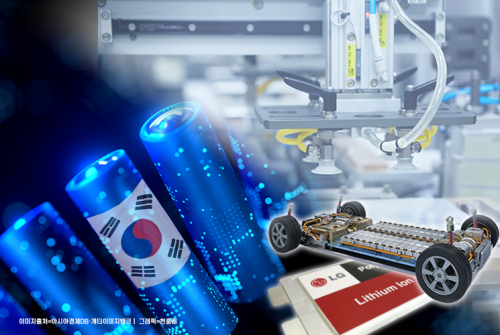
"The chasm, which signifies a temporary stagnation in growth, is causing difficulties for domestic battery companies, but China is not experiencing a chasm."
Kim Gwangju, CEO of SNE Research, stated at the '2024 Korea Advanced Battery Conference (KABC)' held at the Seoul Science and Technology Center on the 24th, "The biggest crisis for Korean batteries right now is China," adding, "It is time to benchmark China's battery industry and national policies in reverse." He pointed out that China is ahead in core technologies such as cathode materials, anode materials, precursors, and packaging, and that the Chinese government is implementing massive support policies, which Korea should also refer to.
SNE Research analyzed the slowdown in the US and Chinese economies and the lack of electric vehicle charging infrastructure as major causes of the chasm. According to a survey by SNE Research, 47% of consumers want 3~4C (charging completed in 15~20 minutes) technology. The reduction or elimination of electric vehicle subsidies by major countries worldwide is also a key factor in the slowdown of the electric vehicle market growth. CEO Kim explained, "The subsidy reduction policies intended to check China are instead having a greater negative impact on electric vehicles in other countries, resulting in an increased share of low-priced Chinese products."
In fact, in the first half of this year, the electric vehicle market including battery electric vehicles (BEV) and plug-in hybrids (PHEV) grew by 30.9% in China, while the US grew by 11.0% and Europe by 3.0%. China has entered the commercialization phase in earnest this year and is expected to continue growing even without subsidy policies in the future. North America and Europe are expected to enter the commercialization phase around 2029~2030.
Excluding China, the market share of Chinese battery companies in the global market increased from 35.1% last year to 38.9% in the first half of this year. SNE Research analyzed, "Production and sales by Chinese companies are becoming full-scale in E7 countries such as Brazil, India, and Turkey, as well as in the five ASEAN countries centered on Thailand, so the high share of Chinese companies is expected to be maintained for the time being."
One of the main reasons for the increased market share of Chinese battery companies is the expanded adoption of low-cost LFP (Lithium Iron Phosphate) batteries. In particular, the price gap between LFP and ternary batteries has widened due to the price decline of LFP cathode materials. The price gap between NCM (Nickel Cobalt Manganese) 622 and LFP batteries was $18 in the first half of last year but expanded to $36 in the first half of this year.
Accordingly, the number of electric vehicle models equipped with LFP batteries has also significantly increased in markets outside China. Outside China, there was only one LFP-equipped electric vehicle model in 2020, but this increased to 39 in the first half of this year.
CEO Kim emphasized that for domestic battery companies to overcome the chasm, it is urgent to develop next-generation batteries with improved safety, such as prismatic LFP batteries with price competitiveness and solid-state batteries. He analyzed, "The three domestic battery companies underestimated the competitiveness of LFP in the past and missed the opportunity," adding, "LFP adoption is increasing not only in passenger cars but also in commercial vehicles such as buses and trucks, as well as in energy storage systems (ESS)."
Along with this, active policy support from the government is also necessary. CEO Kim stressed, "From 2012 to 2022, the government expenditure budgets of Korea and China differ by 7 to 8 times, purchase subsidies by 11 times, and research and development (R&D) support by 8 times," adding, "More investment is required in purchase subsidies, infrastructure, and R&D support, and it is time for national-level policies to induce the transition to electric vehicles."
Meanwhile, SNE Research has revised down the market size forecast for electric vehicle batteries due to the impact of the chasm. The company's forecasted market size for electric vehicle batteries in 2035 is 4,395 GWh, which is 862 GWh lower than the previous estimate. Due to the expansion of the Chinese electric vehicle market, China's battery market share is expected to increase from 54% in 2023 to 57% in 2030, but then decline afterward. CEO Kim predicted, "After 2030, short-term supply shortages may occur in some regions."
© The Asia Business Daily(www.asiae.co.kr). All rights reserved.











