Analysis Based on Population, Location, Regional Value, and Specificity
A 'Regional Characteristic MBTI' categorizing identities based on population, location, and other factors has been developed for 89 population-declining areas.
The Ministry of the Interior and Safety and the Korea Research Institute for Human Settlements announced on the 23rd that they have distributed the analysis results of this 'Regional Characteristic MBTI' to population-declining areas.
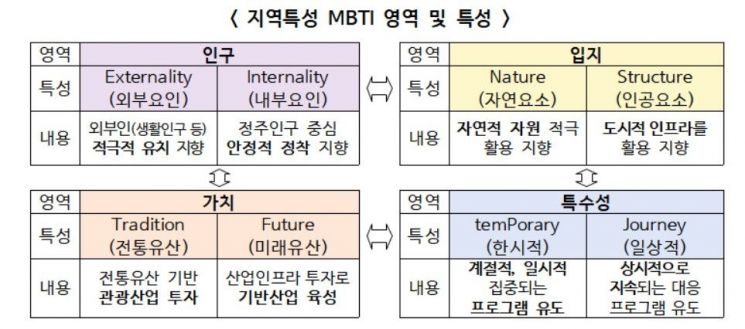
The 'Regional Characteristic MBTI' is a system modeled after the popular personality test MBTI, analyzing regional identities by combining four characteristics: population (E/I), location (N/S), regional value (T/F), and specificity (P/J), resulting in 16 types. To help each region utilize the analysis results, a comprehensive (quantitative) index for population-declining areas is combined to provide tailored implications for local extinction response strategies.
The Ministry of the Interior and Safety conducted a survey of 6,874 residents in population-declining areas to derive the 'Current Regional Perception MBTI' and the 'Desired Future Regional MBTI.'
According to the survey, 57.3% (51 areas) of population-declining regions corresponded to INTP in terms of 'current regional perception,' making it the most common type. INTP regions are characterized by ▲ a stable residential environment with high neighborly intimacy (I), ▲ concentration of visitors during specific local events (P), ▲ possession of excellent natural assets and traditional heritage utilized as tourism resources (N), and ▲ emphasis on traditional values (T).
Next were 'ENTP' (26 areas), characterized by high openness to outsiders and concentration of visitors during specific local events, and 'INFP' (9 areas), which utilize excellent natural assets as tourism resources and have developed representative local industries.
Regarding the desired future regional image, ESTP and ENTP (19 areas each), ESFP (14 areas), and ESTJ (11 areas) were prominent.
The Ministry of the Interior and Safety plans to regularly analyze and distribute related indicators in connection with the re-designation of population-declining areas.
Kim Min-jae, Deputy Minister of the Ministry of the Interior and Safety, stated, "This can be used as data for local governments to establish distinctive local extinction response strategies and policies that align with residents' perceptions and preferences. We will provide diverse analyses and tailored support so that each population-declining area can develop with its unique characteristics."
© The Asia Business Daily(www.asiae.co.kr). All rights reserved.












