2025 Total Fiscal Expenditure to Increase by 0.7%
Focused Investment on Securing Green Bio Core Technologies and Developing and Spreading Solutions to Agricultural Field Challenges
The Rural Development Administration (RDA) has decided to invest 1.1052 trillion KRW in next year's budget to promote the smartization of agriculture and address current issues.
On the 2nd, the RDA announced that the 2025 budget proposal (based on total fiscal expenditure) has been organized at 1.1052 trillion KRW, an increase of 0.7% (7.3 billion KRW) compared to 2024. In particular, the research and development (R&D) sector increased by 4.7% (27.4 billion KRW) to 609.7 billion KRW from 582.3 billion KRW in 2024.

The RDA plans to focus its 2025 budget investment on key areas to achieve results in core tasks such as ▲expanding future response growth engines ▲improving food self-sufficiency rates ▲stabilizing production and supply of agricultural and livestock products ▲revitalizing agriculture and rural areas.
First, 138 billion KRW will be invested to promote smart agriculture as a future growth industry, develop digital breeding models, and support the industrialization of food tech. New projects will be launched, including the development of open-field smart agriculture utilization models such as building data- and artificial intelligence (AI)-based smart orchards (3.8 billion KRW) and the expansion of open-field smart technology convergence demonstration models to promote intelligent precision agriculture production systems (2.4 billion KRW).
To expand digital breeding foundations, the RDA will strengthen the development of promising line selection technologies using national standard breeding big data and AI, and expand the construction of a national breeding platform (6.3 billion KRW → 7 billion KRW) and next-generation crop new breeding technology development (5.3 billion KRW → 7 billion KRW) to support the revitalization of the private seed industry.
Additionally, to add high value to agricultural and livestock products and agricultural food materials, the RDA will newly promote the establishment of an agricultural life microbiome innovation technology base (4 billion KRW) and the development of eco-recycling technology for agricultural by-products (5 billion KRW) to support the industrialization of food tech, including integrated information services for useful agricultural microorganisms and functional materialization of discarded agricultural by-products.
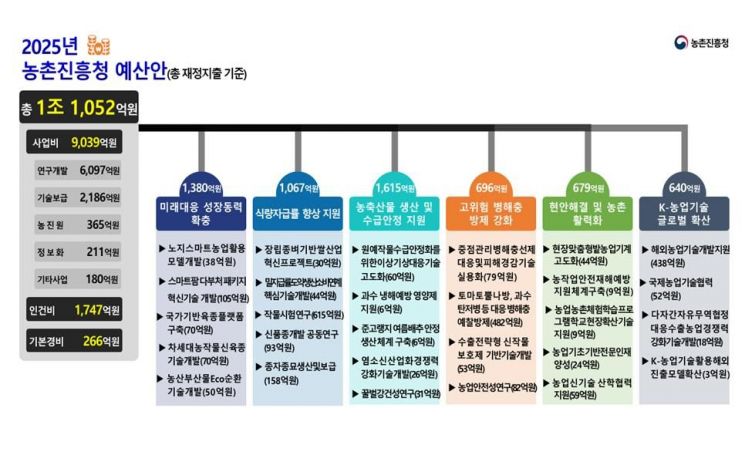
To improve food self-sufficiency rates, 106.7 billion KRW will be invested in developing new varieties of powdered rice with enhanced cultivation stability and yield improvement technologies, developing Korean-type long-grain rice varieties for import substitution and export, customized wheat and soybean varieties by use, and flood damage prevention technologies for paddy soybeans to strengthen the cultivation stability of food crops.
A new project, the Long-Grain Rice-Based Rice Industry Innovation Project (3 billion KRW), will be launched to develop long-grain rice varieties and stable production technologies to regulate rice supply and demand, respond to the demand of foreign residents in Korea, and promote exports. Also, to overcome the constraints of double cropping cultivation that hinder domestic wheat production expansion and to promote consumption through quality improvement, a new project for developing core technologies linking production and consumption to boost wheat self-sufficiency rates (4.4 billion KRW) will be initiated.
Support for agricultural and livestock production and supply stabilization in response to climate change will also be pursued. The RDA will invest 161.5 billion KRW to develop technologies to mitigate damage to agricultural and livestock products caused by abnormal weather and climate change, breed varieties resistant to disasters and pests, and support supply and demand stabilization through standardization of production, harvesting, and shipment data of agricultural products.
To stabilize supply and demand of major horticultural crops such as vegetables and fruits, new projects will be launched to advance abnormal weather response technologies (6 billion KRW) and establish a stable production system for summer cabbage in semi-highland areas (0.6 billion KRW), along with a new plan to support nutrients for fruit frost prevention (0.6 billion KRW).
Furthermore, research on bee robustness will be expanded from 1.7 billion KRW to 3.1 billion KRW, including digital management technologies to prevent bee deaths due to climate change and breeding of native bee varieties. A new project to develop goat new industrialization support technologies (2.6 billion KRW) will be launched to support the industrialization of native black goats through standardized full-cycle production.
Additionally, 69.6 billion KRW has been allocated to strengthen high-risk pest and disease control, 67.9 billion KRW for solving current issues such as mechanization of field agriculture and revitalization of rural areas, and 64 billion KRW for the global expansion of K-agricultural technology.
RDA Administrator Kwon Jae-han said, "The 2025 budget proposal focuses on fostering Korean agriculture as a future growth industry through the development and field expansion of smart agriculture technologies that integrate advanced sciences such as digital breeding, and on enhancing the vitality of agriculture and rural areas by solving field difficulties such as mechanization of field agriculture, supply and demand stabilization in response to climate change, and pest and disease control."
The RDA's 2025 budget proposal was submitted to the National Assembly on the 2nd and is expected to be finalized in December after review and approval by the Assembly.
© The Asia Business Daily(www.asiae.co.kr). All rights reserved.













