'AI Company Transformation' of 3 Major Telecoms
Examining ESG Management Practices
Questioning the Feasibility of RE100 Implementation
The proportion of renewable energy use by the three major mobile carriers, which must catch two rabbits?artificial intelligence (AI) technology and carbon neutrality?was found to fall far short of their targets. Although they pledged to increase the share of renewable energy to over 50% of total energy consumption by 2030, recent figures show it is less than 10%. Considering only six years remain to achieve the goal, there are bleak assessments that it is practically impossible.
According to the industry on the 29th, SK Telecom's renewable energy usage ratio last year was 8.6%. LG Uplus was second at 6.96%, while KT was much lower at only 1.1%. SK Telecom and KT are global RE100 member companies that have pledged to cover 100% of their electricity consumption with renewable energy by 2050. To achieve this, SKT declared it would raise the share of renewable energy use to 65% by 2030, and KT to 56%. Although LG Uplus is not a global RE100 member, it joined the Korean-style RE100 (K-RE100) in 2022 and is promoting the expansion of renewable energy share. Its target renewable energy transition ratios are 48% by 2030 and 100% by 2050, the same as KT and SKT.
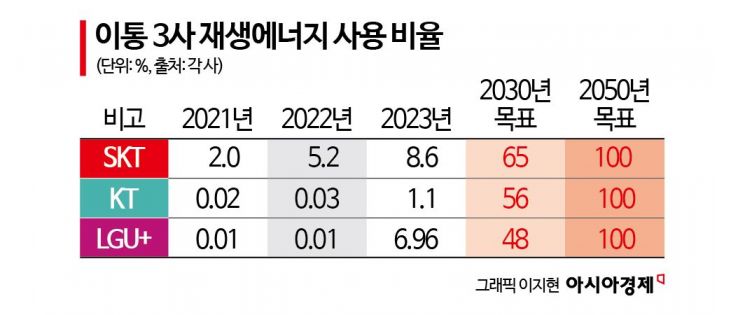
KT’s Renewable Energy Share ‘Last Place’
The emergency in achieving the renewable energy goals of the three mobile carriers is due to the surge in electricity consumption. All these companies are attempting to transform into AI companies. The core of energy in the AI era is electricity. As electricity usage increases, ESG (Environmental, Social, and Governance) management faces a crisis. The increase in 5G service communication equipment has also led to higher greenhouse gas emissions. SK Telecom’s total greenhouse gas emissions last year were 1,149,240 tCO2e, a 4.3% increase from the previous year.
SK Telecom established an ESG Committee in 2021 to oversee the overall direction, goals, and implementation of ESG initiatives. However, the ESG committee members, including Chairperson Oh Hye-yeon, a professor in the Department of Computer Science at KAIST, Professor Yoon Young-min from Korea University’s Media Department, and Associate Professor Kim Jun-mo from KAIST’s Department of Electrical Engineering, are figures far removed from environmental expertise. Regarding this, an SK Telecom official said, "The ESG Committee is an organization under the board of directors with the highest decision-making authority," adding, "It reviews overall management from an ESG perspective, including environmental issues."
KT’s annual electricity consumption has been increasing every year, from 21,581 TJ (terajoules) in 2021 to 22,331 TJ in 2022, and 23,086 TJ last year. A bigger problem is that the 2022 energy consumption statistics excluded KT Cloud, which operates data centers. KT Cloud is a wholly owned subsidiary of KT, launched in April 2022. Data centers are known as “electricity guzzlers” due to their high energy consumption, making the need for renewable energy transition even greater in this area.
To increase its renewable energy usage ratio, KT built 101 solar power plants nationwide as of the end of last year. However, the annual solar power generation last year was 9,530 MWh, of which only 1,376 MWh was self-consumed.
LG Uplus also shows a rising trend in greenhouse gas emissions. Direct and indirect greenhouse gas (Scope 1 and 2) emissions steadily increased from 1,398,814 CO2eq (tons of CO2 equivalent) in 2021 to 1,475,232 CO2eq in 2023. Other indirect emissions not included in this amounted to 560,417 CO2eq last year, about one-third of the direct and indirect greenhouse gas emissions.
The mobile carriers are relying on the Green Premium system targeted at RE100 companies. The Green Premium is considered the easiest way to achieve RE100. It involves paying an additional premium on electricity bills to Korea Electric Power Corporation to purchase electricity at a higher price. The extra fees generated are used by the Korea Energy Agency to invest in renewable energy.
For example, when looking at LG Uplus’s total renewable energy usage, solar power generation in 2023 (3.82 TJ) decreased compared to the previous year (4.02 TJ). However, the Green Premium increased by 2,141 TJ, so the total renewable energy usage significantly increased compared to the previous year (4.02 TJ), when there was no Green Premium at all.
Strong Institutional Support and Active Investment in the U.S.
The low utilization of renewable energy by domestic mobile carriers is also compared with overseas companies. U.S. telecom company T-Mobile, a RE100 member, actively invested in large-scale wind and solar power generation and succeeded in covering 100% of its electricity consumption with renewable energy by the end of 2021.
T-Mobile actively utilized the Renewable Energy Certificate (REC) system. It funded clean power projects across the U.S. and fulfilled its RE100 obligations with renewable energy produced through these projects. Louisa Plotnick, North America Program Manager at the Climate Group, an international nonprofit foundation co-leading the RE100 campaign, praised, "T-Mobile is an exemplary leader in sustainability within the industry."
Big tech company Google also signed a contract with renewable energy company Energetics to supply 1.5 GW of solar energy by 2030 for its data center operations.
The active use of clean energy by U.S. companies is also influenced by the Inflation Reduction Act (IRA). In 2022, the U.S. passed the IRA, focusing on climate change response and clean energy activation. Under this law, the U.S. government plans to invest $369 billion (about 486 trillion KRW) over ten years until 2031 in clean energy and climate change response. This includes tax benefits for carbon-free energy production facilities. Experts commonly agree that achieving RE100 requires not only corporate will but also government incentives and efforts to expand renewable energy distribution.
Jang Hyun-sook, Senior Research Fellow at the Korea International Trade Association, suggested, "Incentives and financial support should be strengthened to compensate for the costs of purchasing renewable energy, and efforts to expand renewable energy distribution and infrastructure should continue." Jeong Hoon, Research Fellow at the Future Institute, emphasized, "It is time to prepare a comprehensive strategy for carbon neutrality and strengthening industrial competitiveness."
© The Asia Business Daily(www.asiae.co.kr). All rights reserved.

![Clutching a Stolen Dior Bag, Saying "I Hate Being Poor but Real"... The Grotesque Con of a "Human Knockoff" [Slate]](https://cwcontent.asiae.co.kr/asiaresize/183/2026021902243444107_1771435474.jpg)















