Internal Procedures Finalized... 'KRX' Name Tag Attached
External Experts and Value-Up Advisory Panel Meetings Remaining
Top Comprehensive Asset Managers Compete to Prepare ETF Products
The Korea Exchange (KRX) has completed the development of the 'KRX Korea Value-Up Index (Value-Up Index),' which is expected to serve as a catalyst for resolving the Korea Discount (the undervaluation of the Korean stock market). If the linked testing proceeds smoothly throughout September, related domestic exchange-traded funds (ETFs) could be available as early as the end of November.
According to the government and the financial investment industry on the 29th, the Exchange recently completed the initial development of the Value-Up Index and finalized internal reporting and approval procedures. Next month, a linked test will be conducted to verify the accuracy and reliability of the Value-Up Index. Since the index name includes 'KRX,' the Exchange will check whether the index calculation has been accurately performed over the one-month period.
Typically, before the Exchange publicly releases a stock price index to the market, it conducts marketability tests. It is expected that the Value-Up Index will also undergo such marketability verification tests. The calculated index will be linked with the stock price trends of the past five years to examine performance such as market returns. A financial investment industry official said, "This is a process to check how the index differs from other KOSPI indices across different market phases."
Afterwards, the Exchange plans to announce the final version of the Value-Up Index around the end of September, following feedback and revisions based on external expert opinions. The related matters will also be discussed at the 'Corporate Value-Up Advisory Group' meeting scheduled for the 2nd of next month. Although the final communication stage with the Financial Services Commission, the supervisory authority, remains, the Exchange's willingness, which holds responsibility for index development and operation, is expected to be crucial.
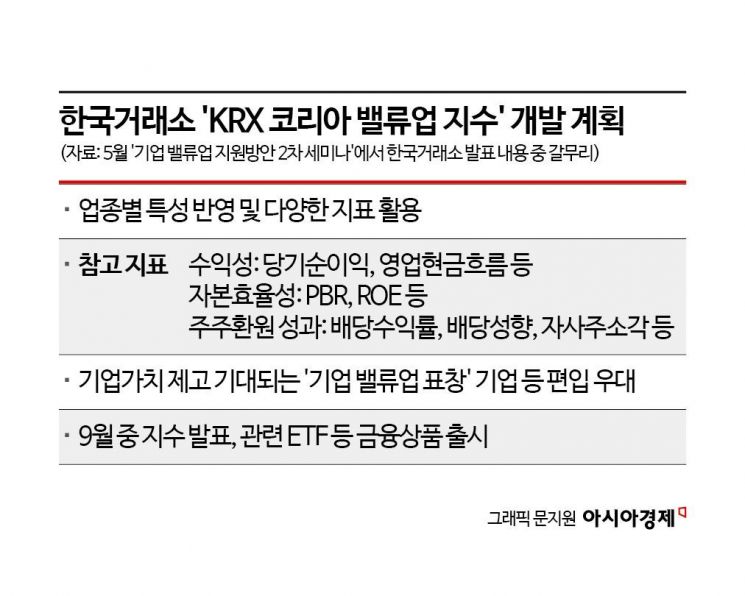
The market's greatest interest lies in the criteria for selecting constituent stocks. The Exchange has stated its intention to utilize various indicators reflecting sector-specific characteristics. For example, profitability indicators include net income and operating cash flow, while capital efficiency indicators include price-to-book ratio (PBR) and return on equity (ROE). Shareholder return performance indicators include dividend yield, dividend payout ratio, and treasury stock cancellation. Companies receiving the 'Corporate Value-Up Commendation,' to be announced in May next year, will receive additional points when being included in the index.
Because there are significant differences in indicators across sectors, the weighting assigned can affect which stocks are included. Financial and telecommunications sectors tend to have higher dividend yields compared to other sectors. Conversely, the bio and internet sectors are characterized by higher multiples due to their sector nature. The Japanese 'JPX Prime 150 Index,' which the Exchange is expected to reference, selects 75 stocks with high capital profitability and 75 stocks with high market valuation profitability from the top 500 stocks by market capitalization in the Japan Prime Market. However, unlike existing high-dividend theme indices such as the 'KOSPI High Dividend 50 Index,' the Value-Up Index is expected to actively consider non-financial indicators including governance, making qualitative evaluation a 'plus alpha' factor.
Because of this, the asset management industry anticipates that multiple indices, rather than a single index, will be launched. A representative from a major asset management firm said, "We have not yet received specific details from the government," but added, "Multiple indices need to be released to create various products, and having diverse index development methodologies allows coverage of a broader range of stocks, so we expect several indices to be introduced."
Related ETF products are expected to be launched as early as the end of November. The government has also anticipated a 2-3 month timeframe. In a prior government pre-demand survey, seven leading comprehensive asset management companies responded positively to product launches. To avoid controversies over benefits to specific management companies, approvals and listings of each company's ETF products are also expected to proceed around the same time.
The asset management industry is expressing anticipation for the launch of the Value-Up Index. This is because pension fund tracking capital is likely to flow into ETFs based on the Value-Up Index. Lee Seok-won, head of the Strategy Division at the National Pension Service Fund Management Headquarters, stated at a press briefing in March, "We support the direction of the Value-Up program," and added, "If it aligns with the direction of the National Pension Service, we can allocate funds." The National Pension Service's fund management scale surpassed 1,100 trillion won this year.
Institutional and individual investors have also become busy proactively seeking beneficiary stocks. The fact that the National Pension Service added securities stocks, considered low PBR stocks, such as Kiwoom Securities and Samsung Securities at the end of May, has also drawn attention. In particular, Kiwoom Securities was noted as the first domestic company to disclose Value-Up information.
Researcher Yum Myung-gan of Mirae Asset Securities stated in a report, "Value-Up is a good investment alternative during times of high uncertainty such as the U.S. presidential election and increased concerns about corporate earnings," and advised focusing on beneficiary sectors in September such as automobiles, banking, insurance, shipbuilding, defense, healthcare, internet, and gaming.
© The Asia Business Daily(www.asiae.co.kr). All rights reserved.












