Lee Chang-yong, Governor of the Bank of Korea, "Interest Rate Held Steady Due to Concerns Over Housing Prices and Household Debt"
Responds to Political Criticism of Rate Freeze
Uncertainty Over October Base Rate Cut
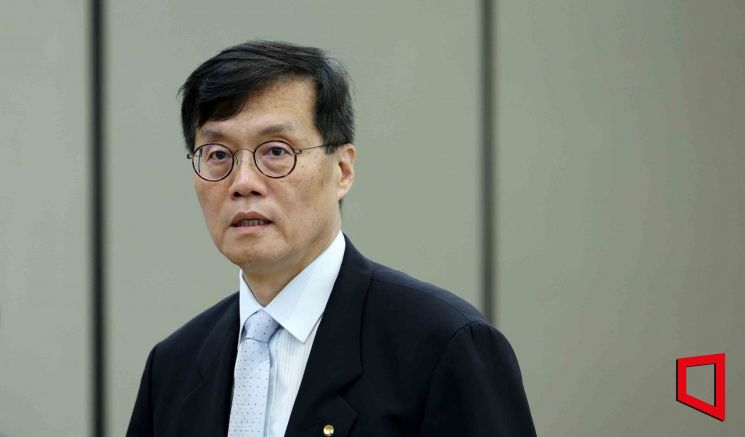 Lee Chang-yong, Governor of the Bank of Korea, is attending the Monetary Policy Committee meeting held last month at the Bank of Korea in Jung-gu, Seoul. Photo by Joint Press Corps
Lee Chang-yong, Governor of the Bank of Korea, rebutted political circles criticizing the decision to keep the base interest rate unchanged in August, and there is a forecast that it will not be easy to lower the base interest rate in October if the issue of rising house prices is not resolved.
At a symposium held at Seoul National University on the 27th, Governor Lee said, "After the August Monetary Policy Committee's decision to keep the interest rate unchanged, many people have expressed their opinions," adding, "What is regrettable is that this debate seems to focus only on what the optimal decision is in the current situation, and lacks reflection on why we have fallen into the quagmire of high household debt and real estate prices in the Seoul metropolitan area to the extent that we hesitate to lower interest rates now."
This is interpreted as a rebuttal to the political criticism that erupted after the Bank of Korea's Monetary Policy Committee decided to keep the base interest rate unchanged on the 22nd. Some in the Presidential Office and ruling party have pressured the Bank of Korea to lower the base interest rate to stimulate domestic demand.
Governor Lee explained, "If the interest rate cut is delayed too much, the recovery of domestic demand may be delayed, weakening growth momentum, but in the current situation, lowering interest rates carries a greater risk of fueling real estate price increases and expanding volatility in the foreign exchange market."
He added, "If monetary and fiscal policies are conducted in a direction to avoid pain while ignoring structural constraints, the vicious cycle of worsening real estate and household debt problems will continue," emphasizing, "This Monetary Policy Committee decision contains the intention to raise awareness that such a vicious cycle is undesirable at least once."
If the issues of rising house prices and increasing household debt are not resolved, lowering the base interest rate will be difficult
As the Governor's remarks became known, the market is expressing views that the possibility of the Bank of Korea lowering the base interest rate in October has somewhat decreased. Governor Lee is evaluated to have reiterated a somewhat hawkish view that the base interest rate cannot be lowered unless the problems of rising house prices and increasing household debt are resolved. He warned, "If our household debt increases further, it will lower economic growth, and if it goes too far, it could even trigger a financial crisis."
Park Sang-hyun, Senior Advisor at iM Securities, said, "Governor Lee strongly pointed out the financial instability risk caused by the rapid rise in apartment prices in the Seoul area at the August Monetary Policy Committee meeting, suggesting that the timing of the interest rate cut would be delayed, and his remarks on this day are seen as an extension of that," adding, "The earliest expected timing for Korea's base interest rate cut is October."
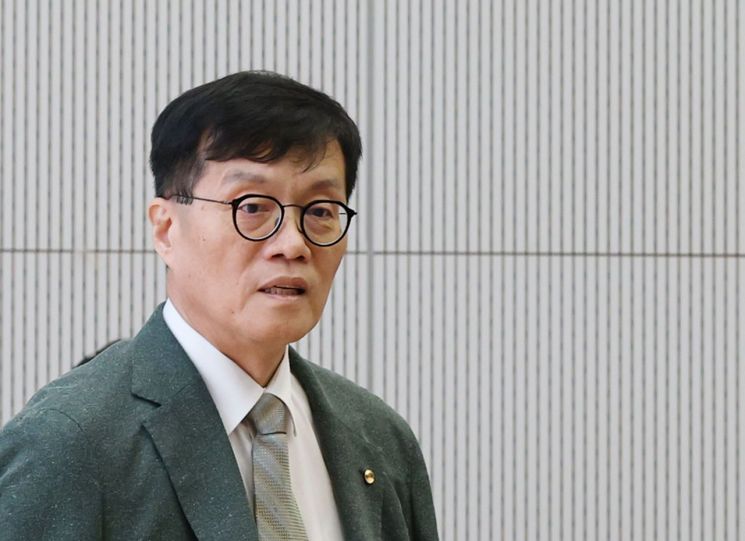 Lee Chang-yong, Governor of the Bank of Korea, is entering to attend the 'Seoul National University National Future Strategy Institute-Bank of Korea Joint Symposium' held at Seoul National University in Gwanak-gu, Seoul, on the afternoon of the 27th. [Image source=Yonhap News]
In fact, after Governor Lee's remarks on the previous afternoon, the representative market interest rate, the government bond yield, increased. The government bond yields rose across the board after the government announced plans to issue the largest-ever amount of government bonds next year, and it is analyzed that the increase was further amplified by Governor Lee's remarks. As of 9:45 a.m. on the 28th, government bond yields are still rising, especially for long-term bonds.
Governor Lee has repeatedly expressed the opinion that market interest rates are moving ahead too much, reflecting expectations of a base interest rate cut. Choi Kyu-ho, a researcher at Hanwha Investment & Securities, said, "This symposium comment is interpreted as a statement to reduce the shock in the market where expectations of an interest rate cut are excessively reflected, such as the recent increase in bond market volatility."
There was also an opinion from a Monetary Policy Committee member that if the problems of house prices and household debt worsen, the base interest rate may need to be raised rather than lowered by the end of the year.
On the 23rd, at the Federal Reserve's annual economic policy symposium (Jackson Hole Meeting) held in Wyoming, USA, Monetary Policy Committee member Shin Sung-hwan told reporters, "Looking at inflation and the overall economy, the base interest rate should be lowered, but we cannot ignore the rising trend in real estate prices," adding, "In an extreme situation where house prices continue to rise, we may need to raise interest rates." Shin's remarks are interpreted as being in line with Governor Lee's concerns about rising house prices.
© The Asia Business Daily(www.asiae.co.kr). All rights reserved.













