The Constitutional Court's decision on whether laws and enforcement decrees that set greenhouse gas reduction targets infringe on the life rights and pursuit of happiness of the next generation of youth, as well as the life rights and environmental rights of the general public, will be announced this week.
According to the legal community on the 26th, the Constitutional Court will deliver a ruling on the 29th at 2 p.m. by consolidating four constitutional complaints filed by youth and civic groups regarding the Framework Act on Low Carbon, Green Growth (Green Growth Act), the Framework Act on Carbon Neutrality and Green Growth for Climate Crisis Response (Carbon Neutrality Framework Act), and the National Carbon Neutral Green Growth Basic Plan. This is the first time in Asia, as well as domestically, that a legal judgment on the constitutionality of climate measures will be issued.
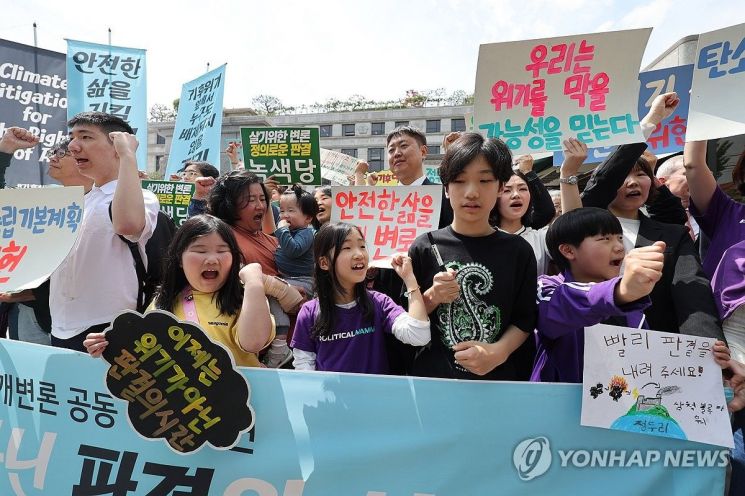 On April 23, climate litigation stakeholders condemned the government's inadequate response to the climate crisis during a joint press conference held in front of the Constitutional Court in Jaedong, Jongno-gu, Seoul, at the first public hearing of the climate constitutional complaint.
The petitioners filed constitutional complaints arguing that Article 42, Paragraph 1, Subparagraph 1 (Greenhouse Gas Reduction Targets) of the Green Growth Act, which was abolished with the enforcement of the Carbon Neutrality Framework Act in 2022, and Article 25, Paragraph 1 of the Enforcement Decree of the Green Growth Act amended in 2016 that abolished the 2020 greenhouse gas reduction target, infringe on environmental rights, health rights, life rights, and the right not to have one's body harmed, thus being unconstitutional.
They also claimed that Article 8, Paragraph 1 of the Carbon Neutrality Framework Act, which sets mid- to long-term national greenhouse gas reduction targets by having the government reduce national greenhouse gas emissions by a rate determined by Presidential Decree within a range of at least 35% compared to 2018 levels by 2030, infringes on the petitioners' life rights, pursuit of happiness, general freedom of action, and equality rights. Furthermore, Article 3, Paragraph 1 of the Enforcement Decree of the Carbon Neutrality Framework Act, which sets the reduction rate at 40%, establishes greenhouse gas reduction targets that fall short of the minimum level necessary for the state to prevent climate disasters and protect citizens from their risks by mitigating global warming and climate change caused by greenhouse gases. This violates the state's basic duty to protect fundamental rights under the principle of underprotection and infringes on life rights, environmental rights, and intergenerational equality rights, thus being unconstitutional.
The 2015 Paris Agreement aims to limit the global average temperature increase to 2 degrees Celsius or 1.5 degrees Celsius above pre-industrial levels, and a key issue is whether the reduction targets set by the Korean government align with this goal.
If the Constitutional Court rules that the provisions defining the government's current climate measures are unconstitutional or constitutionally incompatible, those provisions will lose their effect. The government and the National Assembly must then establish stronger climate measures reflecting the Court's intent.
While courts in Europe and the United States, including the Netherlands, Germany, Belgium, and others, have ruled that governments violated residents' fundamental rights by neglecting or accelerating the climate crisis, no such rulings have been made in Asia.
The European Court of Human Rights, Europe's highest court, ruled in April that the Swiss government must pay 100 million KRW in damages for infringing on the rights of an elderly woman by failing to curb greenhouse gas emissions. In the United States, in August last year, a Montana state court recognized for the first time the rights of youth to live in a clean environment and the government's responsibility to protect those rights.
The Constitutional Court held two public hearings in April and May to hear the positions of civil society, academia, and the government.
© The Asia Business Daily(www.asiae.co.kr). All rights reserved.












