Gwangju City Holds Residents' Autonomy Federation Workshop
Nation's First Transition to Residents' Autonomy Association... Representatives from 96 Neighborhoods Attend
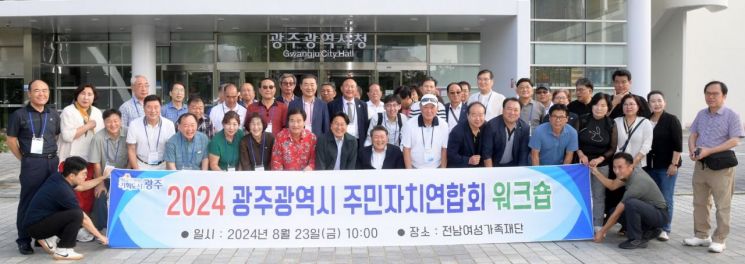 Gwangju City is taking a commemorative photo in front of the city hall before departing for the Residents' Autonomy Federation workshop to realize the 'Gwangju-type Residents' Autonomy.'
 [Photo by Gwangju City]
Gwangju Metropolitan City (Mayor Kang Gi-jung) held the ‘Gwangju Metropolitan City Residents’ Autonomy Association Workshop’ on the 23rd at the Jeonnam Women and Family Foundation in Muan-gun, Jeonnam, with over 100 participants including Deputy Mayor Ko Gwang-wan and Kim Chang-yeol, President of the Gwangju Residents’ Autonomy Association, along with chairpersons of residents’ autonomy associations from 96 neighborhoods.
The workshop was organized as a platform for communication and discussion to help residents’ autonomy associations grow into more advanced representative resident organizations, in line with Gwangju’s initiative to fully implement the ‘Gwangju-type Residents’ Autonomy,’ which is the nation’s first 100% conversion to residents’ autonomy associations, together with local self-sustaining organizations and village communities.
Residents’ autonomy associations are organizations that carry out resident autonomy activities at the neighborhood level, first piloted in five neighborhoods in May 2013. By the end of this year, the last 16 neighborhood residents’ autonomy committees are expected to complete their conversion to residents’ autonomy associations.
This signifies the establishment of a grassroots residents’ autonomy foundation aimed at strengthening resident-centered living autonomy and revitalizing local communities.
The event proceeded with a special lecture by Min Moon-sik, CEO of the Gwangju Urban Regeneration Community Center, on the role of residents’ autonomy associations in local communities, presentations on outstanding cases of residents’ autonomy from autonomous districts (Buk-gu, Gwangsan-gu), awards for meritorious residents’ autonomy contributors, and a roundtable discussion.
Outstanding cases of residents’ autonomy introduced included ▲the climate and environment cooperative project ‘Dongun Village Connection’ and ▲Wolgok 2-dong’s ‘365 Happy Neighborhood.’
‘Dongun Village Connection’ is a cooperative project involving Unam 1-dong, Unam 2-dong, Unam 3-dong, and Dongnim-dong. It was recognized for achieving public value in Dongun Village through proper waste separation and the practice of resource circulation in the village, and was selected as an excellent organization in the ‘2023 Gwangju Sustainable Development Council Ecological and Cultural Village Making’ initiative.
Additionally, Wolgok 2-dong’s ‘365 Happy Neighborhood’ is creating happy autonomy through activities such as establishing a flower-filled walking path, making Sanjeong Park beautiful throughout the four seasons, and conducting urban regeneration village experience group activities involving both existing residents and newcomers.
Participants shared their thoughts and communicated on topics such as residents’ autonomy association projects, residents’ general meetings, and development plans for residents’ autonomy associations.
Deputy Mayor Ko Gwang-wan stated, “The driving force behind Gwangju becoming the first city nationwide to convert all 96 neighborhoods into residents’ autonomy associations is the result of over 10 years of communication and effort by the residents’ autonomy association members,” adding, “Gwangju City will actively support residents’ autonomy and decentralized governance, which are grassroots democracy.”
Meanwhile, the Gwangju Residents’ Autonomy Association is a self-governing organization composed of 3,000 members from residents’ autonomy associations in 96 neighborhoods, carrying out projects that promote local community development such as policy development for residents’ autonomy, autonomy capacity education, and implementation of public interest projects.
© The Asia Business Daily(www.asiae.co.kr). All rights reserved.












