Transparent Solar Cell Modules Accelerate Commercialization, Leading Eco-Friendly Energy
Achieves Aesthetics and Efficiency, Applicable to Building Glass, Published in 'PNAS'
A technology that allows direct charging of batteries from a smartphone screen has emerged.
A UNIST research team has developed a method to supply energy directly from building, automobile, and mobile device glass using transparent solar cells.
The team led by Professor Seo Kwan Yong of the Department of Energy and Chemical Engineering at UNIST has introduced a new type of transparent solar cell and module that maintains colorless transparency, like glass, while achieving high efficiency.
 Professor KwanYong Seo, Department of Energy Chemical Engineering, UNIST.
By adopting an 'all-back-contact' design, which places all components of the solar cell on the rear side, they secured colorless transparency. This achieves both the high efficiency and aesthetics that are essential for transparent solar cells.
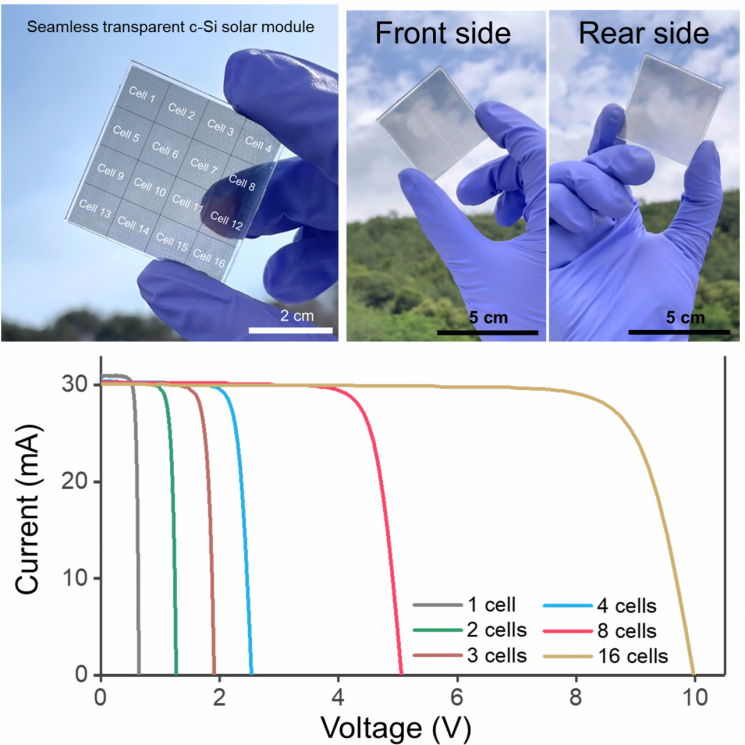
The research team developed a 'seamless modularization' technology, which eliminates gaps between devices and uses no metal wires, making connection points invisible. This solves the problem in conventional modularization methods where gaps and opaque metal wires damage the appearance of transparent solar cells.
The developed transparent solar cell module, sized at 16 cm², achieved a high efficiency of 14.7% at 20% transmittance, while maintaining aesthetics similar to a single device.
They also succeeded in charging a smartphone using natural sunlight, demonstrating the potential for small mobile device screens to be used as energy sources.
Researcher Park Junghwan and Assistant Professor Lee Kangmin said, "This study fundamentally solved the aesthetic issues of conventional solar cell modularization through a new device structure design," adding, "It presents the possibility that transparent silicon solar cells can be used in various industries, including not only building and automotive glass but also small devices."
Professor Seo Kwan Yong said, "We have opened a new path for modularization research, which is essential for the commercialization of transparent silicon solar cells," and added, "We plan to continue further research so that transparent solar cells can become a core technology in the eco-friendly future energy industry."
The research was published on August 7 in the international journal PNAS (Proceedings of the National Academy of Sciences). The study was supported by the Korea Institute of Energy Technology Evaluation and Planning and utilized equipment and facilities from the UNIST Research Support Headquarters.
© The Asia Business Daily(www.asiae.co.kr). All rights reserved.












