Non-GMO Soybean 'Chakhyupgi'... Emphasizing the Importance of Post-Harvest Management
Pod Reduction Due to Moisture Deficiency Leads to Decreased 'Yield'
The Jeonbuk Special Self-Governing Province Agricultural Research and Extension Services (Director Choi Jun-yeol) emphasized that thorough late-stage comprehensive management, including water management and pest control, is necessary for high-quality production of paddy field soybeans due to the prolonged heatwave and drought in August.
According to Jeonbuk Agricultural Research Institute on the 14th, the paddy field soybean cultivation area in Jeonbuk this year is about 13,299 hectares, accounting for 54% of the national total, which is an increase of 2,144 hectares compared to last year. Recently, the average temperature in the main paddy field soybean producing areas of Jeonbuk was 1.4℃ higher than the normal year, and rainfall was 120mm less than the normal year.
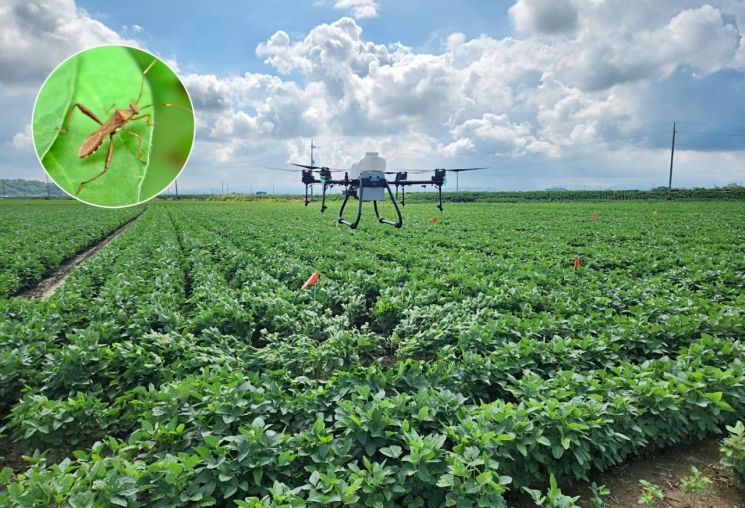 Drone pest control for soybean diseases.
 Photo by Jeonbuk Agricultural Research and Extension Services
Currently, paddy field soybeans have passed the flowering stage and entered the pod-setting stage. During this period, lack of moisture leads to a decrease in the number of pods and the size of soybean seeds, significantly affecting the harvest yield. It is important to maintain soil moisture content at 20-25% through appropriate irrigation to harvest high-quality soybeans.
Following the flowering stage, the continuation of hot and humid conditions can cause a rapid increase in stink bug pests. Stink bugs such as Antestiopsis thunbergii, long-bodied stink bug, leaf-footed bug, and soybean pod midge occur on soybeans. Among these, Antestiopsis thunbergii mainly damages the seeds inside the pods, directly affecting yield and quality.
Pesticide spraying should be conducted about three times at 10-day intervals from mid to late August, when pods are forming, preferably in the early morning or late afternoon when mobility is low.
In the late growth stage, diseases such as anthracnose, purple spot, and bacterial leaf spot increase. These diseases have higher incidence rates in hot and humid environments, requiring comprehensive control through monitoring. Pesticide spraying should be done preventively from after flowering.
Agricultural researcher Jo Young-min stated, "To increase the unit yield of paddy field soybeans, it is necessary to minimize damage through comprehensive pest and disease control," and added, "It is important to maintain leaf color through thorough moisture management until the late stage to enhance photosynthetic efficiency."
© The Asia Business Daily(www.asiae.co.kr). All rights reserved.











