U.S. President Joe Biden stated on the 13th (local time) that ceasefire negotiations between Israel and Hamas are "becoming increasingly difficult," but emphasized that he "will not give up."
As Iran is expected to launch retaliatory attacks in response to the assassination of Hamas political leaders by Israel, concerns over escalation in the Middle East are rising.
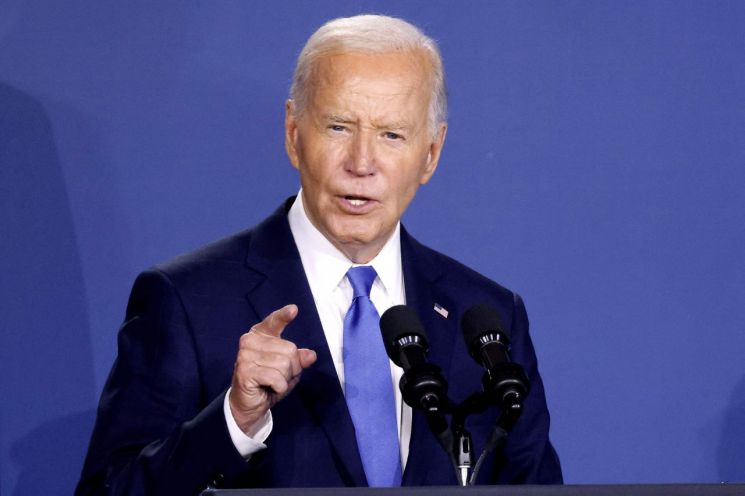
President Biden said he would observe what Iran does and what happens if there is an attack. When asked if he expects Iran to hold off on retaliatory attacks if a ceasefire agreement between Israel and Hamas is reached, he replied, "That is my expectation."
White House Press Secretary Karine Jean-Pierre stated at a briefing that the resumption of ceasefire talks in the Gaza Strip on the 15th is important, saying, "We believe the negotiators need to come to the discussion table," and "We believe that reaching a ceasefire agreement is the best way to ease tensions."
According to foreign media, Mahmoud Abbas, head of the Palestinian Authority, said that Iran could decide to retaliate against Israel within hours regarding the assassination of Hamas political leaders. On the same day, the U.S. provisionally approved a $20 billion (approximately 27 trillion won) arms supply to Israel. The U.S. State Department decided to sell weapons including 50 F-15 fighter jets, advanced medium-range air-to-air missiles, tank shells, and high-explosive bombs, and requested congressional approval.

Ukraine has been attacking Kursk in mainland Russia for eight consecutive days as of this day. President Biden said about Ukraine’s infiltration operation into Russia, "We are in direct communication with Ukraine," and "All I can say while it is ongoing is this."
Press Secretary Jean-Pierre said that the U.S. was not notified in advance when Ukraine infiltrated Russia’s Kursk region, stating, "We have nothing to do with this. The Ukrainian military operation is something Ukraine will disclose."
© The Asia Business Daily(www.asiae.co.kr). All rights reserved.













