Hyundai Motor Group's First Pedal Misoperation Assistance Feature Equipped
Interior Space Expanded... Upgraded from Compact to Small Car
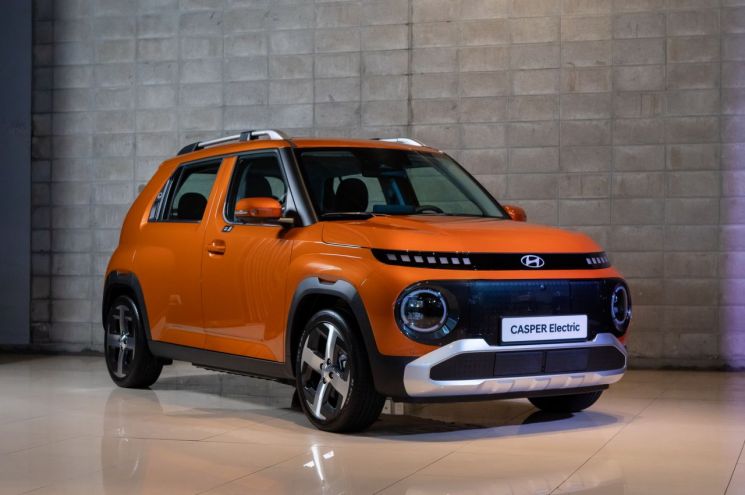
Hyundai Motor Company's smallest vehicle, the Casper, has been launched as an electric car. Although compact in size, it incorporates the latest technologies such as the Pedal Misapplication Safety Assist (PMSA), which automatically detects pedal misapplication and applies braking, delivering a dense and impactful presence.
On the 6th, Hyundai held a technical briefing for the new Casper Electric in Gangnam-gu, Seoul. Researchers who developed the Casper Electric personally explained the new technologies and the background of its development at the event.
The most notable new technology is PMSA. This system automatically applies brakes when an obstacle is within 1 meter in front or behind the vehicle during low-speed driving, either while stopped or starting to move after stopping, if the accelerator pedal is pressed quickly and deeply. It is a technology that prevents collisions by judging pedal misapplication regardless of the driver's intention. While similar to the Parking Collision-Avoidance Assist (PCA) function, it differs in that it only activates when there are obstacles in front or behind and the accelerator pedal is pressed beyond a certain speed. Casper Electric is the first Hyundai Motor Group vehicle to apply this technology.
The precise activation condition is when the accelerator pedal is fully pressed (100%) within 0.25 seconds. This function operates when the steering angle is 430 degrees or less and the ground slope is 25 degrees or less. It controls the drive force to nearly zero in the first stage and, if the distance between the vehicle and the obstacle decreases to within 60 cm, it controls hydraulic braking to prevent a collision. This can prevent accidents caused by mistakenly pressing the accelerator pedal when an emergency brake is needed. When the function activates, a warning message to press the brake pedal appears on the instrument panel, and an alert sound is also emitted. Hyundai plans to expand this feature to other models in the future.
Ha Jung-woo, a researcher from Hyundai Motor's Vehicle Drive Control Development Team 1, explained, "Since a law mandating safety functions related to pedal misapplication is expected to be enacted under the United Nations Economic Commission for Europe (UNECE), we developed this technology proactively to respond in advance," adding, "It will allow elderly drivers and inexperienced drivers to drive with peace of mind."
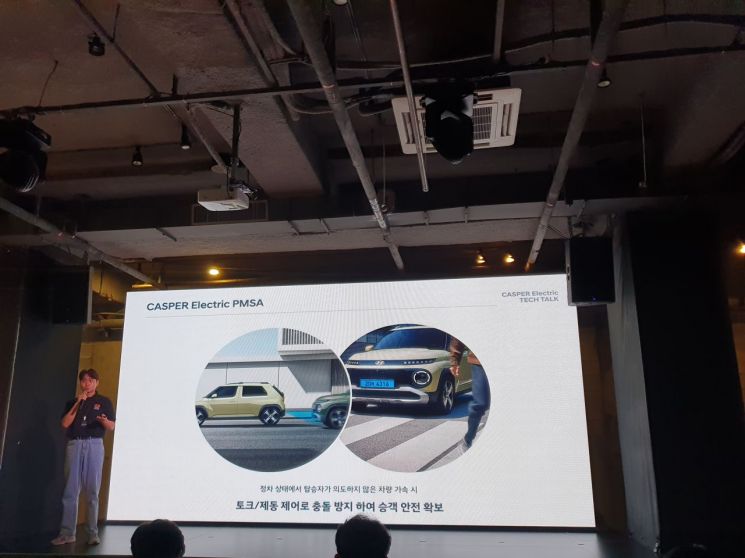 Researcher Ha Jung-woo of Hyundai Motor Company's Vehicle Drive Control Development Team 1 is explaining the pedal misoperation prevention technology PMSA at the Casper Electric technology briefing held on the 6th in Gangnam-gu, Seoul.
The Casper Electric has grown in size. Compared to the internal combustion engine version, its length and width have increased by 230 mm and 15 mm respectively. As a result, it is no longer classified as a light car (length under 3.6 m, width under 1.6 m) but as a compact car. The wheelbase, which determines the size of the interior space, has increased by 180 mm. Jihun Jang, a researcher from Hyundai Motor's MSV Engineering Solution Team, said, "It was very challenging to maximize the limited space by equipping Casper with technologies comparable to larger vehicles," adding, "We developed it by reviewing and evaluating the component mounting positions down to the millimeter."
Customer deliveries of the Casper Electric are expected to begin at the end of this month. Unlike typical affordable electric vehicles equipped with LFP (Lithium Iron Phosphate) batteries, it uses a 49 kWh NCM (Nickel Cobalt Manganese) battery. It can travel up to 315 km on a single charge. The battery is produced by HLI Green Power, a joint venture between LG Energy Solution and Hyundai Motor in Indonesia. The launch price is 31.49 million KRW, but with electric vehicle tax benefits and subsidies from the government and local authorities, it can be purchased for the mid-20 million KRW range.
© The Asia Business Daily(www.asiae.co.kr). All rights reserved.













