US Fed Holds Interest Rates Steady for 8th Consecutive Time
Powell: "Real Risk of Employment Slowdown... September Rate Cut Discussion"
FOMC Policy Statement Highlights 'Employment Risks'
'Dovish' Powell Boosts New York Stock Market
Wall Street Also Expects "Three Rate Cuts This Year"
Jerome Powell, Chairman of the U.S. Federal Reserve (Fed), hinted at the possibility of a rate cut in September. While cautioning against the risk of a slowdown in the labor market, he expressed increased confidence that inflation is steadily easing toward 2%. As Chairman Powell opened the door to a shift in monetary policy and the market-anticipated rate cut in September, Treasury yields fell sharply and the New York stock market surged. The benchmark interest rate was kept unchanged as expected.
Fed Holds Rates Steady for 8th Consecutive Time... Powell Says "Rate Cut Discussion Possible in September"
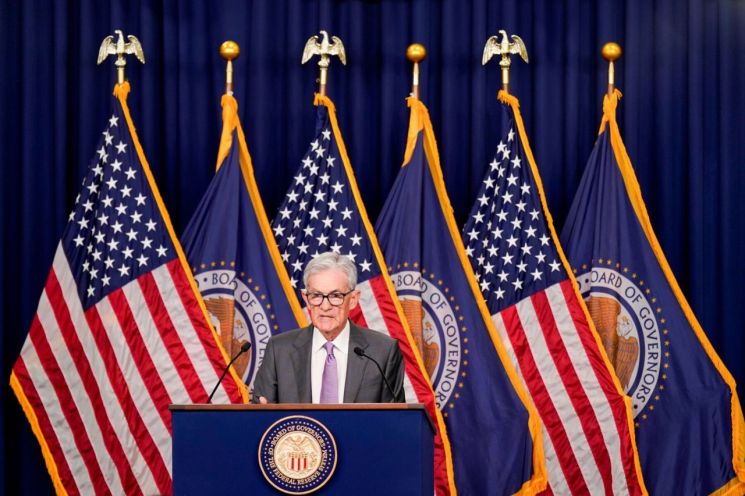
The Fed announced on the 31st of last month (local time) after the FOMC regular meeting that it would unanimously keep the federal funds rate at 5.25-5.5%. This marks the eighth consecutive hold since last September. As a result, the interest rate gap with South Korea remained at 2 percentage points at the upper bound.
At the subsequent press conference, Chairman Powell said, "A policy rate cut could be discussed at the next meeting in September," adding, "It is not yet the right time to cut rates, but we are getting closer." He stated, "If inflation continues to ease, growth remains strong, and the employment situation persists as it is, a rate cut in September is possible," and emphasized that "interest rate decisions will be made by comprehensively considering the economic outlook, inflation, labor market, and the balance of risks (price and employment)."
The background to Powell’s first mention of a possible September cut lies in concerns about a cooling labor market. The U.S. unemployment rate reached 4.1% in June, the highest in two years and seven months. At the press conference, Powell gave an improved assessment of inflation but repeatedly expressed caution about the risk of employment slowdown.
He said, "While the risk of inflation rebounding due to a cooling labor market has decreased, the risk of employment slowdown is now substantial," adding, "We are watching very carefully for a rapid deterioration in the job market." He also noted, "The Q2 price indicators have strengthened our confidence that inflation is steadily easing toward 2%," and diagnosed, "With progress on inflation, there is no longer a need to focus 100% on prices."
Gargi Chaudhry, Chief Investment Strategist at BlackRock, evaluated, "Chairman Powell focused a lot on the dual risks of (price and employment) during the press conference," and added, "Powell’s remarks on labor market risks were much more frequent than recently heard."
'Employment Risks' Evident Throughout FOMC Policy Statement
Signals of a shift in Fed’s monetary policy were evident throughout the FOMC policy statement released that day. Compared to the June FOMC statement, the description of inflation was revised from 'elevated' to 'somewhat elevated,' and the inflation progress was changed from 'modest' to 'some' progress. These changes indicate an improved Fed assessment of the inflation situation.
Especially, the evaluation of the labor market changed. The Fed added the phrase that the unemployment rate "has moved up" to the policy statement. It also deleted the phrase "inflation risks" and added "the risks to both sides (employment and prices)" to express its intention to pay attention not only to price stability but also to full employment. With recent signals of labor market slowdown appearing one after another, this suggests that a rate cut could come soon.
It was revealed that some officials at the FOMC meeting advocated for an early rate cut in July. Chairman Powell explained at the press conference that discussions about rate cuts took place among Fed officials, but a strong majority supported holding rates steady. This means that at least one of the 19 FOMC members pushed for a rate cut. As demands for rate cuts grow within the Fed, the importance of inflation and employment data to be released over the next month and a half, which will form the basis for a September rate cut, is expected to increase. The U.S. Department of Labor’s July employment report to be released on the 2nd, along with the July and August Consumer Price Index (CPI) reports ahead of the September FOMC, are expected to determine whether rates will be cut in September.
The likely size of the rate cut at the September pivot is 0.25 percentage points. When asked about the possibility of a 0.5 percentage point cut, Chairman Powell avoided a direct answer, saying, "I don’t want to get into specifics going forward," but immediately shook his head, effectively signaling that if rates are cut in September, the cut will be 0.25 percentage points.
'Dovish' Powell Sparks New York Stock Rally... Wall Street Predicts "Three Cuts This Year"
The market cheered the FOMC meeting results and Chairman Powell’s dovish remarks. On the New York Stock Exchange (NYSE) that day, the S&P 500 index closed at 5,522.3, up 1.58% from the previous trading day, and the Nasdaq index extended its gains after the FOMC, rising 2.64% to close at 17,599.4. Both indices recorded their largest daily gains since February. The Dow Jones Industrial Average closed at 40,842.79, up 0.24% from the previous session.
U.S. Treasury yields fell sharply on expectations of a September rate cut, hitting their lowest levels since February. The 2-year Treasury yield, sensitive to monetary policy, dropped 9 basis points (1bp=0.01 percentage point) from the previous day to 4.26%, while the 10-year Treasury yield, a global bond benchmark, fell 6 basis points to around 4.03%.
On Wall Street, there are also views that the Fed could start cutting rates three times this year beginning in September. Sam Coffin, an economist at U.S. investment bank Morgan Stanley, forecasted, "With growth slowing to 2% in the second half of 2024, the Fed will lower rates by 0.25 percentage points at the remaining meetings this year (September, November, December)," adding, "In 2025, rates will be cut four more times, lowering them by an additional 1 percentage point." Bob Michele, Chief Investment Officer (CIO) at JPMorgan Asset Management, analyzed, "The Fed is well aware that keeping rates too high for too long risks pushing the economy into a recession."
Investors are also betting on three rate cuts this year. According to the Chicago Mercantile Exchange (CME) FedWatch, the federal funds futures market on that day priced in nearly a 100% probability that the Fed will cut rates by at least 0.25 percentage points in September. The probability of a 0.5 percentage point cut in November is 78.3%, and the probability of a 0.75 percentage point cut in December is 79.2%.
© The Asia Business Daily(www.asiae.co.kr). All rights reserved.
















