Chosun: Demand and Export Effects of Eco-Friendly Ships
Construction Impacted by Rising Costs and Reduced Investment
Jobs in the shipbuilding and semiconductor sectors are expected to increase in the second half of the year compared to the same period last year. Jobs in the textile and construction sectors are expected to decrease. Some sectors such as machinery, electronics, and steel are likely to maintain similar levels.
The Korea Employment Information Service and the Korea Institute for Advancement of Technology announced the "2024 Second Half Job Outlook for Major Industries" with these findings. The study aimed to forecast job increases and decreases in the second half of the year for eight major domestic manufacturing industries?machinery, shipbuilding, electronics, textiles, steel, semiconductors, automobiles, and displays?as well as construction, finance, and insurance sectors.
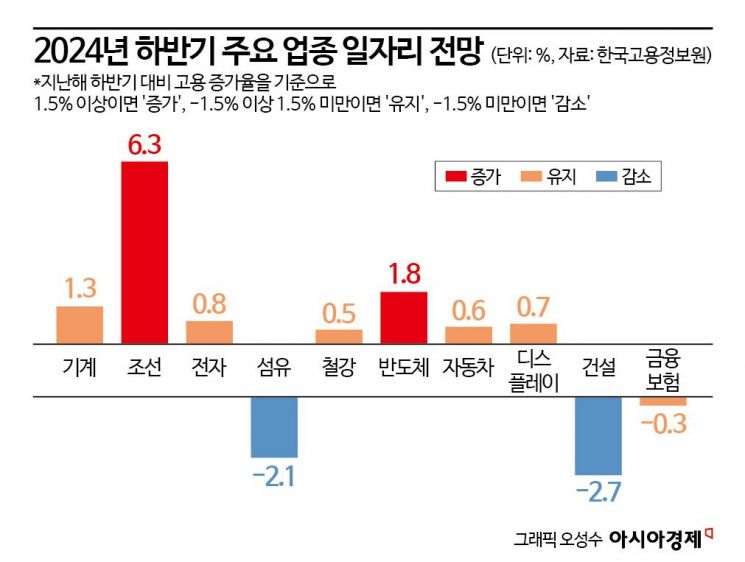
According to the survey results, the industries expected to see job growth compared to the second half of last year are shipbuilding (6.3%) and semiconductors (1.8%). Machinery (1.3%), electronics (0.8%), steel (0.5%), automobiles (0.6%), displays (0.7%), and finance and insurance (-0.3%) are expected to maintain similar levels as the same period last year. Textile (-2.1%) and construction (-2.7%) sectors are likely to see a decrease in jobs.
The domestic employment scale in the shipbuilding sector in the second half of the year is expected to increase by 7,000 people. Global ship orders are slightly increasing, along with rising demand and exports of eco-friendly ships. Domestic shipyard production in the first half recorded 5,589,000 CGT (Compensated Gross Tons; 1 CGT = 100 ships). The total production volume for this year is expected to increase by more than 20% compared to last year.
Semiconductors are expected to see increased exports due to improved demand from the global economic recovery and a booming high-value memory market driven by the growth of the artificial intelligence (AI) market. Semiconductor exports this year are expected to reach around $135 billion, an increase of approximately 36.9% compared to last year. Capital investment in semiconductor facilities may increase by 1.9% this year due to improved business conditions. Accordingly, employment in the second half is expected to increase by 3,000 people.
On the other hand, the textile sector is expected to see a reduction of 3,000 jobs due to continued growth in overseas production and increased re-imports. Although clothing consumption is expected to rise in the second half and demand for textile materials is increasing due to the recovery of related domestic industries, negative factors in the market may outweigh the positives.
Employment in the construction sector is expected to decrease by 58,000 people due to sustained high interest rates, rising construction costs, and reduced construction investment leading to weakened demand. Although the government’s social overhead capital (SOC) budget has increased this year, the real growth rate is not high due to rising construction costs. Construction investment in the second half may decrease by 2.4% compared to the same period last year due to concerns over real estate project financing (PF) defaults and a contraction in the private housing market.
© The Asia Business Daily(www.asiae.co.kr). All rights reserved.












