Real Estate R114 Weekly Market Report for the Seoul Metropolitan Area
Seoul Leads with Expanded Gains, Sales Up 0.05%, Jeonse Up 0.04%
Demand Shifts Toward New Buildings Over Established Ones Amid Growing Uncertainty in Redevelopment Projects
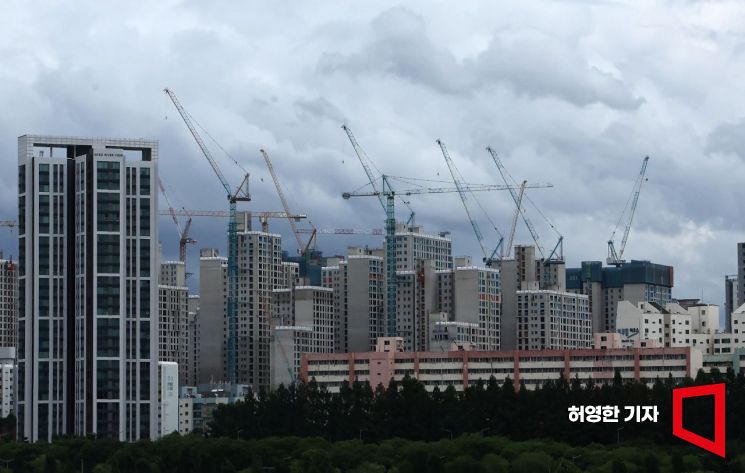 When crossing the Banpo Bridge in Seoul, you can see new apartments, old apartments, and apartments under construction all at once in the Sinbanpo area. The new apartments on the left are Acro Riverview Sinbanpo, the low old apartments on the right are Sinbanpo 2nd Complex, and the apartments under construction in the back are the Maple Xi construction site. Photo by Younghan Heo younghan@
Seoul apartment sale prices are increasing their rate of growth week by week. According to the 'Major Price Change Rates in the Metropolitan Area for the Third Week of July' announced by Real Estate R114 on the 21st, the market has entered a clear recovery phase, with prices rising for six consecutive weeks based on Real Estate R114's survey.
Another price survey institution, the Korea Real Estate Board, reported a rise in Seoul apartment sale prices for 16 consecutive weeks, while KB Kookmin Bank reported a rise for 9 consecutive weeks, indicating that all three major domestic price survey institutions are observing an expanding rate of increase.
As of June, the volume of apartment transactions in Seoul is expected to surpass 7,000 units (with the reporting period extending until the end of July), reaching the transaction volume seen during the overheated market of 2020. The soaring prices of newly built apartments and monthly rent prices continue to stimulate anxiety among actual demand groups, suggesting that the upward trend led by Seoul is expected to spread throughout the metropolitan area.
Seoul apartment sale prices continued their upward trend for six consecutive weeks, rising by 0.05%. While redevelopment projects remained flat (0.00%), general apartments increased by 0.05%. Due to conflicts over construction costs and issues with association member contributions, demand has shifted from redevelopment projects, which have increased uncertainty, toward new or nearly new apartments.
New towns rose by 0.01%, while Gyeonggi and Incheon remained flat (0.00%). In Seoul, the number of areas with weekly price increases exceeding 0.10% has grown for three consecutive weeks (from 2 areas to 4 areas to 5 areas). Notable movements were seen in Gangdong (0.16%), Gwanak (0.13%), Gangnam (0.11%), Mapo (0.10%), Dongjak (0.10%), and Seongdong (0.06%).
In new towns, Gwanggyo (0.06%), Dongtan (0.03%), Jungdong (0.02%), and Bundang (0.02%) saw increases. In Gyeonggi and Incheon, rises centered around Hwaseong (0.01%), Uiwang (0.01%), Anyang (0.01%), Gwacheon (0.01%), and Incheon (0.01%).
The jeonse (long-term lease) market has been rising for a year straight, with the rate of increase gradually expanding. Seoul rose by 0.04%, while new towns and Gyeonggi-Incheon increased by 0.01%. Within Seoul, individual areas rose in the order of Gangnam (0.18%), Guro (0.15%), Gangseo (0.10%), Gwanak (0.08%), Dongjak (0.06%), and Dobong (0.05%).
In new towns, Gwanggyo (0.05%), Dongtan (0.03%), and Paju Unjeong (0.01%) increased, while in Gyeonggi and Incheon, rises were seen in Guri (0.04%), Hwaseong (0.03%), Suwon (0.03%), Uiwang (0.02%), and Anyang (0.02%).
A Real Estate R114 official stated, "The government announced supply plans for 240,000 public housing units in the metropolitan area and 20,000 new housing units through the Real Estate Ministers' Meeting aimed at stabilizing the housing market." He added, "Furthermore, additional supply expansion measures will be announced again in August."
He continued, "Since most of the housing supply currently provided in Seoul depends on redevelopment and reconstruction projects, the announced plans to enhance project feasibility, mediate conflicts, and support project financing (PF) are timely measures. Also, considering that redevelopment projects causing demolition have limited supply effects, the supply expansion plans through the 3rd New Towns and Greenbelt release are effective in dispersing demand from Seoul," he said.
However, he noted, "Since it will take considerable time for the housing supply volume perceived by demanders to visibly increase, it is necessary to block early any rise in anxiety among demand groups through more active communication processes. If the government’s pre-announced 'special measures in case of market overheating' mainly focus on demand suppression policies in the future, market pains and side effects could increase as in the past. Therefore, for now, policy responses should focus on expanding the supply of quality housing," he emphasized.
© The Asia Business Daily(www.asiae.co.kr). All rights reserved.












