Kukpyowon Announces Revision of Technical Standards
Software Changes Possible with Notification Only
The classification of electric vehicle chargers, currently divided only into alternating current (AC, slow charging) and direct current (DC, fast charging), will be further detailed. AC chargers will be classified into 2 grades, and DC chargers into 3 grades. Additionally, software (SW) changes to chargers can now be made through notification alone.
The National Institute of Technology and Standards under the Ministry of Trade, Industry and Energy announced on the 16th that it will promulgate revisions to the technical standards for electric vehicle chargers reflecting these changes.
The institute explained that the domestic type approval standards have been revised in accordance with the G22 standard (Electric Vehicle Supply Equipment - Metrological and technical requirements) announced by the International Organization of Legal Metrology (OIML) in September 2022. The institute finalized the draft by reflecting industry opinions through public hearings and administrative notices targeting various stakeholders such as manufacturers, charging service providers, and type approval agencies.
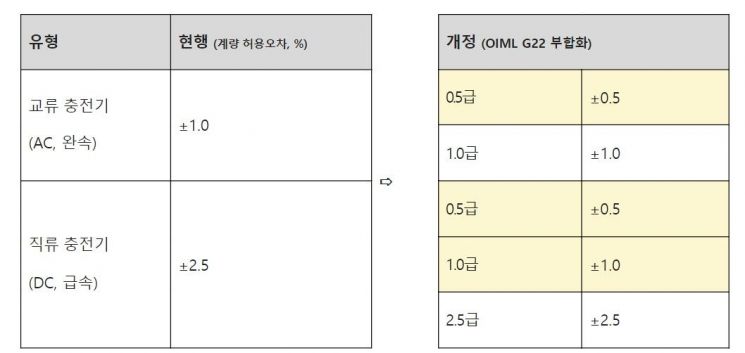
First, the institute subdivided the type approval grades based on allowable measurement errors. Accordingly, electric vehicle chargers, which previously had two grades for AC and DC, will now be classified into AC grade 2 and DC grade 3.
For example, chargers with a measurement error range of ±0.5% will be approved as grade 0.5, those with ±1.0% as grade 1.0, and those with ±2.5% as grade 2.5. A lower error range means more accurate charging. With this measure, consumers will be able to select higher-grade chargers for charging by checking external charger labels or smartphone applications. Electric vehicle charger operators will also be able to use this information for marketing purposes.
The institute also relaxed the requirement for software function changes from prior approval to notification only.
Park Jaeyoung, Director of the Conformity Policy Bureau, said, "Through this revision, we expect to differentiate electric vehicle chargers with higher metrological performance, thereby enhancing the choice for electric vehicle drivers, while also reducing the type approval burden on the electric vehicle charger manufacturing industry and supporting their overseas expansion."
© The Asia Business Daily(www.asiae.co.kr). All rights reserved.