Visited India on the 13th to Inspect IT Market
Meeting with Local Employees and Executives
India's Rapid Economic Growth... Need for Strategic Approach
Samsung Electronics Ranks No.1 in TV and Smartphone Markets in India
Attended Wedding of 'Richest Tycoon' Ambani Family
Samsung Electronics Chairman Lee Jae-yong visited Mumbai, India's largest economic city, on the 13th to explore the IT-related market and encourage employees working locally, Samsung Electronics announced on the 14th. At the meeting, Chairman Lee said, "Let's make history with fierce competitive spirit and urgency."
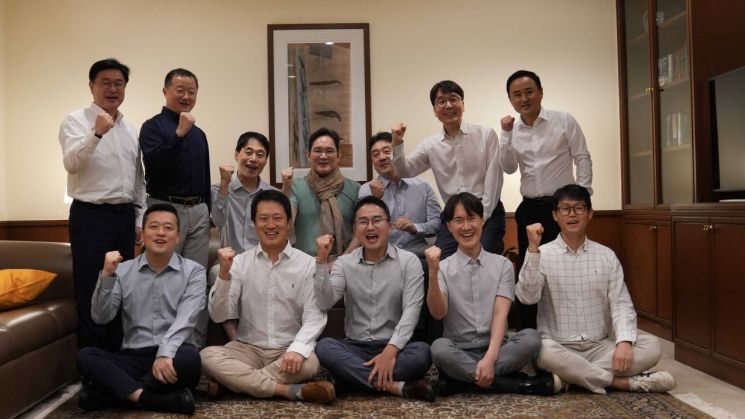 On the 13th, Samsung Electronics Chairman Lee Jae-yong held a meeting with local employees in Mumbai, India, and took a commemorative photo afterward.
 [Photo by Samsung Electronics]
According to Samsung Electronics on that day, Chairman Lee embarked on the business trip, judging that targeting the Indian market is crucial for the company's continuous growth. India, which has surpassed China to become the world's most populous country (1.44 billion people), has recently expanded its influence across various sectors due to rapid economic growth. India ranked 5th in the world in terms of Gross Domestic Product (GDP) last year, is forecasted by the International Monetary Fund (IMF) to have the highest economic growth rate among major countries this year, and has an average national age of 29, making it a country with significant growth potential.
Additionally, India has a large population of young customers in their 20s and 30s and a growing middle class, leading to a surge in demand for premium products in the smartphone and home appliance markets. The country also has abundant excellent science and engineering talent, playing a key role in Samsung Electronics' talent acquisition. Research centers located in Noida, Bengaluru, and Delhi collaborate not only on local products but also with the Korean headquarters to jointly develop core functions of Samsung Electronics' flagship products. Recently, the Bengaluru research center partnered with local universities to integrate Hindi, the representative language used by about 600 million Indians, into Galaxy artificial intelligence (AI).
Samsung Electronics first entered India in 1995. Since then, it has steadily grown over more than 30 years to become the largest electronics company in India.
Currently, Samsung Electronics operates a smartphone factory in Noida, a home appliance factory in Chennai, research centers in Noida, Bengaluru, and Delhi, Samsung Design Delhi, a sales corporation in Gurugram, 200,000 retail stores, and 3,000 after-sales service centers in India. The local workforce amounts to 18,000 employees.
In particular, the Noida factory, which began producing mobile products in 2007, added a new plant in 2018 and has emerged as a core hub for Samsung Electronics' smartphone business. Samsung Electronics has maintained the number one market share in the Indian TV market since 2017. Last year, it also reclaimed the top spot in the smartphone market for the first time in six years since 2017. Samsung held an 18% share last year, surpassing China's Vivo (17%) and Japan's Xiaomi (16.5%).
Samsung Electronics plans to continue strengthening its dominance in the Indian market by expanding sales of locally specialized and premium products. Products introduced so far in India, such as refrigerators that can make curd (handmade yogurt), AI washing machines with Hindi user interfaces (UI), and microwaves that can make naan (traditional Indian bread) and pickles, have been well received in the local market, contributing to enhancing the company's image and boosting performance.
Meanwhile, on the 13th, Chairman Lee attended the wedding of Anant Ambani, the youngest son of Mukesh Ambani, Chairman of Reliance Industries, held at the Jio World Convention Center in Mumbai, India. Chairman Ambani is India's richest man and ranked 9th in the global wealth rankings selected by Forbes in April. His net worth is approximately $116 billion. Reliance Industries, led by him, is considered India's largest company.
Attendance at the wedding is seen as another glimpse into Chairman Lee's extensive "global network." He actively exchanges with ICT industry leaders worldwide to create business opportunities. Previously, he has interacted with Mark Zuckerberg, CEO of Meta; Elon Musk, CEO of Tesla; Jensen Huang, CEO of Nvidia; Satya Nadella, CEO of Microsoft; and Tim Cook, CEO of Apple, sharing future technology trends and exploring business opportunities.
Chairman Lee has also met with big pharma companies leading the global bio market and bio venture incubation firms, directly and indirectly supporting Samsung's bio business. This is evaluated as contributing not only to Samsung's bio business but also to the growth of South Korea's bio industry. He has maintained ongoing exchanges with Noubar Afeyan, co-founder and chairman of Moderna, and met with Joaquin Duato, CEO of J&J; Giovanni Caforio, CEO of BMS; Christopher Viehbacher, CEO of Biogen; and Kevin Ali, CEO of Organon, discussing mutual cooperation plans for discovering new businesses.
Chairman Lee has also engaged with key political figures in major countries, contributing to Samsung's business and national interests, acting as a "private diplomat." He has met with U.S. President Joe Biden, Chinese Premier Li Qiang, Saudi Crown Prince and Prime Minister Mohammed bin Salman Al Saud, UAE President Mohammed bin Zayed Al Nahyan, and Vietnamese Prime Minister Pham Minh Chinh.
© The Asia Business Daily(www.asiae.co.kr). All rights reserved.












