The 10th Full Meeting of the Minimum Wage Commission... Submission of the 2nd Amendment
"10 Won Increase is Mockery of Workers" Intense Standoff
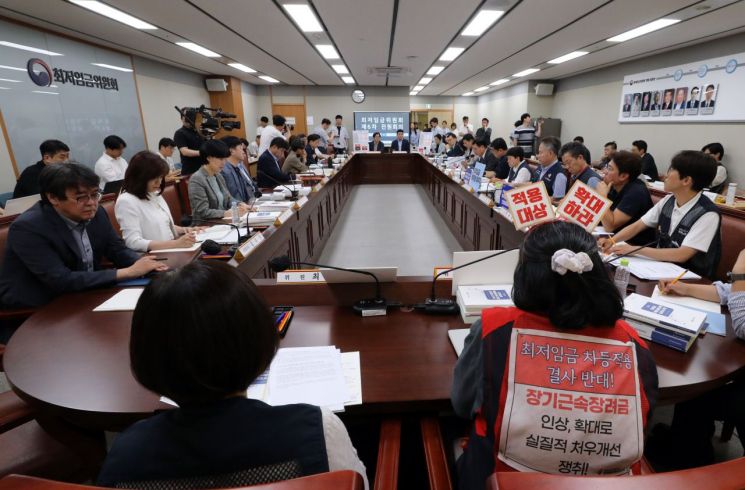
At the Minimum Wage Commission deciding next year's minimum wage, the business sector proposed 9,900 won, and the labor sector proposed 11,150 won as their second revised proposals. Compared to this year's minimum wage of 9,860 won, the business sector is demanding an increase of 30 won (0.4%), while the labor sector is demanding an increase of 1,290 won (13.1%). The gap between the two sides still amounts to 1,250 won, so it is expected to take more time to narrow the difference.
At the 10th plenary meeting held on the 11th at the Government Complex Sejong, the employer representatives representing the business sector and the worker representatives representing the labor sector each submitted these second revised proposals to the Minimum Wage Commission.
Earlier, at the meeting on the 9th, the labor sector initially demanded 12,600 won, a 27.8% increase compared to this year, but lowered it to 13.6% in the revised proposal, about half the initial demand. This is interpreted as a strategy to start high and negotiate down to the maximum possible increase. On the other hand, the business sector initially proposed freezing the wage at 9,860 won, then raised it by 10 won in the revised proposal. Compared to the first revised proposal, the labor sector lowered their demand by 50 won, while the business sector raised theirs by 30 won on this day.
At the meeting, Im I-seon, Vice Chairperson of the Korean Confederation of Trade Unions (KCTU) representing the labor side, criticized, "The business sector's revised proposal raising the wage by only 10 won is mocking the labor side." She argued, "Nowhere in the Minimum Wage Act does it state that payment ability can be a criterion for deciding the minimum wage," and claimed, "The business sector is blocking the minimum wage increase by using the difficulties of self-employed and small business owners as a shield."
Another labor representative, Ryu Ki-seop, Secretary General of the Federation of Korean Trade Unions (FKTU), said, "The deliberation on the minimum wage increase should strictly be for minimum wage workers," urging employer representatives to present realistic increase proposals and requesting public interest commissioners to prioritize the livelihood stability of low-wage workers in their deliberations.
The business sector responded in kind. Ryu Ki-jung, Executive Director of the Korea Employers Federation, said in his opening remarks, "The minimum wage has already reached a very high level, and even an increase rate similar to the past would have a significant impact on the market," adding, "It should be decided at a level close to freezing so that small and medium-sized enterprises and small business owners can survive."
Lee Myung-ro, Head of the Human Resources Policy Division at the Korea Federation of SMEs, also argued, "If the minimum wage is raised at a high rate, it will cause significant damage to small and medium-sized enterprises, small business owners in critical situations, and vulnerable job seekers."
The labor and management sides continued discussions late into the night to narrow the gap. The minimum wage is decided by the business and labor sectors submitting initial demands and then revised proposals to narrow the gap. If the gap cannot be narrowed through revised proposals, public interest commissioners set a 'deliberation promotion range' or decide on a mediation proposal by vote.
The Ministry of Employment and Labor must publish next year's minimum wage in the official gazette by the fixed announcement date of the Minimum Wage Act, which is the 5th of next month. The Minimum Wage Commission should decide the minimum wage by the 16th, 20 days before the fixed announcement date, considering objection procedures, but many expect the minimum wage to be decided after the deadline, on the 18th or later this year as well.
© The Asia Business Daily(www.asiae.co.kr). All rights reserved.












