Western Media and Experts Highlight Preference for Dialogue and Flexibility
"Limited Presidential Powers and Conservative Hardliners as Barriers" Counterarguments Also Raised
With the election of moderate reformist candidate Masoud Pezeshkian in the Iranian presidential election, there is speculation that dialogue between Iran and the West could be initiated.
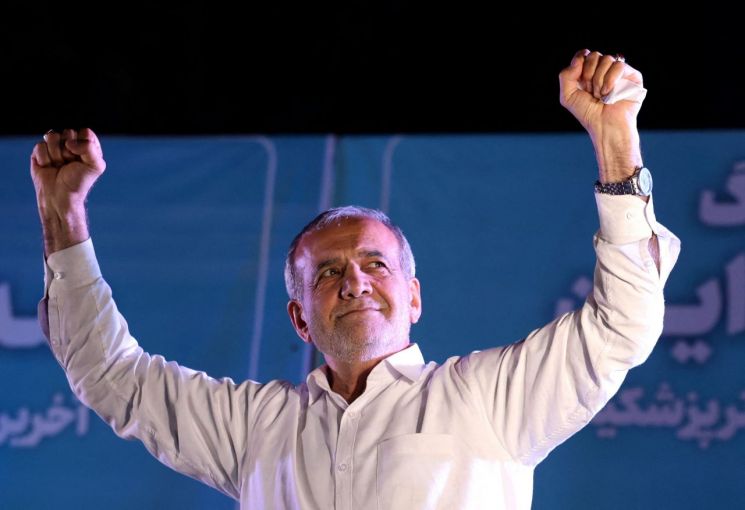
On the 5th (local time), US CNN reported that Pezeshkian, who won the runoff vote in the Iranian presidential election, is a figure who has preferred dialogue with Iran’s adversaries, especially regarding Iran’s nuclear program, and views it as a means to resolve domestic issues. Experts believe that Pezeshkian could facilitate dialogue between Iran and Western countries.
However, there are also forecasts that it will be difficult to expect immediate changes in foreign policy due to the limited powers of the president in Iran and the growing influence of conservative hardliners within the internal power structure amid the volatile Middle East situation. For example, Sanam Vakil, a Middle East expert at the UK think tank Chatham House, predicted that Pezeshkian’s election is unlikely to lead to immediate policy changes. She observed that there might be only slight room for change regarding social freedoms.
She explained, "Pezeshkian will probably try to work through and within the system to provide a less repressive environment," but added, "Pezeshkian does not guarantee change, which shows the limitations of the presidency in Iran."
In Iran’s Islamic theocratic system, the Supreme Leader holds absolute power. Major national policies such as defense, security, and foreign affairs follow the Supreme Leader’s will. Given the escalating tensions in the Middle East due to the war between Israel and the Palestinian armed group Hamas and the involvement of Iranian proxy forces, it is said that Pezeshkian, who has taken office as president, will not go against the Supreme Leader’s will or change Iran’s foreign policy, especially its hardline stance toward Israel.
Nevertheless, from the perspective of Western countries, Pezeshkian may be a better choice than a hardline conservative candidate who could worsen Middle East tensions.
The US daily Wall Street Journal (WSJ) analyzed that fear of a hardline candidate led to Pezeshkian’s election, who promised to control the "morality police" and resume nuclear negotiations. However, it also noted, "It is a tough battle to bring about change in the Iranian system dominated by conservative institutions including the judiciary, military, and senior officials," and predicted that Pezeshkian’s enthusiasm to ease mandatory hijab (headscarf) rules and revive the economy through a nuclear agreement with the West could face opposition from the conservative parliament.
Pezeshkian was elected as the 14th president of Iran with 16,384,000 votes (54.8%) of valid votes in the runoff held the previous day. The hardline conservative "Khamenei loyalist" candidate Saeed Jalili received 13,538,000 votes (45.2%). This is the first time in 19 years since 2005 that a presidential winner in Iran has been decided by a runoff.
© The Asia Business Daily(www.asiae.co.kr). All rights reserved.












