Plan to be Established by Year-End... Scheduled for Announcement in the First Half of Next Year
The government has officially begun the process of establishing a 'Long-term Energy Supply and Demand Outlook' that looks 25 to 30 years ahead. The plan is to prepare the framework by the end of this year and announce the long-term energy supply and demand outlook in the first half of next year.
An official from the Ministry of Trade, Industry and Energy said on the 14th, "As preliminary work for establishing the long-term energy supply and demand outlook, we recently commissioned a research project on the foundation-building plan. Through this, we aim to establish basic data such as the current domestic and international energy supply and demand status, which serves as the foundation for long-term forecasts, as well as forecasting methodologies by the end of the year, and to establish and announce the long-term energy supply and demand outlook as early as the first half of next year."
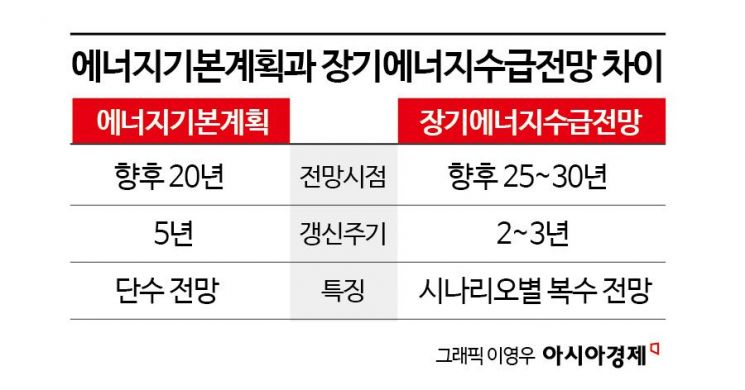
Since 2008, the government has presented trends in energy demand and supply over the next 20 years, measures for securing and managing energy sources, and plans for improving energy efficiency and technology development through the Basic Energy Plan (BEP). Based on the BEP, which is the highest-level statutory plan in the energy sector, subordinate plans such as the Basic Plan for Electricity Supply and Demand, the Long-term Natural Gas Supply Plan, and the Basic Plan for Renewable Energy have been established. However, with the enforcement of the Carbon Neutrality Basic Act in March 2022, the 'Low Carbon Green Growth Act,' which provided the legal basis for establishing the BEP, was abolished. Consequently, the BEP’s third plan (2019?2040), finalized in 2019, became the last.
An official from the Ministry of Trade, Industry and Energy explained, "To consistently pursue energy policy from a long-term perspective, a mid- to long-term energy supply and demand outlook, which forms the basis for policy formulation, is necessary. However, there is currently no suitable means to replace the BEP. Considering uncertainties in domestic and international climate and energy policies and technological changes, an analytical system capable of forecasting energy supply and demand under various scenarios is needed, which is why we are undertaking the establishment of this long-term energy supply and demand outlook."
First, through this research project, the Ministry plans to develop a sophisticated establishment plan to ensure that the long-term energy outlook is not a one-time effort. To this end, a system involving experts from various fields such as energy demand and efficiency, energy technology, electricity, nuclear power, renewables, hydrogen, and resources will be established and operated. Advisory groups of experts, forecasting model research groups, and policy and technology research groups will be continuously operated to design and evaluate various scenarios.
The role model is the 'World Energy Outlook' presented by the International Energy Agency (IEA), which is a non-statutory plan. Since 1998, the IEA has published annual reports covering global energy supply and demand, energy security, and climate change goals. The '2023 World Energy Outlook' released last October includes forecasts up to 2050.
The Ministry plans for the upcoming long-term outlook to look further ahead than the existing BEP and to shorten the update cycle. It is also considering providing multiple forecasts under various scenarios rather than a single forecast. An official from the Ministry said, "Compared to the BEP, which forecasts 20 years ahead, we plan to look further into the future and revise and supplement the forecasts at least every 2 to 3 years. In particular, we intend to establish scenario-based forecasts rather than predictions, reflecting rapidly changing situations such as technological advancements in energy efficiency and overseas trends."
© The Asia Business Daily(www.asiae.co.kr). All rights reserved.













