Participation of 1,500 Companies from 36 Countries in the 'Largest Scale'
Big Tech CEOs Continuously Unveil Issues
Jensen Huang Unveils AI GPU 'Rubin' for the First Time
Samsung and SK Also Reach a Turning Point
The largest information and communication technology (ICT) exhibition in Asia, 'Computex 2024,' which attracted global attention, concluded its four-day schedule and closed on the 7th (local time).
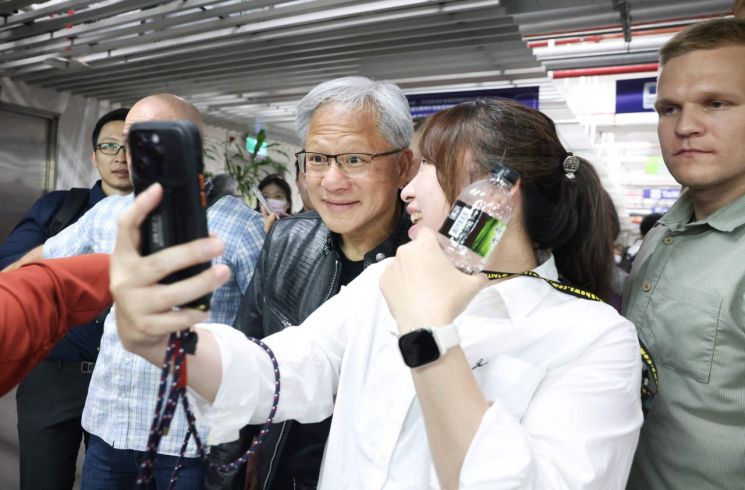 On the 4th, Jensen Huang, CEO of NVIDIA, attending the IT exhibition 'Computex 2024' held in Taipei, Taiwan, is taking a selfie with a female fan. Photo by AFP Yonhap News
With the dawn of the artificial intelligence (AI) era, Taiwan, known as the 'Island of Semiconductors,' proved through this event that it is at the center of AI. A record number of 1,500 companies from 36 countries participated, and over 1,000 journalists gathered, making the Nangang Exhibition Hall crowded every day during the event.
CEOs of global big tech companies participated in large numbers and continuously released AI-related issues throughout the event. Among them, Nvidia, regarded as a leader in the AI chip market, demonstrated its strong presence. Jensen Huang, CEO of Nvidia, unveiled the next-generation AI graphics processing unit (GPU) platform 'Rubin' for the first time during his keynote speech on the 2nd, a day before the opening, announcing that it will be released in 2026. In addition, Nvidia showcased this year's ambitious AI chip 'Blackwell' and AI models created for various fields using Blackwell. Nvidia's stock price rose throughout the event, reaching a market capitalization of $3.011 trillion (approximately 4,134 trillion KRW) on the 5th, surpassing the $3 trillion mark. This is the third company to break the $3 trillion market cap, following Apple and Microsoft (MS).
Competitors also countered Nvidia by unveiling new products or highly evaluating the performance of their own products. Lisa Su, CEO of AMD, announced that the new AI accelerator 'MI325X' will be released in the fourth quarter of this year. This product features the industry's largest 288GB capacity with ultra-high-speed HBM3E memory. Pat Gelsinger, CEO of Intel, introduced the AI package 'Gaudi3' developed by his company and expressed confidence that it outperforms Nvidia's AI accelerator H100 in training and inference performance.
Taiwan closely covered these developments and emphasized that the AI revolution is taking place in Taiwan. In particular, there was high interest in CEOs Huang and Su, who are natives of Taiwan. Taiwanese media, which had referred to them by their American names 'Jensen Huang' and 'Lisa Su' until last year, changed to their Chinese names 'Huang Renxun (黃仁勳)' and 'Su Zifeng (蘇姿?)' this year, drawing attention. This is interpreted as an effort to emphasize that although they hold American nationality, their body and mind belong to Taiwan. The Taiwanese government is expected to accelerate various industrial policies using this Computex as a stepping stone. President Lai Ching-te of Taiwan stated, "Everyone in the science and technology sector has worked for decades to make Taiwan the focal point of the AI revolution and has made Taiwan an unsung hero and a pillar of the world," emphasizing, "We will make Taiwan an 'AI Smart Island.'"
Korean companies also found new opportunities at Computex. Samsung Electronics, which had been evaluated as being in crisis in semiconductors, seems to have reached a turning point with announcements from global company CEOs. CEO Huang addressed the quality test (Qualtest) of Samsung Electronics' high-bandwidth memory (HBM), which had been reported as a failure in the U.S., stating, "There has been no failure, and the certification process is underway." Cristiano Amon, CEO of Qualcomm, mentioned that he is considering diversifying smartphone chip production, which is currently unified at TSMC, hinting at renewed foundry cooperation with Samsung Electronics. SK Hynix participated in Computex for the first time, showcasing memory products such as HBM3E to potential local customers and demonstrating its technological capabilities. SK Hynix supplies HBM3E to Nvidia and is collaborating with Taiwan's TSMC on the development of HBM4.
© The Asia Business Daily(www.asiae.co.kr). All rights reserved.











