China will enforce the "Food Security Guarantee Law" (hereinafter referred to as the Food Security Law) starting from the 1st, aiming to protect food security through legal enforcement, according to reports from Chinese state-run Xinhua News Agency and other foreign media.
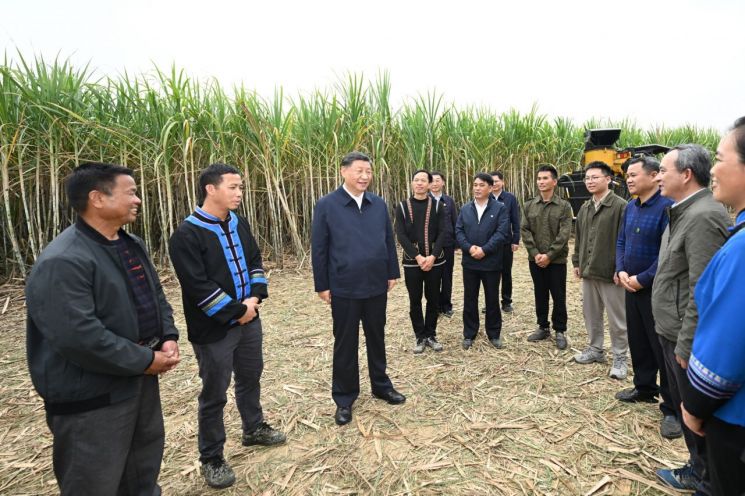 Chinese President Xi Jinping visiting a sugarcane farm in Laibin, Guangxi Zhuang Autonomous Region.
 [Image source=Yonhap News]
The Food Security Law was promulgated in December last year. It consists of 11 chapters and 74 articles, covering the entire food supply process from production to storage, distribution, and processing. It also stipulates that grain processing operators must comply with relevant industry standards and bear responsibility for product quality and safety.
In particular, the law includes provisions on preventing the conversion of farmland to other uses and reducing food waste, along with penalties for violations. Organizations and individuals who violate the law may be fined between 20,000 and 2 million yuan (approximately 38 million to 380 million KRW).
The Korea Rural Economic Institute pointed out in a report released in March that "the Food Security Law is significant in that it reflects a strong determination to achieve food security goals through legal enforcement." The institute analyzed that the impact of the Food Security Law on South Korea would be limited.
Senior Research Fellow Jeon Hyeong-jin explained, "While the possibility of grain export controls to secure food security can be considered, South Korea's imports of Chinese grain are at a minimal level."
South Korea's imports of Chinese grain reached 4.49 million tons, but since China began controlling grain exports in 2007 amid the global food crisis, the annual average imports from 2021 to 2023 sharply declined to 200,000 tons.
However, the institute expects that the implementation of the law will alleviate concerns about a China-originated global food crisis. Senior Research Fellow Jeon stated, "The world feared that China, a populous country, would face food shortages during its rapid growth, leading to large-scale grain imports on the international market, causing international grain price increases, market instability, and ultimately shifting the damage to developing countries, thus raising the possibility of a China-originated global food crisis," and made this forecast.
© The Asia Business Daily(www.asiae.co.kr). All rights reserved.

![Clutching a Stolen Dior Bag, Saying "I Hate Being Poor but Real"... The Grotesque Con of a "Human Knockoff" [Slate]](https://cwcontent.asiae.co.kr/asiaresize/183/2026021902243444107_1771435474.jpg)














