Shinhan Bank Applies Green Finance to Corporate Loans
Policy Financial Institutions Begin Issuing Bonds
Banks are accelerating their ESG (Environmental, Social, and Governance) management efforts. Green finance, which provides loans to companies leading the transition to eco-friendly businesses, is receiving particular attention. Among commercial banks, Shinhan Bank is the most proactive, while the Korea Credit Guarantee Fund and Korea Development Bank are also issuing green bonds. Internet banks, which are in the early stages of their business, contribute to carbon emission reduction through branchless operations.
On the 27th, Shinhan Bank introduced a corporate loan process applying the green taxonomy. This aims to support the low-carbon transition of domestic companies and activate green finance supply based on the Korean green taxonomy. Green finance is a financial system that supplies funds for the production of environmentally improving products and services to achieve green growth, while blocking funding for environmentally destructive activities. To promote green finance, the Ministry of Environment introduced the Korean green taxonomy in 2021, classifying specific economic activities as green or non-green. Activities contributing to six environmental goals (greenhouse gas reduction, climate change adaptation, water, circular economy, pollution, biodiversity) are classified as green economic activities, and funds are directed only to these activities.
Since last year, Shinhan Bank has established operational standards, built related systems, and expanded the application target after pilot operations for large corporations. Specifically, if a company applies for a corporate loan of 1 billion KRW or more at a Shinhan Bank branch for carbon reduction, the head office ESG department conducts a separate review process based on four suitability criteria according to the Korean green taxonomy. If these are met, benefits such as preferential interest rates are provided.
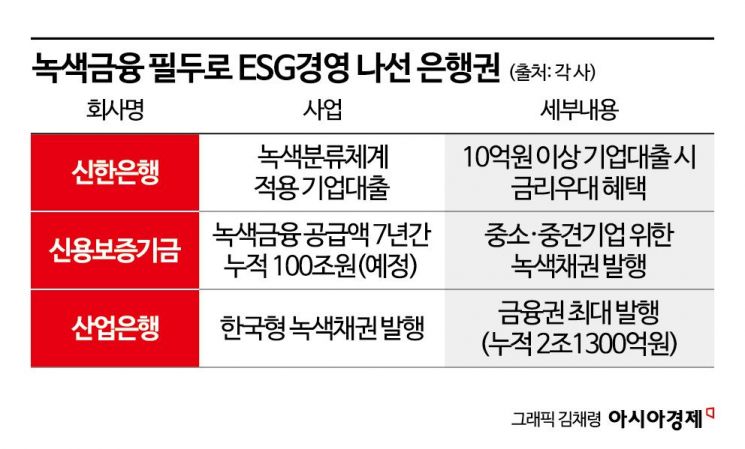
Policy financial institutions are also stepping up in line with the ‘Plan to Expand Financial Support for Climate Crisis Response’ announced in March. At that time, financial authorities expanded the average annual green fund supply of five policy financial institutions?Korea Credit Guarantee Fund, Korea Development Bank, Industrial Bank of Korea, Export-Import Bank of Korea, and Korea Technology Finance Corporation?from 36 trillion KRW (the average of the previous five years) by 67% to 60 trillion KRW. The supply amount is expected to increase to 420 trillion KRW by 2030. Accordingly, the Korea Credit Guarantee Fund (KCGF) will support 100 trillion KRW in the green finance sector by 2030. It is expected to activate green finance mainly through green bonds. KCGF’s securitization company purchases corporate bonds or loan receivables issued by small and medium-sized enterprises and mid-sized companies that comply with the green taxonomy, then issues green securitized bonds based on these assets. By providing guarantees for these bonds, they are sold to the market with the highest credit rating or acquired by companies to raise green funds.
In the case of Korea Development Bank, on the 21st, it issued 500 billion KRW of Korean green bonds with a 2-year maturity and a 3.54% coupon rate. Korea Development Bank explained that the funds raised through this method will be used to support green finance in secondary battery material industries, eco-friendly transportation, resource circulation, and more. Since issuing the first domestic green bond of 300 billion KRW in 2018, Korea Development Bank has become the institution issuing the largest amount of green bonds in the financial sector (accumulated 2.13 trillion KRW).
Internet banks, which are in the early stages of their business, contribute to carbon reduction through branchless operations. According to Kakao Bank’s 2023 Sustainability Management Report, the carbon emissions reduced by Kakao Bank’s branchless business model and eco-friendly digital transformation projects amount to 12,981 tCO2eq. Converted into trees, this is equivalent to the amount absorbed annually by 1.97 million 30-year-old pine trees.
© The Asia Business Daily(www.asiae.co.kr). All rights reserved.











