Constitutional Court: "Current Alternative Service System Recognized for Legitimate Legislative Purpose and Appropriateness"
Dissenting Opinion: "Burden Level Set Excessively Compared to Active Duty Service"
The Constitutional Court has ruled that setting the alternative service period to 36 months, requiring service in a dormitory setting, and limiting service institutions to correctional facilities does not violate the Constitution.
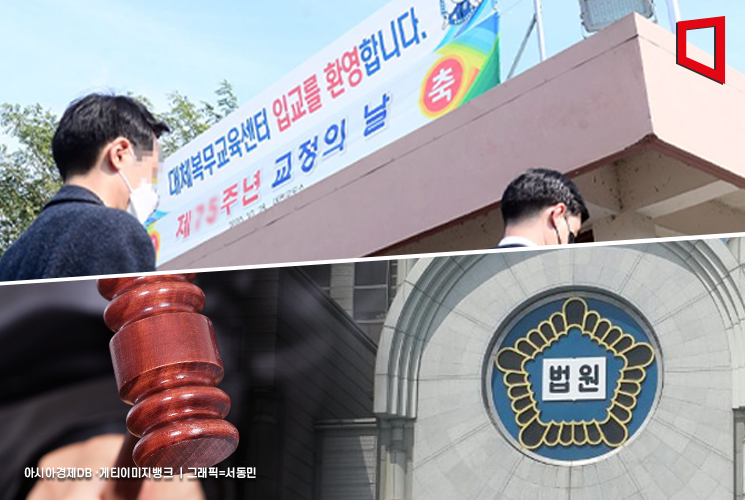
On the 30th, the Constitutional Court dismissed a constitutional complaint regarding Article 16 Paragraph 1, Article 18 Paragraph 1, Article 21 Paragraph 2 of the Act on the Incorporation and Service of Alternative Military Service, and Article 5 Paragraph 1 Item 6 of the Military Service Act, with a decision of 5 justices (constitutional) to 4 justices (unconstitutional).
The alternative service system is a system that allows individuals who refuse military service due to religious beliefs or other reasons to fulfill their military duties by engaging in non-military public service work. It was introduced in 2020 following the Constitutional Court's decision that punishing conscientious objectors was unconstitutional (constitutional inconsistency). Alternative service personnel must serve for 36 months in correctional facilities or similar institutions.
The Constitutional Court stated, "The legislative purpose is legitimate as it aims to harmonize the constitutional duty of national defense with the constitutional fundamental right of freedom of conscience, to maintain the military service system based on the conscription system and the selective conscription system by ensuring fairness in military service burdens between active duty and alternative service, and ultimately to realize the constitutional legal interests of national security and protection of citizens' fundamental rights."
Furthermore, the Court ruled, "Considering that service in correctional facilities involves duties necessary for public interest without military training such as bearing arms, that active duty soldiers generally cannot commute to work and must serve in dormitory settings within military units, and that there are other military service types under the Military Service Act with a service period of 36 months, the provisions under review contribute to achieving the legislative purpose by requiring alternative service personnel to serve in 'prisons, detention centers, and branch offices of prisons and detention centers' for '36 months' in a 'dormitory' setting. Therefore, the appropriateness of the means can be recognized."
On the other hand, Justices Lee Jong-seok, Kim Ki-young, Moon Hyung-bae, and Lee Mi-seon dissented, stating, "The current alternative service system sets the hardship level excessively beyond what is necessary to ensure fairness with active duty service. This means that the current alternative service system primarily aims to suppress the increase of draft evaders rather than actively accommodating conscientious objectors, making the choice of alternative service difficult and effectively functioning as a punishment. Therefore, it fails to meet the requirements of minimal infringement and balance of legal interests."
© The Asia Business Daily(www.asiae.co.kr). All rights reserved.