Ministry of Education Announces Medical School Admission Plan
Total Medical School Quota Including CHA University 4,695
1,913 Regional Talent Selected in Non-Capital Medical School Admissions
Efforts to Improve Educational Conditions Following Medical School Expansion
The university admission plan reflecting the increase in medical school quotas for next year has been finalized. A total of 4,695 students will be selected nationwide from medical schools (including medical professional graduate schools), an increase of 1,540 from the previous year. For the non-metropolitan regional talent admission track, a total of 1,913 freshmen will be recruited, averaging 59.7% per university.
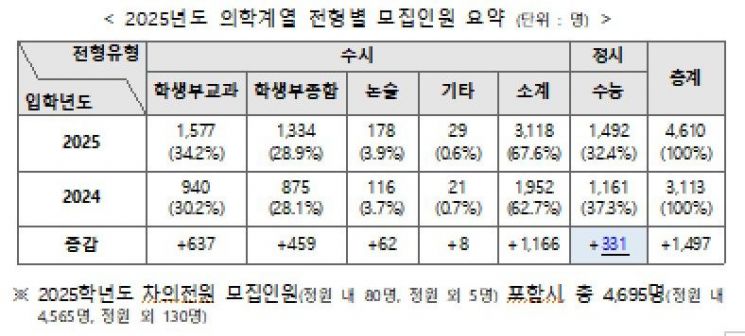
On the 30th, the Ministry of Education announced the "Key Points of the 2025 Medical School Admission Plan," which includes these details. In the 2024 admissions, the total number of recruits from 40 medical schools nationwide, including CHA University, was 3,155. With an increase of 1,540, the total number of recruits became 4,695.
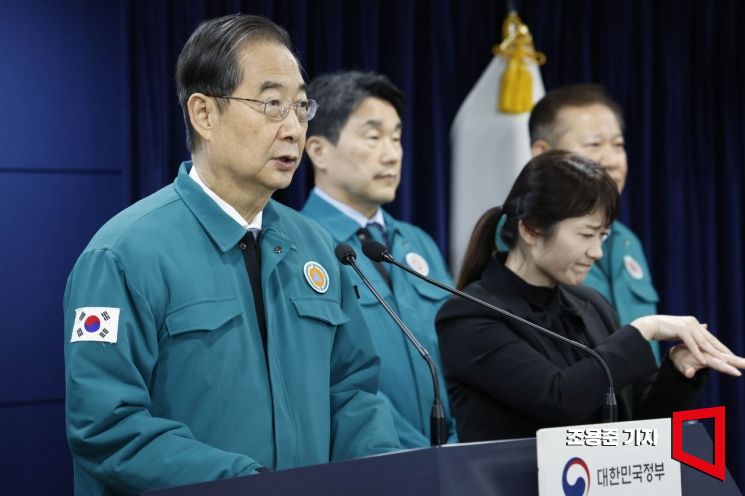 Prime Minister Han Duck-soo is delivering a statement on medical reform and the allocation of 2,000 medical school quotas on the 20th at the Government Seoul Office in Jongno-gu, Seoul. Present at the announcement were Choi Sang-mok, Deputy Prime Minister and Minister of Economy and Finance; Lee Ju-ho, Deputy Prime Minister for Social Affairs and Minister of Education; Lee Sang-min, Minister of the Interior and Safety; Cho Kyu-hong, Minister of Health and Welfare; and Bang Ki-sun, Director of the Office for Government Policy Coordination. Photo by Jo Yong-jun jun21@
In the 2025 admissions, CHA University will select 80 students within the quota and 5 students outside the quota. The total number increased by 43 this year from 42 the previous year.
Excluding CHA University, among the 1,497 increased medical school quotas, 1,326 were added to metropolitan area medical schools, and 3,284 to non-metropolitan medical schools. The number of students selected within the quota is 4,485, and those selected outside the quota include 125 students under categories such as rural area admissions, basic livelihood security recipients, and overseas Koreans.
67.6% (3,118 students) will be selected through early admissions, and 32.4% (1,492 students) through regular admissions. By admission type in early admissions, 1,577 students (34.2%) will be selected through the school record screening, 1,334 students (28.9%) through comprehensive student record screening, 178 students (3.9%) through essay screening, and 29 students (0.6%) through other methods.
By university, the quotas are as follows: ▲Gachon University (137) ▲Catholic Kwandong University (115) ▲Catholic University (96) ▲Kangwon National University (91) ▲Konkuk University (110) ▲Konyang University (102) ▲Kyungpook National University (157) ▲Gyeongsang National University (142) ▲Kyung Hee University (111) ▲Keimyung University (125) ▲Korea University (112) ▲Kosin University (103) ▲Dankook University (82) ▲Daegu Catholic University (82) ▲Dongguk University (124) ▲Dong-A University (102) ▲Pusan National University (163) ▲Seoul National University (137) ▲Sungkyunkwan University (112) ▲Soonchunhyang University (154) ▲Ajou University (113) ▲Yonsei University (112) ▲Yonsei University (Mirae) (104) ▲Yeungnam University (103) ▲Ulsan University (110) ▲Wonkwang University (157) ▲Eulji University (106) ▲Ewha Womans University (76) ▲Inje University (104) ▲Inha University (123) ▲Chonnam National University (165) ▲Chonbuk National University (171) ▲Jeju National University (72) ▲Chosun University (152) ▲Chung-Ang University (87) ▲Chungnam National University (158) ▲Chungbuk National University (126) ▲Hallym University (104) ▲Hanyang University (110).
In the 2025 admissions, the number of recruits for the non-metropolitan regional talent admission track at medical schools will also increase. The regional talent admission track is a system that allows only students who have attended high school for three years in the region where the non-metropolitan university is located to apply to medical schools in that region.
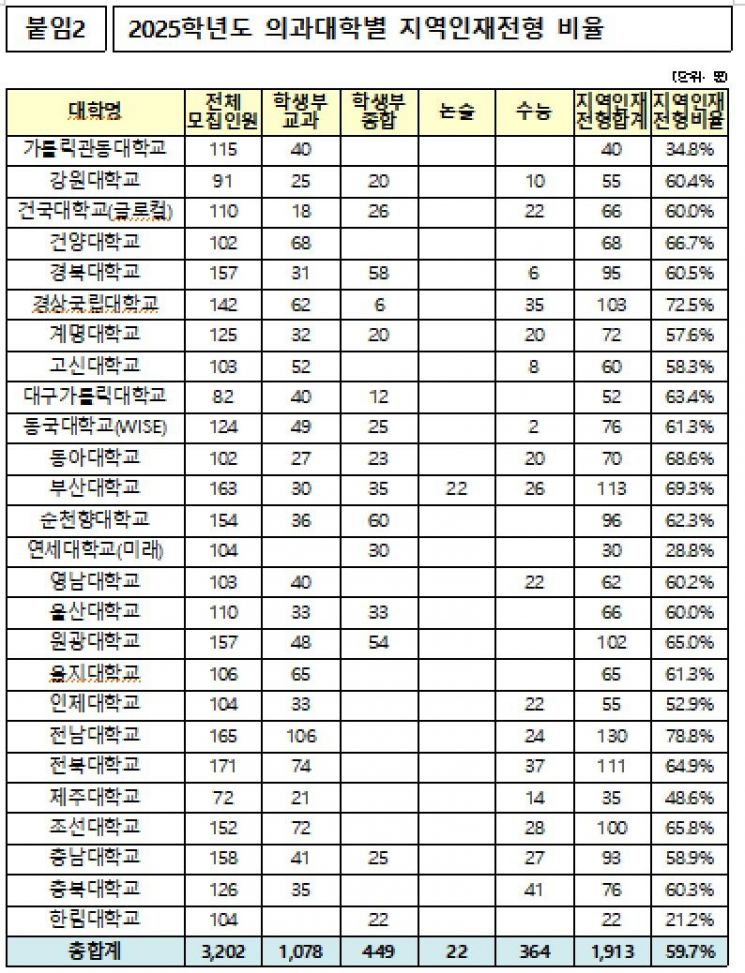
Through the regional talent admission track, 1,913 students will be selected, an increase of 888 from the previous year. The average proportion of regional talent admissions at universities obligated to select regional talent is 59.7%. Previously, the Ministry of Education recommended that each university select at least 60% through the regional talent admission track.
In early admissions, 1,549 students (81.0%) will be selected, and in regular admissions, 364 students (19.0%). By early admission type, the school record screening accounts for the highest proportion at 56.4% (1,089 students). Others include ▲comprehensive student record screening (449 students, 23.5%) ▲essay screening (22 students, 1.1%).
By university, Chonnam National University had the highest regional talent admission rate at 78.8% (165 students), while Hallym University had the lowest at 21.2% (104 students). Regarding the proportion of regional talent admissions by university, Yoon So-young, Regional Talent Policy Officer at the Ministry of Education, explained, "Although the proportion of regional talent admissions has increased, if the quota is not filled, universities can fill it later through regular admissions or use various methods depending on their circumstances. We understand that universities are considering various ways, such as lowering the minimum CSAT grade requirements."
The Ministry of Education stated that it is preparing educational conditions in response to the increase in medical school quotas. Policy Officer Yoon said, "Each school is preparing facilities, personnel, and equipment to educate the increased number of students. We plan to finalize the facility investment plan by visiting the sites this month and confirm the government plan around August."
The medical community argues that the increase and distribution of medical school quotas should be put on hold until the Supreme Court's re-appeal ruling on the injunction against the quota increase and distribution is issued. In response, the Ministry of Education said, "Some second-instance rulings were dismissed (rejected), and the effect of the disposition continues. Students and parents are waiting for the confirmation of this year's admission plan, so we cannot delay any further."
Once each university publishes the finalized admission guidelines on their website by the 31st, the procedure for next year's medical school quota increase will be completed.
© The Asia Business Daily(www.asiae.co.kr). All rights reserved.



















