Discussion on Reinstating Conscription After Ukraine War
Clashes Between Public Backlash and Ruling Party Opposition
Plan to Increase 20,000 Troops by 2031 Faces Challenges
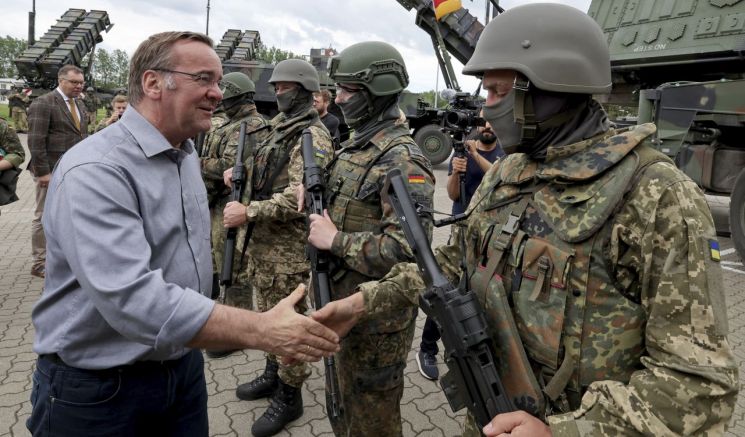 On the 29th (local time), Boris Pistorius, the German Minister of Defense, visited the air defense missile unit located in Mecklenburg and greeted the soldiers.
 [Image source=AP·Yonhap News]
The German government is facing growing controversy after retreating from discussions on reinstating conscription and instead proposing a modified volunteer recruitment system that offers incentives to volunteers. In order to respond to the increased threat of Russian invasion following the Ukraine war, the military needs to significantly increase its personnel immediately, but without conscription, it is difficult to replenish the forces. Some express concerns that it will be impossible to recruit volunteers before making a revolutionary improvement to the military barracks environment, which has significantly deteriorated since the abolition of conscription in 2011.
According to the German daily Der Spiegel on the 29th (local time), Defense Minister Boris Pistorius announced a plan to improve the military service system by providing various incentives to volunteers at a meeting of the ruling Social Democratic Party (SPD). At the meeting, Minister Pistorius proposed offering benefits such as covering the cost of obtaining a driver's license, student loan repayment, and language course attendance to volunteers.
This marks a significant retreat from the earlier discussions on reinstating conscription, which Minister Pistorius and the German government had been considering. Following Russia's invasion of Ukraine, the German government declared a "turning point" and announced it would consider reinstating conscription, which was abolished in 2011. In particular, they studied Sweden's case, which reinstated conscription in 2017. Sweden implements a selective conscription system where only those selected through physical fitness tests from among 100,000 men and women aged 18 and over each year are conscripted.
However, the plan to reinstate conscription has been stalled due to opposition from the younger generation and disagreements within the ruling SPD. Crucially, Chancellor Olaf Scholz recently expressed opposition, causing the conscription reinstatement discussion to fade within the government. At a press conference on the 14th, Scholz stated, "Conscription will no longer be effective, and no one is pushing such a plan," adding, "It is important to persuade a sufficient number of men and women to serve in the military and to make soldiers view it as their profession."
Nevertheless, there are concerns that it will be difficult to immediately recruit the necessary personnel with just some incentives. As of last year, the German Bundeswehr had about 181,000 personnel, but at least 200,000 are needed to maintain defense capabilities, and it is pointed out that recruiting 20,000 volunteers in a short period is impossible. Johannes Winkel, head of the youth organization of the Christian Social Union (CSU), which leans center-right, criticized, "Restoring national defense with just a driver's license bonus is a ridiculous idea."
The German government previously failed to encourage enlistment by offering incentives such as childcare support and telecommuting under then-Defense Minister Ursula von der Leyen in 2015. Eva H?gl, a member of the Bundestag Defense Committee, told Der Spiegel, "The Bundeswehr barracks lack Wi-Fi and have mold in the showers; I don't know if anyone would want to volunteer," adding, "None of the soldiers have seen the 100 million euros (about 148.3 billion KRW) special defense fund announced by the government in 2022. It will take more than half a century to modernize the German military barracks," strongly criticizing the situation.
© The Asia Business Daily(www.asiae.co.kr). All rights reserved.












