Rishi Sunak, the UK Conservative Party Prime Minister, has taken a gamble on an 'early general election' less than two years into his tenure. This surprise announcement comes amid demands for an early election from the main opposition Labour Party, whose approval ratings are over 20 percentage points higher. Locally, it is being described as "Prime Minister Sunak's last gamble."
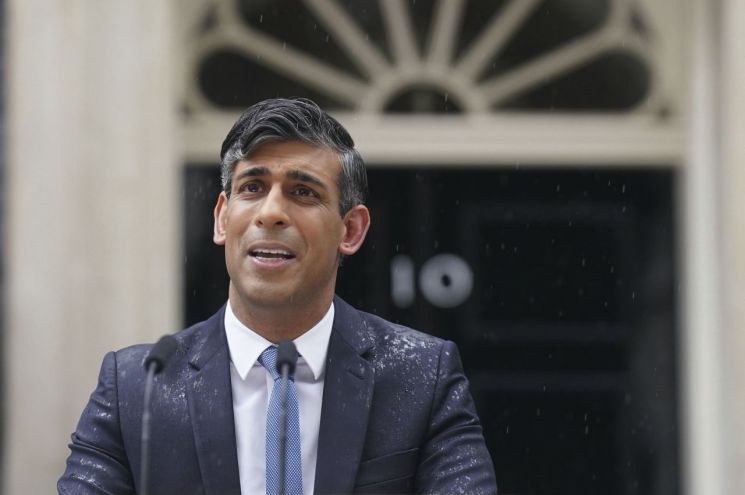
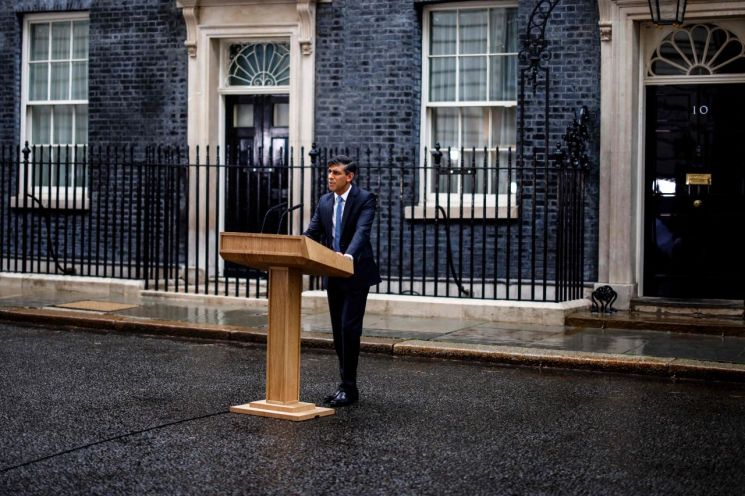
On the 22nd (local time), Sunak announced in the rain outside 10 Downing Street, the Prime Minister's residence in London, that the general election would be held on July 4. He emphasized, "Now is the time for the UK to choose its future," adding, "During these globally unstable times, the Conservative Party can lead the nation." Accordingly, the UK Parliament will be dissolved on May 30, and a six-week election campaign will officially begin.
Surprise Announcement of Early Election, Why?
Sunak's announcement of an early general election has come as a surprise even within the ruling Conservative Party. Unlike the Labour Party, which has been pushing for an early election based on its high approval ratings, Sunak had previously shown a negative stance toward this. Even earlier that day in Parliament, when asked about the timing of the election, he only replied "in the second half of the year" as before.
Under current law, the next UK general election must be held by January 28 next year. As a result, October to November was considered the most likely period, and political experts widely believed that Sunak would delay the election as long as possible to overcome his lower approval ratings.
This week's Ipsos poll results show that the Labour Party, led by Keir Starmer, is ahead of the Conservative Party by 21 percentage points. Additionally, in this month's local elections, which are seen as a kind of prelude to the general election, Labour achieved a landslide victory over the Conservatives.
Sunak's decision to play the early election card is interpreted as a move considering geopolitical risks such as the Ukraine war and the recent improvement in the UK economy. His strategy is to appeal to voters with the confusing international situation and economic recovery to shake up the unfavorable situation. He said, "Together, we can stop the chaos, turn the page, rebuild the UK, and transform the country."
Sunak, a former Goldman Sachs executive, particularly emphasized that the UK government has reached "two major milestones" by lowering inflation and growing the economy faster than other Group of Seven (G7) countries. He explained that as Prime Minister, he will continue to focus on restoring economic stability, which forms the foundation for future success. He also highlighted government policies aimed at reducing net immigration, a major concern among many voters, and reaffirmed the Conservative Party's plan to increase defense spending over the coming years to counter the threat from Russia.
Immediately after, at his first election campaign event, Sunak claimed that if Labour comes to power, taxes would increase by ?2,000. However, The Guardian pointed out that this figure was based on Conservative Party analysis and was dismissed by Labour as untrue. Major local media quoted Conservative officials saying, "Sunak concluded in discussions with Chancellor Jeremy Hunt that waiting until autumn would not be beneficial," adding, "Behind this is the hope that good economic news will save the Conservatives."
Bloomberg News analyzed, "In a situation where the approval gap is double digits, this is not about aiming for victory but holding an election before popularity falls further."
"Prime Minister's Last Gamble" - Local Reactions
Locally, the move is being described as a gamble by the UK Prime Minister. Election expert John Curtice wrote in The Times immediately after the early election announcement, "He has made a huge gamble," pointing out, "Recent polls show the Conservatives trailing Labour by an average of 21 percentage points, and since Sunak took office, Labour has never narrowed this gap to less than 15 points." Curtice had previously estimated a 99% chance of Labour taking the next government.
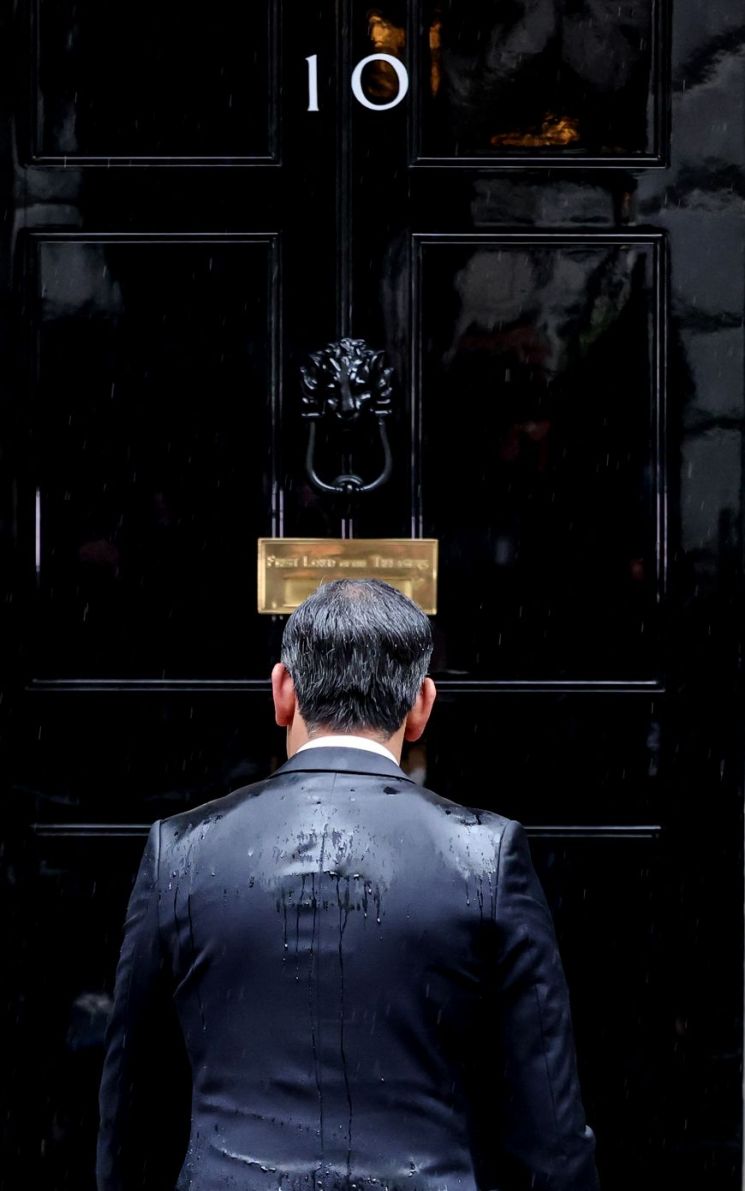
The Financial Times, in an opinion piece that day, described it as "the long road ahead for the UK Prime Minister's last gamble," noting, "This decision is a product of his political weakness." It added, "There is no reason to believe the gamble will succeed," and even the rain that day seemed like an ominous sign of what is to come. The Guardian also called it a "big gamble," diagnosing that "a drenched Sunak has started his farewell tour."
The New Statesman reported that some Conservative MPs felt bewildered and angry about the early election announcement, with some submitting letters of no confidence against Sunak. The outlet noted, "Until that morning, the Prime Minister's office had sent very strong signals that there would be no election until autumn," and MPs were saying things like "terrible idea," "strange," "incomprehensible," and "he has given up."
Looking at the front pages of major UK newspapers on the 23rd, images of a soaking-wet Sunak were plastered with headlines such as "Sunak Gambles on Polls" (The Telegraph), "Drown & Out" (The Mirror), and "The Deluge" (The Spectator). On social media, many mocking comments were seen, including "(Sunak) can't afford an umbrella?" and "Usually, you don't go out if you know it's raining."
However, there has been little impact on financial markets. The British pound rose 0.2% after Sunak's announcement, maintaining a level of $1.27 and moving within a stable range. Government bond yields also showed almost no change.
Conservative Party in Crisis: Will They Keep Power?
Attention is also focused on whether the ruling party will be replaced through the early election. The current low approval ratings for the Conservatives reflect the high level of dissatisfaction among UK voters over Brexit, the pandemic, inflation caused by the Ukraine war, and a surge in illegal immigration.
During Sunak's speech, an activist opposing the Conservative Party played the UK group D:Ream's "Things Can Only Get Better" loudly to disrupt the speech. This song was used as the Labour Party's election anthem during their landslide victory in 1997.
The Labour Party has been advocating for a change of government, citing soaring prices, worsening public safety, and a crisis in public services over the past 14 years. Labour leader Keir Starmer posted a video on X (formerly Twitter) immediately after Sunak's announcement, saying, "After 14 years of Conservative rule, nothing is working properly," and urging, "Let's stop the chaos, turn the page, and start rebuilding."
If Labour succeeds in the early July election, the UK will have had six prime ministers in eight years. Sunak took office in October 2022, following David Cameron (2010?2016), Theresa May (2016?2019), Boris Johnson (2019?2022), and Liz Truss (2022). Johnson resigned amid scandals, and Truss stepped down after only 49 days due to fiscal policy failures.
Stephen Fielding, Emeritus Professor at the University of Nottingham, said, "As polls have shown, voters are not listening to the Conservatives," adding, "In some ways, an early election might be the only way for the Conservatives to get a positive response."
© The Asia Business Daily(www.asiae.co.kr). All rights reserved.

![Clutching a Stolen Dior Bag, Saying "I Hate Being Poor but Real"... The Grotesque Con of a "Human Knockoff" [Slate]](https://cwcontent.asiae.co.kr/asiaresize/183/2026021902243444107_1771435474.jpg)
















